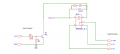
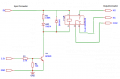
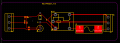
General guidelines for schematic annotations-
1. Signal flow - left to right (in to out).
2. Supply voltages - Top to bottom (Positive top, Neg/ground at bottom).
3. Notes - lower left
4. Title - lower right
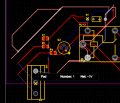
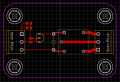
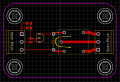
I suggest ditching the autorouting – that's a right proper mess. The tracks from the relay contacts should be large and direct to the terminal block as possible. What's with the two angled parallel tracks on the left, going a long distance before joining together?
I suggest ditching the autorouting – that's a right proper mess. The tracks from the relay contacts should be large and direct to the terminal block as possible. What's with the two angled parallel tracks on the left, going a long distance before joining together?
Yes i remove auto routing and do manually i have never done before.
The input connector contains the +5V, 3.3V and Gnd signals, I will work to check why it is showing in parallel.
I like manually routing circuit boards. It's kind of like a puzzle, finding the best ways to place components and route tracks.
Look at the schematic, and move parts around to make the most direct connections. Sometimes, rotating a component makes things much simpler.
I suggest making the tracks wide where room allows. It will make the board more reliable. Also, you may want to add some mounting holes in the corners of the board.
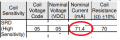
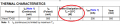
Power Dissipation at 25DegC:
P = (71.4mA)^2 * 5.3 Ohm = 0.025 Watts
I hope Drain current and Power Dissipation are within the limits. Please correct me if i am wrong.
Did manual routing easy eda has feature to bring the schematic into layout.
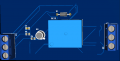
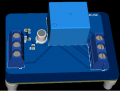
3D model
I plan to add additional features like a. reverse polarity protection, b. short circuit protection c. Input port protection, i have to update the schematic accordingly so that once i understand and test it, i can reuse for future projects as well.
I feel the circuit has a problem since when the output is low (relay is OFF) there will be fixed voltage of 1.4V applied across the port pin. To know the amount of sink current i have to know the input impedance of the pin, and when i verified the data sheet it says if the pin is configured as input then either the pull up or pull down can be 40 kOhms, the current will be 1.4V / 40 kOhms = 0.035mA = 35uA, but i am not clear in case if i configure it as output how much impedance the pin will have, how do i proceed, is the continuous current of 35uA when relay is off is acceptable?
Sorry the problem will be with the VGS threshold value it is mentioned as minimum of 0.8V and max 3V, so 1.4V will fall in between so the MOSFET will start to conduct not fully OFF.
I feel the circuit has a problem since when the output is low (relay is OFF) there will be fixed voltage of 1.4V applied across the port pin. To know the amount of sink current i have to know the input impedance of the pin, and when i verified the data sheet it says if the pin is configured as input then either the pull up or pull down can be 40 kOhms, the current will be 1.4V / 40 kOhms = 0.035mA = 35uA, but i am not clear in case if i configure it as output how much impedance the pin will have, how do i proceed, is the continuous current of 35uA when relay is off is acceptable?
Sorry the problem will be with the VGS threshold value it is mentioned as minimum of 0.8V and max 3V, so 1.4V will fall in between so the MOSFET will start to conduct not fully OFF.
The mosfet was only a suggestion from someone. Just use an NPN transistor driver like you started out to use.
Then the 3.3v MCU voltage problem basically goes away. Drive the NPN base with about 3mA.
most people just order standard PCB with 1oz copper. that is 35um thick. in that case for 10A relay traces should be 4mm or wider.
if the relay contacts are used to switch any loads powered by higher voltage such as mains. add U shaped slot in the PCB between low and high voltage:
Thank you for support and clarifications, it is taking time to adjust with terminology and understanding of PCB design. The problem i am facing is the relay footprint does not flip vertically hence the long trace near the diode, can i use a Via? I have added fuse for protection, but the size is big. I am confused on the trace width for the relay how much i have to set? (the default is 0.254mm) at present i have used 0.554mm.
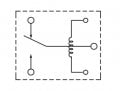
The relay coil does not care about polarity (almost always true unless the relay includes an integral diode).
As far as trace width, for the relay contacts, you want wide traces to carry the load. Simple test – compare the width of the trace to the width of the fuse link. If the trace won't carry the current the fuse will, an overload will blow the trace off the board before the fuse blows.
If you have space, there's no advantage to thin traces. The thinner the trace, the greater chance of fabrication defect.

 Facebook
 Google
 GitHub
 Linkedin