Refrigerator compressor wiring...

Thread Starter

Externet

Joined Nov 29, 2005
2,626
Compressors have the common, start winding and run winding terminals.

To start, power is applied to both start and run windings, and the start current decreases after a series PTC heats up shortly.

Others have a relay and capacitor which am not sure how are they wired/work; can you explain ?

Question is... can a refrigerator compressor factory implemented with the capacitor can receive instead, the PTC starter, and work equally well ?
What value PTC ohms should be chosen for a given removed uF capacitor ? Should they be the same impedance ?
 

#12

Joined Nov 30, 2010
18,224
The basics of a refrigerator compressor...It's fractional horsepower. Vaguely 3 to 6 amps. Read the label for RLA. It has a cooling method that uses the refrigerant. It isn't going to overheat in the 1.6 seconds required to get it started. It doesn't matter how you hit the start winding, as long as you quit when the RPMs come up. The value of the PTC ohms...Very low resistance compared to the motor impedance, like 5 ohms when cold, at least several hundred when hot. Not really related to the capacitor because the capacitor is used as an inverse inductor. It cancels the inductance of the start winding so the only impedance left is the ohms in the copper wire.

Can you get it to work with a PTC?

Grab a power cord and connect the common terminal. Place an Amprobe on the common line. Set it to the 15 amp scale. In one swift move, connect the run winding to the power wire in a stable manner and touch the power wire to the start winding. Get off of the start winding after 2 seconds. Did it start?
How do you know? The amps will jump to the high third of the 15 amp scale or peg the meter during the start surge and drop to the lower third of the 15 amp scale if it started. If it didn't start, the amps will be above the labeled run current after you get the power off the start terminal.

That's how the pros do it. The rest of the world may now chime in with all the cautions and exceptions.
 
Last edited:

Thread Starter

Externet

Joined Nov 29, 2005
2,626
Thanks, #12. Suspected you would be the one to answer this first.

So 5 ohm is the cold PTC value, not the hot... good teaching. There is 24 ohm PTCs too. I then ordered the wrong one :-(
Will try to convert the starting method of this 1/3 HP refrigerator to PTC; will see...

Is this the normal operating way for the capacitor type ? :

phase--------------------startwinding-----------------C----relay----C-------------------neutral

With C and C where the capacitor connects ? Then shortly after energizing, the relay opens and the start winding current is limited by the capacitor ? Then that capacitor is in the starting circuit, but actually is a 'run' capacitor ?
What creates a couple of seconds delay for the relay to open ?
What differs if the capacitor is not there ?----> The starting winding would then pass zero current while running, helping nothing ? So is the start winding by design, a complementary need to the running winding ?
 

#12

Joined Nov 30, 2010
18,224
Look at the math: If the PTC is 24 ohms and you have 120 VAC, then the maximum start current is 5 amps. Actually, it is less because the start winding has impedance. 5 amps seems stingy, but you're welcome to try it.

The way a start capacitor works is that it is in series with the start winding and resonant with the start winding inductance at the power line frequency. That means the Xc = Xl and the only impedance left is the resistance of the copper wire in the start winding. So, power line, starting device, capacitor, start terminal. Shortly after starting there is zero (or insignificant) current in the start winding. The start winding has no job to do after the RPMs come up to running speed.

A lot of compressors just have a current operated relay which energizes the start winding. If the compressor gets hard to start, we add a capacitor in series with the start winding to increase starting current. It's called a "hard start" kit. The current which controls the relay coil is the run winding current. At stalled rotor current, the run winding allows way too much current. After the start winding gets the motor turning, the run winding allows less current and the start relay drops out. The connection to the start winding is stopped.

What the run cap does is correct the power factor of the run winding. I did this to a refrigerator which originally came equipped with no capacitors. Add 80 uf in parallel with the run winding and the current from the wall outlet dropped from 5 amps to 3 amps. The main problem with this would be welding the relay contacts during a peak voltage start-time event (lack of zero voltage crossing control). A PTC could probably survive this where a relay wouldn't.

Then again, a refrigerator has a thermostat which will suffer the start surge and still be in danger of welding closed. Don't invent a run cap for a motor that wasn't born that way.
 
Last edited:

debe

Joined Sep 21, 2010
1,413
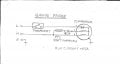
Interesting description #12. I used to repair fridges but was only self taught & not realy good with Electrical theory. In the following circuit (mains here is 240V ac) is for a small sanyo fridge that originaly did not have the start capacitor shown. But it wouldn't start up on a 240V 400Watt generator due to the high start current. So tried putting a start capacitor in the start circuit, & it would start easily on the generator. It has continued to work this way for quite a few years now. I guess I was just lucky that it worked on this particular compressor, as it did not work on another compressor that I tried it on.SANYO COMPRESSOR.jpg
 

#12

Joined Nov 30, 2010
18,224
Thanks for demonstrating the start cap in its proper position.
No surprise at starting difficulty. It is not strange for a compressor to require 10X its run current to start.
In your case, 3x the generator rating.
So, you got the start winding impedance low enough to work with a badly loaded generator. Good for you!

ps, the start cap is usually hundreds of uf in a dry electrolytic style.
 
Last edited:
Top