Reduce number of batteries from a school practical circuit

Thread Starter

GaryClifford

Joined Sep 19, 2024
1
My school has a practical lesson where the students wire up a mains voltage plug. The current set-up is to use a 200mm length of 3 core cable and a plug. (for safety, the plug has a rivet attached through the earth pin to prevent it being fitted into the mains sockets on the pupil's benches. The teacher has to inspect every plug to check it is wired up correctly but I would like to create a simple set of circuits so that if the wire is fitted into the correct location in the plug, it will light an LED. Ihave a working prototype using three separate PP3 batteries, which ensures LEDs do not light up when the wire is fitted to the incorrect terminal. I would like to reduce the number of batteries to one, so it packages better within the plug socket box and also reduces the overall cost of the set-up (I am building 10 sets). Please can you let me know if there is a way to run the set-up with just one battery, without allowing the LED to light up erroneously? For info, for my planned set-up with the LEDs, I have modified the earth pin socket so the plug can be fitted with the rivet attached.
 

Attachments

Irving

Joined Jan 30, 2016
4,995
Guys - please read what's written, its not homework - its a teacher or a support tech asking - and it specifically states no mains voltage - its to teach wiring a UK plug properly.

Gary, welcome to AAC. Its an interesting and non-trivial problem. PP3's being expensive, I'd look to run this on 2 AA or AAA cells. But it can't be done, AFAIK, with just wiring, it needs an 'active' solution, for which I have a couple of options. Are you adverse to a little soldering exercise?
 

MisterBill2

Joined Jan 23, 2018
27,159
Certainly it can be done with only one battery, BUT it gets a bit complicated. The tricj is to have either a 3 positin switch or three buttons, to apply the battery to one lead at a time: Mains, Neutral, and "ground." On the test outlet there are three LEDs, identified for the three connections: Mains, Neutral, and Ground.Simple but different feom before in that only one line at a time gets tested.
 

Irving

Joined Jan 30, 2016
4,995
Certainly it can be done with only one battery, BUT it gets a bit complicated. The tricj is to have either a 3 positin switch or three buttons, to apply the battery to one lead at a time: Mains, Neutral, and "ground." On the test outlet there are three LEDs, identified for the three connections: Mains, Neutral, and Ground.Simple but different feom before in that only one line at a time gets tested.
Replace the 3-position switch with a tiny 8-pin mcu, a PIC or an ATtiny85 and it will look like it's simultaneous... under 50p a unit and you could run it forever on a couple of AA cells.
 
If the goal is to reduce the complexity, adding a processor module and it's I/O and power switch will INCREASE the complexity AND require programming. And most processors are rather sensitive to polarity reversals and shorted outputs. ALSO, it would need to be mounted someplace and physically protected. aside from that, some connection to the other end of that 20CM length of cord would also be required.

The best check for an open circuit connection is to check that there is no continuity between pins. The single battery test can apply a positive voltage to the "Line" conductor of the cord thru an LED, and tie the battery negative thru a button switch to the "neutral" conductor. The test outlet can also have an LED connected between the "line" and the "neutral" sides. Then a correct connection will light both LEDs at the same time. For checking the third "Ground" connection, a wire to the test outlet will be required, tied to the battery positivethru another LED, with the cord "ground" conductor tied to the battery negative. So inserting the plug in the outlet will immadiately light the "ground " check LED, while the "power" circuit test will require operating the button.
 
Last edited:

Alec_t

Joined Sep 17, 2013
15,101
The teacher has to inspect every plug to check it is wired up correctly but I would like to create a simple set of circuits so that if the wire is fitted into the correct location in the plug, it will light an LED.
It's a nice idea, but :-
Correct wiring of the plug also requires (a) the right amount of insulation to be stripped from each of the three wires, (b) the three wires to be of the correct individual lengths to avoid mechanical stress and to ensure the earth wire is the last to be pulled out if the cable is tugged hard, (c) no stray strands which could cause a short circuit, (d) the cable sheath to be correctly clamped inside the plug by the strain relief member, (e) terminal screws tightened.
So the teacher would still have to inspect inside the plug.
 
Last edited:

Irving

Joined Jan 30, 2016
4,995
If the goal is to reduce the complexity, adding a processor module and it's I/O and power switch will INCREASE the complexity AND require programming. And most processors are rather sensitive to polarity reversals and shorted outputs. ALSO, it would need to be mounted someplace and physically protected. aside from that, some connection to the other end of that 20CM length of cord would also be required.
  1. There is no I/O or power switch,
  2. it would be significantly smaller than a PP3 battery, would be mounted in the same space as a PP3, inside the socket box
  3. would be no more complex - has exactly the same # of connections - and would use the same 3 connectors to the students 'cable' as there must be in the 3 battery version and in your proposal
  4. requires no expensive and hard-to-mount push buttons which would take up real-estate on the socket box
  5. Would be cheaper to run, just 2 AA cells rather than a PP3,
  6. here is no possibility of a polarity reversal or shorted outputs, given the hard-wired nature of the device.
  7. As to programming, well yes I'll give you that, but I'd be happy to do that for free, or for less than the price of a decent PP3 Gary could buy a programmer off AliExpress!
 
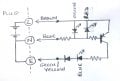
I don't think this is quite right, but maybe someone can analyse and correct? If the battery is connected between the Live and Neutral pins and the cable has green and red LEDs connected as shown, If Live and Neutral wires are correctly connected then the Green LED will light, but if they are connected the wrong way around, the Red LED will light. I'm fairly confident of that!
1777140115055.jpeg
But I'm not happy about the Earth connection. The idea is that if the live and neutral are correctly connected the transistor will turn on, turning the blue LED on, so long as it is connected to the plug earth pin. Problem is that, if the neutral wire is connected to the earth connection on the plug it still turns on the green LED. I know it's wrong, but maybe someone can correct?
 
Top