Reduce gain of LM386 further below the default 20

Thread Starter

sunny_2000

Joined Oct 23, 2025
16
Hi all,

I have a circuit where I have a TL072 set as a unity buffer and as a pre amp for my electric guitar

Which feeds into an LM386, and an 8ohm speaker
When playing with the humbuckers, the audio quality is good without clipping

But whenever I switch to the single-coil pickups, the audio starts to ditsort

I want to reduce the gain of the lm386 further below 20 such that it does not distort my single coil pickups

When I add a resistor across pins 1 and 8, it simply increases the gain.
What can I do to decrease it??
 

Thread Starter

sunny_2000

Joined Oct 23, 2025
16
Connect the input to the LM386 through a resistive voltage divider.
If I understand correctly, that means basically adding a volume knob, correct?

But won't that mean that at full volume, it will always distort, and the user will have to keep adjusting it to get a clean sound, also resulting in a lower volume?
 

crutschow

Joined Mar 14, 2008
38,314
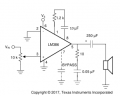
As shown in the data sheet, you can add a 10kΩ pot at the input to adjust the gain (below):

For a nominal linear adjustment of apparent loudness (due to the logarithmic response of the ear), use an audio log pot rather than a linear pot.
You can also use a linear 100kΩ pot with a 10kΩ resistor from its wiper (pin 3) to ground to get a quasi log output.

1761316374588.png
 

crutschow

Joined Mar 14, 2008
38,314
But won't that mean that at full volume, it will always distort, and the user will have to keep adjusting it to get a clean sound, also resulting in a lower volume?
Yes.
But I don't see anyway around that unless you want to add some type of AGC circuit.
It's the same as reducing the gain of the amp.
 

sghioto

Joined Dec 31, 2017
8,633
If I understand correctly, that means basically adding a volume knob, correct?
On your other thread about this same subject:
How to make a simple TL072 based impedance buffer
Your LM386 schematic shows a 1K level or volume control on the input is this actually connected?
 

Thread Starter

sunny_2000

Joined Oct 23, 2025
16
On your other thread about this same subject:
How to make a simple TL072 based impedance buffer
Your LM386 schematic shows a 1K level or volume control on the input is this actually connected?
Hello,

Sorry but that schematic is actually incorrect

I have 10K potentiometers with me, not 1K

And for now, I have not atttached them yet
 

Thread Starter

sunny_2000

Joined Oct 23, 2025
16
Yes.
But I don't see anyway around that unless you want to add some type of AGC circuit.
It's the same as reducing the gain of the amp.
So as I am understanding it, the input of the guitar is, too strong? For the LM386?

Why is it that even with the impedances matched, and a 12V battery giving the amp additional headroom, the single coils distort the amp?

When I connect my phone, the amp very reasonably plays audio from it, without much distortion at all

So what is happening with the guitar?
 

Thread Starter

sunny_2000

Joined Oct 23, 2025
16
Yes, the guitar has a volume knob

However, for most guitar amplifiers, users keep the knob at full, and simply choose to adjust the volume from the amp itself

And I would like to keep that feature here
 

Thread Starter

sunny_2000

Joined Oct 23, 2025
16
The audio output signal is too high, and it overdrives the amp.
Right, so the phone is low and stable

Whereas the guitar is not uniform and when I strum chords it makes it too much for the 386

Again, re iterating, none of this happens with the humbuckers

Only with the single coiled pickups

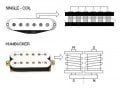
1761368772697.jpeg
 

sparky 1

Joined Nov 3, 2018
1,218
If we can determine the scale of magnitude, then we can impedance match the signal into the first stage.
There is a sweet spot for the LM386 I think it is about 45% where the THD improves.
If you had three settings; low, medium and high, it could relate to what you are playing and
how hard you are working the strings at any given time The humbucker and the guitarist can be
matched or unmatched. The artist adjusts naturally with his ears. The tune in memory and the feedback.

"When I strum, it is too much for the lm386"
yes, you are correct that is common. and that is where a humbucker and an attenuator come together.
A common guitar attenuator uses a Jfet like 2N5457 these are normally on, Since you want an adjustable attenuator
The Jfet is a good choice to use voltage to lower the amplitude of an incoming signal but don't expect miracles.
It is possible to get very exact attenuator performace if you understand how to control the pinch off field.
That is not done with positive polarity and has to be done precisely. We can read datasheet and we can determine
when the Jfet turns off, we can see that on the multimeter, you can decrease the signal and match it to the amplifier.

The basic manual attenuator like the 10k pot mentioned earlier. The pots can be large in some cases according to amplifier scale.
By looking at how to build the larger attenuators you can see how they are related to smaller variety amplifiers.
Inside there is not much, the box, hardware and switches makes it easy to use. The LM386 being used at the first stage.
Some LM386 projects start simple then some useful additions are added.
Simple LM386 Based Guitar Amplifier : 5 Steps - Instructables

 
Last edited:

Thread Starter

sunny_2000

Joined Oct 23, 2025
16
If we can determine the scale of magnitude, then we can impedance match the signal into the first stage.
There is a sweet spot for the LM386 I think it is about 45% where the THD improves.
If you had three settings; low, medium and high, it could relate to what you are playing and
how hard you are working the strings at any given time The humbucker and the guitarist can be
matched or unmatched. The artist adjusts naturally with his ears. The tune in memory and the feedback.

"When I strum, it is too much for the lm386"
yes, you are correct that is common. and that is where a humbucker and an attenuator come together.
A common guitar attenuator uses a Jfet like 2N5457 these are normally on, Since you want an adjustable attenuator
The Jfet is a good choice to use voltage to lower the amplitude of an incoming signal but don't expect miracles.
It is possible to get very exact attenuator performace if you understand how to control the pinch off field.
That is not done with positive and has to be done precisely. We can read where that is and we can determine
when the Jfet turns off, we can see on the multimeter, you can decrease the amplitude and match it to the amplifier.
I, so I don't have access to JFET transistors, so that's why I am using a TL072, is there a way it can be configured to make it such that the output it provides to the 386 is within the headroom of the 386?
 

crutschow

Joined Mar 14, 2008
38,314
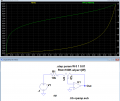
Below is the LTspice sim of a simple op amp circuit that gives a log-response gain range of 0 to 10 (-60dB to+20dB indicated) from a 100kΩ linear pot:
The green trace shows the log (dB) response (right vertical axis) with the nearly straight portion showing a desired log (audio taper) gain curve from the pot, with a 55% pot setting (0.55 on the horizontal axis) giving 0dB (gain of 1).

1761412421085.png
 
Last edited:
Top