Rectifier to 7805 output voltage have many LOW dips

Thread Starter

sunnyksl

Joined Sep 1, 2016
7
I have a AC transformer that deliver 20 VAC to the circuit, and it goes through a full wave bridge rectifier. The rectified output drives the DC motor and 7805 in parallel. I have a smoothing capacitor at 330 uf, I have a 330 uf that ties 7805 input to gnd, 100 uf that ties output to gnd, and a few ceramic cap. However, I am getting many "LOW" when I logic analyzes the 5V regulated output ( < 2.5v). In fact, the Arduino nano and hall sensor are connected to the 7805 regulated output. The dips will cause Falling Edge interrupt to trigger a lot more than expected ( The rpm should be around 1800, and I get 50000 ish). I have tried changing capacitor and have not yet resolve the problem. When i turn off the motor, the hall sensors works as expected. Any help or suggestion is appreciate. Thanks in advance.
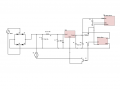
circuit_sunnyksl.png
 

wayneh

Joined Sep 9, 2010
18,096
Check the AC voltage at the transformer when the motor is running. Your transformer is probably underrated for the current needed by the motor.

What is the value of R3? You could be drawing too much current from your Arduino.
 

Thread Starter

sunnyksl

Joined Sep 1, 2016
7
R3, 1000 ohm, I just pull the PIN to HIGH to turn on the motor. The motor have 2 ceramic caps , and 2 diodes connected. The AC transformer is rated at 20 VAC , 3.5 A.
 

Thread Starter

sunnyksl

Joined Sep 1, 2016
7
The motor may be momentarily drawing more current than it's rating.
What is its load?
stall is 0.5 amps. However, it is spinning. I did check with PSU once, see it in between 0.1-0.2 A. Are we suspecting that total DC current draw will make ripple such that the voltage input will be lower than the dropout voltage of the regulator (7v for 7805)? I am pulling my hairs off. Please help~
 

wayneh

Joined Sep 9, 2010
18,096
You might also have inadequate ground return for the motor, so that current on that ground is interfering with the regulator, sensor and Arduino.
 

hp1729

Joined Nov 23, 2015
2,304
I have a AC transformer that deliver 20 VAC to the circuit, and it goes through a full wave bridge rectifier. The rectified output drives the DC motor and 7805 in parallel. I have a smoothing capacitor at 330 uf, I have a 330 uf that ties 7805 input to gnd, 100 uf that ties output to gnd, and a few ceramic cap. However, I am getting many "LOW" when I logic analyzes the 5V regulated output ( < 2.5v). In fact, the Arduino nano and hall sensor are connected to the 7805 regulated output. The dips will cause Falling Edge interrupt to trigger a lot more than expected ( The rpm should be around 1800, and I get 50000 ish). I have tried changing capacitor and have not yet resolve the problem. When i turn off the motor, the hall sensors works as expected. Any help or suggestion is appreciate. Thanks in advance.
What is the current capability of the transformer? Try a 1,000 uF cap. 330 may not be enough to run the motor and the processor. You said you changed the cap but didn't say what you changed it to.
 

Thread Starter

sunnyksl

Joined Sep 1, 2016
7
What is the current capability of the transformer? Try a 1,000 uF cap. 330 may not be enough to run the motor and the processor. You said you changed the cap but didn't say what you changed it to.
Before I post this, I changed from 220 uf @ 7805 input C2 to 330 uf @ 7805 input C2, I changed the R1 from 260 ohm to 80 ohm. The dips seems to be a little bit less, but i did notice something weird when i change the C1 to 470 uf 50v (was a 2 x 470uf 25v in series) , the motor will stop occasionally , so which problem ( smoothing capacitor not high enough, grounding) seems to be the closest bet? Anyways, thanks everyone in advance.
 

wayneh

Joined Sep 9, 2010
18,096
Just double up your ground wires and make them as short as possible. Or at least give the motor it's own ground wire. If it's a problem, that will make a difference.
 

Thread Starter

sunnyksl

Joined Sep 1, 2016
7
Just double up your ground wires and make them as short as possible. Or at least give the motor it's own ground wire. If it's a problem, that will make a difference.
I did that according to your suggestion and it seems it doesn't make much difference. I am still getting a lot of dips when I analyse the output pin of 7805 and and ground when run it through 16 mhz logic analyser. If motor is off, it is just a straight line. Sadly I don't have oscilloscope look at the voltage levels. I have also removed R1, and the regulator get more heat, but doesn't get where I want to. I guess changing C1 to 1000 uf is the last bet?
 

wayneh

Joined Sep 9, 2010
18,096
That may help.

I'm wondering why your regulator is getting hot. It should not be the base current to the transistor, so where is the current going? The sensor? Maybe the regulator is oscillating?
 
Top