realistic convertion of PWM signal into a sine

Thread Starter

yef smith

Joined Aug 2, 2020
1,446
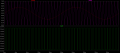
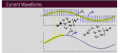
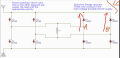
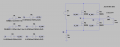
Hello, As you can see from the simulation I have built a basic H bridge according to the lecture at the time moment shown below.
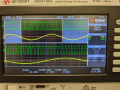
for some reason the current threw the inductor is not a sine but mudulation.
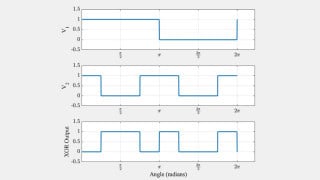
what is the realistic way this modulation turns into a sine (but by putting mathematical formula to convert it.
What is the way in real life the modulated current turns into a sine shown below?
Thanks.

Lec 8: Bipolar vs Unipolar PWM
12:03
1772654576315.png
1772654514345.png
1772655237396.png
 

Attachments

WBahn

Joined Mar 31, 2012
32,702
how in real life the motor load converts this pulsed modulated current into sine?
What makes you think that it does?

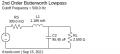
In general, the motor acts as a low pass filter. If the dominant content of the PWM signal that lies below the motor's mechanical cutoff frequency is at a single frequency and most of the other content is well above that cutoff frequency, then only the single dominant frequency will appear in the motor's mechanical output.
 

ronsimpson

Joined Oct 7, 2019
4,645
You should not pass 100Vp-p 100khz over long wires to a motor. It makes RF noise. Typically, there is a LC multi state filter that removes the switching frequency. There might be a 100hz low pass filter to remove all the high frequency noise. That will leave you with the sine wave.
 

Thread Starter

yef smith

Joined Aug 2, 2020
1,446
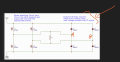
Hello ,I was told that I need to have catch diodes to handle situation where the inductor voltage will be higher then DC supply.
few questions:
1.how do I change my circuit so it will suffer from the inductor going higher then Vdc
2.why did they connected the diode in differential way to the inductor?
3.I know that overshoot can make temporarely exceed the voltage of VCC when points A or point B are with potential above VCC.
Or in case points A and B are below GND values.
the problem is that points A and B are not single ended to the ground but differential to each other.
What is the mathematical way to see the single ended value of A and B?

Thanks.


1772693514597.png
 

DickCappels

Joined Aug 21, 2008
10,661
By the way, a 1N4007 is a very "slow recovery" diode. Generally, a much faster diode would be more reliable. The peak current the diode should be able to handle greater than the peak current you expect to be going through L1 (in your circuit above).
 

Thread Starter

yef smith

Joined Aug 2, 2020
1,446
given this great circuit .Could you please give me an example for design specs so I could really gain expirience with this mechanism?I know its a simple circuit but still it would be great if you could give me actual ingeneering specs I could try and achieve with this circuit.
Thanks.
 

panic mode

Joined Oct 10, 2011
4,864
Hello ,I was told that I need to have catch diodes to handle situation where the inductor voltage will be higher then DC supply.
so you don't even know what is happening, or how the voltage across inductor can be higher than supply.
inductors oppose rapid current change.
when T1 and T4 are on, A is more positive than B and current flows through inductor (it increases gradually until saturation is reached).
and then when T1 and T4 are off, this current should stop but it cannot stop instantly - because of inductor (since current was flowing moment ago, inductor tries to maintain it).
so even with transistor off, current through inductor still flows for some time..... and the only way that can happen is if it goes through diodes D2 and D3.
this is going to result in increase of potential at Vcc.
without those diodes, voltage increase would be across transistors and they would be destroyed.

1.how do I change my circuit so it will suffer from the inductor going higher then Vdc
well, remove diodes... that will make your circuit suffer but - not for long.

you can put large capacitor across Vcc/GND to absorb the energy returned by inductor.

2.why did they connected the diode in differential way to the inductor?
no choice, or transistors would die....

3.I know that overshoot can make temporarely exceed the voltage of VCC when points A or point B are with potential above VCC.
Or in case points A and B are below GND values.
the problem is that points A and B are not single ended to the ground but differential to each other.
What is the mathematical way to see the single ended value of A and B?
go back to your lecture material. simplify the circuit by shorting D3, removing T1,T3,T4,D4,D2. bring square wave to T4 and observe what happens at A.
 

Thread Starter

yef smith

Joined Aug 2, 2020
1,446
Hello Panic mode,Great explanantion regarding why D1 and D3 will be opn because the current needs to stay inthe same direction so it opens D1 and D3 so anode of D1 and D3 needs to be above VCC
What about D2 and D3 , what circumsatances will casuse them to open?
Thanks.


"when T1 and T4 are on, A is more positive than B and current flows through inductor (it increases gradually until saturation is reached).
and then when T1 and T4 are off, this current should stop but it cannot stop instantly - because of inductor (since current was flowing moment ago, inductor tries to maintain it).
so even with transistor off, current through inductor still flows for some time..... and the only way that can happen is if it goes through diodes D2 and D3.
this is going to result in increase of potential at Vcc.
without those diodes, voltage increase would be across transistors and they would be destroyed."

1772808480068.png
 
Top