RC integrator - for audible triangle waves? (20 Hz - 20 KHz)

Thread Starter

Green Bean

Joined Mar 31, 2017
126
I want generate an audible triangle wave with a simple RC integrator circuit. I don't know a whole lot about these circuits, but it's to my understanding that typically, at frequencies lower than 50KHz (I think) the circuit produces either an output basically identical to the input, or a distorted triangle. At high frequencies, the output is a smooth triangle waveform. It's also to my understanding that the circuit does not have much effect on low frequencies because it is a low pass filter. So, I have two questions:

1. Can I use an abnormally large (for this application) capacitor to produce a triangle wave within the audio frequency range? If so, how large would it need to be?

2. This circuit is a low pass filter. It allows low frequencies to pass (altering them only slightly), but distorts medium and high frequencies, coincidentally, into triangular waves. If I use a high pass filter, will high frequencies not be distorted and lower (audible) frequencies be contorted into triangular waveforms? Could this be more practical than using a giant capacitor?
 

MrChips

Joined Oct 2, 2009
34,721
An RC integrator can be used to convert a square wave to a triangular wave but only over a narrow range of frequencies.

The reason for this is because the time-constant of RC is fixed, that is, the slope of the triangular wave remains constant for all frequencies. The effect of this is that the amplitude of the triangular wave will increase linearly with the period of the square wave. In other words, the amplitude of the triangular wave will decrease as the frequency goes up.

Using a large value capacitor has the immediate effect of increasing the RC time constant. This is going to push down the useful range of frequency of your triangular waveform.

What you really want to do is to be able to alter the RC time-constant with frequency.
 

Alec_t

Joined Sep 17, 2013
15,112
I want generate an audible triangle wave with a simple RC integrator circuit.
You can use an RC integrator as part of a triangle wave generator, but the circuit won't be as simple as you'd probably like :).
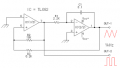
Here's an example of a typical circuit.
upload_2017-8-5_14-6-47.png
R1, C1 and IC2 are the integrator. IC1 is configured as a Schmitt trigger.
 
Last edited:

Thread Starter

Green Bean

Joined Mar 31, 2017
126
You can use an RC integrator as part of a triangle wave generator, but the circuit won't be as simple as you'd probably like :).
Here's an example of a typical circuit.
View attachment 132324
R1, C1 and IC2 are the integrator. IC1 is configured as a Schmitt trigger.
Thanks. I was planning on using a 555 timer to generate the square wave, would it be possible to integrate that into this circuit? And also, if I feed the triangle into another identical filter, will I get a sine wave out?
 

MrChips

Joined Oct 2, 2009
34,721
Thanks. I was planning on using a 555 timer to generate the square wave, would it be possible to integrate that into this circuit? And also, if I feed the triangle into another identical filter, will I get a sine wave out?
Depending on your application you may be able to use the signal from pin-6 of the 555-timer circuit.


Thread Starter

Green Bean

Joined Mar 31, 2017
126
Depending on your application you may be able to use the signal from pin-6 of the 555-timer circuit.

Thanks, but according to my research, putting a load on that line ruins the signal (I could be wrong) and I'd like to put the signal out to a piezoelectric buzzer or even drive a speaker. I'm sure I could make another little circuit to get around that but anyway, that wave looks a little sharp, and I'd like a nice even triangle if possible. But I appreciate the suggestion.

I guess I'll probably make a generator like Alec's and forgo the 555. But if I feed the triangle into another identical filter, can I get a sine wave? If not, what would come out?
 

MrChips

Joined Oct 2, 2009
34,721
Thanks, but according to my research, putting a load on that line ruins the signal (I could be wrong) and I'd like to put the signal out to a piezoelectric buzzer or even drive a speaker. I'm sure I could make another little circuit to get around that but anyway, that wave looks a little sharp, and I'd like a nice even triangle if possible. But I appreciate the suggestion.

I guess I'll probably make a generator like Alec's and forgo the 555. But if I feed the triangle into another identical filter, can I get a sine wave? If not, what would come out?
I said that it depends on your application.
Why do you need a triangular wave?

What do you mean by "sharp"?
Stretch it out in time and you will see it doesn't look as "sharp".

If you just want to listen to the waveform I assume you will tap off the signal from pin-6 with a high impedance load, right?

What is the input impedance of your piezoelectric transducer or your speaker?
You are going to use an active powered speaker, right?

As long as your input impedance is at least ten times the value of the resistances in the 555-timer circuit then you wouldn't see or hear a difference.
 

Thread Starter

Green Bean

Joined Mar 31, 2017
126
I said that it depends on your application.
Why do you need a triangular wave?

What do you mean by "sharp"?
Stretch it out in time and you will see it doesn't look as "sharp".

If you just want to listen to the waveform I assume you will tap off the signal from pin-6 with a high impedance load, right?

What is the input impedance of your piezoelectric transducer or your speaker?
You are going to use an active powered speaker, right?

As long as your input impedance is at least ten times the value of the resistances in the 555-timer circuit then you wouldn't see or hear a difference.
I just wanted to figure out how to produce audible triangle wave. That's my application. What I meant by "sharp" was that it is a slight ramp, but I suppose it's impossible to get a perfect triangle in reality, and I guess you're right, it would be less noticeable if it were stretched. I'm not sure about the input impedance of a piezoelectric transducer, but if I were to use a speaker it'd be a typical 8 ohm speaker. I'm not even sure if I'm going to build the circuit, I'm just trying to learn more about waveforms and waveform generators, so all of this is hypothetical. I guess I shouldn't have been so picky about the slight ramp, but I digress. Thank you for your help and suggestions.
 
Top