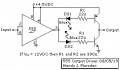
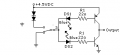
I actually tried something like that using white LED's. I was going for something a little different this time. I would like to keep the 4.5 Volt DC power supply spec.
At that low an operating voltage, tuning the circuit values is tricky. The conduction "knee" of a bipolar transistor (Vbe vs Ic) does not have a sharp corner. That is, there is a span of Vbe over which the transistor goes from completely off to firmly on. To prevent any cross-conduction, you have to protect at least a 1 V span around the nominal 0.5 V - 0.6 V "normal" value 0 for *each* transistor. 2 V in a 4.5 V system is over 44%. That's a lot of your operating space, and leaves very little room for noise margin, temperature drift, etc.
Of course it can be done, but two quick issues. First, there may not be a zener diode for theexact value you need. Second, I've noticed that low voltage zener diodes do not have a sharp conduction knee, either.
Like I said at the beginning of this thread I've been trying to do this for several years, the only reason I rejected the LED method is it result in a non inverting Schmitt trigger and I wanted inverting. 555 Output Driver Revisited
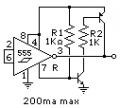
As above, R1 and R2 can be re-located into a single resistor. OTOH, keeping then separate means you can tweak the values so the two base currents are equal despite the asymmetrical 555 output waveform at pin 3.
I do not think the currents need to be balanced, just enough current to send the transistor into saturation. If you're going for high current applications, then you need to pay more attention to the input resistors. Each transistor is going to need its own base current limiter
Disagree. Per your schematic. only one transistor is on at a time. Thus, one base current limiting resistor can serve both devices. However, each transistor needs its own turn-off resistor.
I am aiming for a collector drive on each polarity (common emitter). As much current as is safe for the transistor.
Here are the design specs I have set myself.
555 (standard) full voltage range 4.5VDC to 15VDC
Rail to rail, should drive 200ma each polarity.
Total design must be inverting (for a hysteretic oscillator).
And of course minimum parts count.
I am convinced there is a way to do this, which is why I keep coming back to it. Simplicity above all else.
The standard rule of thumb for firm saturation is Ic : Ib = 10:1. I think this is not necessary for parts developed in the 60's and later, so I'd go for something like 20:1. Still, that's 10 mA of base current for each output transistor. And (referring to post 25) the two currents do not have to be equal or balanced, but they both must be greater than 10 mA.
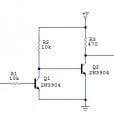
For a schematic such as #20 or #25, the external output stage will be inverting, so the overall 555 + output stage will not work as a simple hysteretic oscillator. Because all transistors are inverting when operating as a saturated switch, I don't think you can get there without more parts.
You could do it with two optocouplers, but standard cheap parts cannot source/sink 200 mA.
The circuit I was responding to (post #23) relies on the two Vbe's plus the two LED Vf's adding up to something greater than Vcc. For example, if each LED Vf is 3 V and the transistor Vbe is 0.5 V (onset of conduction), then Vcc must be at least 7 V for anything to turn on. His Vcc is less than this, so there is no cross-conduction during the 555 output transition (at 2.5 V for example).
I wouldn't feel comfortable depending on the 2x Vf of the LEDs not conducting. Don't forget I want the same circuit to work the 4.5V-15.0V power supply range. Then there is the fact it will become a non inverting gate.
Buffering the 555 or 7555 with an MCP1402 is the obvious, single-component, relatively cheap solution if you want a high current rail-to-rail output, but if you use the inverting version, the MCP1401, you can make it oscillate much like a 555.
The schottky diode produces a signal like the "discharge" output.
The hysteresis thresholds are not so conveniently symmetrical being 1.3V and 1.6V, and not varying with supply voltage, but you can make most of the usual 555 circuits.
You can also reverse the diode and make the circuits "upside down".
This isn't an "off-label" use of the device - I saw it in some Microchip application note many years ago. It will probably work with all Low-side drivers that have a Schmitt trigger front-end.
Something like the UCC27512 might be even better as it has wider and more accurate hysteresis levels.
Thanks, I might buy a few for future experimentation . For now I will go with the project I've started .
Key part Numbers?
MPC1401 Inverting
MPC1402 Non Inverting
I'll be interested in the internal schematics too.

 Facebook
 Google
 GitHub
 Linkedin