Facebook
 Google
 GitHub
 Linkedin
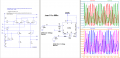
One of the standard mixer topologies is the Gilbert Cell which amounts (greatly simplified) to a pair of stacked differential amplifiers. If we are feeding this from an unbalanced source, then one half of each of these dif-amps is essentially unused while the other half does all the work.
So, my theory is that the same thing can be done with a simple stack of three transistors.
- The bottom is used as the current source.
- The center is the L.O. input.
- The top is the signal.
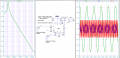
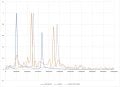
My simulation model seems to work exactly as I expect it to work.
With this great simplification and the fact that the Gilbert Cell is so ubiquitous, I am thinking that there is a good reason NOT to use my simplified version.
Can someone enlighten me on this?
So, my theory is that the same thing can be done with a simple stack of three transistors.
- The bottom is used as the current source.
- The center is the L.O. input.
- The top is the signal.
My simulation model seems to work exactly as I expect it to work.
With this great simplification and the fact that the Gilbert Cell is so ubiquitous, I am thinking that there is a good reason NOT to use my simplified version.
Can someone enlighten me on this?



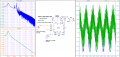
![LTspice XVII - [Mixer-Gilbert Cell with xfmr.asc] 11_15_2019 5_26_37 PM.png](https://forum.allaboutcircuits.com/data/attachments/179/179181-2062bc35aeed1f883a06e0e4ce5a8311.jpg "LTspice XVII - [Mixer-Gilbert Cell with xfmr.asc] 11_15_2019 5_26_37 PM.png")