Audio mixer. ..#2

Thread Starter

zselectronics

Joined Feb 2, 2016
2
Hello All,
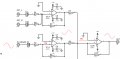
I still have a question to the circuit attached to #16 (https://forum.allaboutcircuits.com/threads/audio-mixer.202418/#lg=post-1930196&slide=1). (Can I call it a "consensus" circuit?)
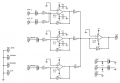
In the circuit, the output of the first three op-amps are connected (through resistors). I just wonder if, or under what conditions, this can create problems? Can one output (with two high or low voltage) backdrive (if this is a correct expression at all) the output of the others? Also, I saw on other circuits a capacitor attached to the output of each of the first three op-amps. Is this necessary? With or without these capacitors, under what conditions can one safely connect the outputs?
Thanks in advance!
1768057404255.png

Mod: created your own thread.
Link to old thread
https://forum.allaboutcircuits.com/threads/audio-mixer.202418/post-1932319
 
Last edited by a moderator:

crutschow

Joined Mar 14, 2008
38,418
under what conditions, this can create problems? Can one output (with two high or low voltage) backdrive (if this is a correct expression at all) the output of the others?
No.
The resistors go to the summing junction of the output op amp, which is at essentially 0V virtual ground, so there is no backdrive (or crosstalk) between the inputs.
I saw on other circuits a capacitor attached to the output of each of the first three op-amps. Is this necessary? With or without these capacitors, under what conditions can one safely connect the outputs?
Those likely are to roll-off high frequency noise above the highest audio frequencies of interest.
The simplest way to do that is with a small capacitor across R10.

The circuit is inherently "safe", whatever that means. :confused:
 

MrChips

Joined Oct 2, 2009
34,700
The output impedance of drivers (analog or digital) is usually low.
If one driver is sending a low voltage and another is sending a high voltage, they compete against each other. What would be the resulting voltage? You have created a short circuit across the power rails and the current through both drivers is high, possibly destroying both drivers.

The purpose of the resistors is to increase the output impedance of each driver. In other words, you are summing the output currents without loading down each voltage output.
 

ronsimpson

Joined Oct 7, 2019
4,662
A picture = 1000 words. A signal on IN_ORGAN becomes 0V at the inputs of the op-amp. The signal appears again at the output of the amp but inverted. The same thing happens again. Both inputs of U2B are at 0V.
The summing is done at 0V. There should be no " backdrive".
Even if a signal could flow back through R3 into U2A the amplifier has a very low output impedance. (approaching 0 ohms) If you could lift up on the amplifiers output, it will try very hard to resist that.
1768060297503.png
If you find "backfeed" it is most likely caused by a poor PCB layout. Or the signal is feeding back into the +/-15V supply.
 

ronsimpson

Joined Oct 7, 2019
4,662
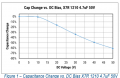
ceramic or film cap values
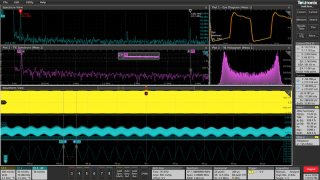
There are types of ceramic caps where the value changes depending on the voltage across the cap. I design power supplies, and I have to watch that value there is at the voltage applied. Many audio amp design books talk about the distortion that comes from running audio through these ceramic caps. I do agree cheap X7R ceramics used in treble and base circuits cause distortion. I think the caps in this circuit have a constant voltage across them. (0V) I don't see any problem in using any type of ceramic cap here.
1768063801064.png
 

MisterBill2

Joined Jan 23, 2018
27,323
The short answer to the question in post #1 is "sometimes". The better quality audio mixers all have an amplifier stage between the inputs and the mixing buss (which is the point in the circuit where the signals actually combine.) But adding all those additional amplifier nodes costs more, and so in circuits where low cost is the priority, only a single resistor is used. Often that is OK, but not all of the time.
 

Thread Starter

zselectronics

Joined Feb 2, 2016
2
You guys are terrific. I have learnt a lot from your answers and comments, thank you very much! (Especially #2 and #4 are highly educational for me. - Actually, I want to build my circuit and I now have the confidence to not only simulate it but build the hardware itself.)
 

MisterBill2

Joined Jan 23, 2018
27,323
Consider that without an amplifier stage in the string between the input and the mixing bus there is not complete isolation of the reverse signal path between each input and that common mixing bus.
The lack of isolation will not be an issue in all cases, but in some conditions it does matter. In addition, the input amplifiers tend to isolate common mode noise that may be present on a balanced input signal from the mixing bus.
AND, having that input amplifier brings the common "ground " side of each signal to the same level. That often matters.
 

MisterBill2

Joined Jan 23, 2018
27,323
The two circuits shown, with multiple op-amps feeding what is often called a mixing bus, is a classic used in most good mixer systems. My previous comments relate to the "classic" summing junction input scheme shown prior to the first op-amps . For those inputs there is, in theory, no interaction between sources. That will be the case unless the signal source amplitude is much greater than the output of the op-amp.
 
Top