Audio mixer to power amplifier and line out

Thread Starter

Alex Cristian R

Joined Feb 16, 2019
36
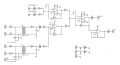
I want to make a new board for my organ and i have some doubts.

Does the line out look ok? Or should i get the signal from U2B pin 7 and feed it into U2B pin 2?
Also, the resistor and cap of the line out are ok?

Obs: the inputs of the transformers are differential signal from DACs. This i know it works.
 

Attachments

MisterBill2

Joined Jan 23, 2018
27,323
I want to make a new board for my organ and i have some doubts.

Does the line out look ok? Or should i get the signal from U2B pin 7 and feed it into U2B pin 2?
Also, the resistor and cap of the line out are ok?

Obs: the inputs of the transformers are differential signal from DACs. This i know it works.
It looks good the way it is. The transformers are good if you already have them, expensive if you don't have them.
NO!
Do not feed the one signal to the input of the other. No need for that.
 

sghioto

Joined Dec 31, 2017
8,634
Does the line out look ok? Or should i get the signal from U2B pin 7 and feed it into U2B pin 2?
Also, the resistor and cap of the line out are ok?
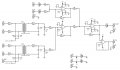
This is how I would configure the circuit.
I changed R5 and R8 to 47K and reconfigured U2B as a non inverting buffer for the PA output.
The circuit functions as a zero gain mixer.
C2 and C3 can be eliminated as there is no DC voltage offset from the transformers.
1729292154134.png
 
Last edited:

Ian0

Joined Aug 7, 2020
13,114
Don't connect the inverting inputs of U2A and U2B together.
As an alternative to @sghioto 's circuit, duplicate R6 and R9 and connect to U2b's inverting input.
 

MisterBill2

Joined Jan 23, 2018
27,323
While there is no DC voltage from the two transformers, there is a DC resistance that could affect the
bias of the op-amps. AND, any bias current flowing thru the transformers will have some effect, although it might not matter.
 

Thread Starter

Alex Cristian R

Joined Feb 16, 2019
36
Thanks everyone!

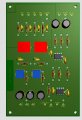
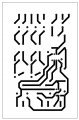
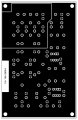
I decided to do it this way based on your recommendations. I have also made the pcb design (90x140mm). The digital ground is separated from the analog ground, it worked fine on the prototype board, hopefully will be fine too.

Would the audio transformer impact the opamp given the fact that they are only 10mm apart?
 

Attachments

MisterBill2

Joined Jan 23, 2018
27,323
GOOD audio input transformers are well shielded, and most audio ICs are quite resistant to small magnetic fields. I have an audio mixer panel that seems to use small toroids for the microphone input transformers. Those would be self-shielding magnetically.
 

Thread Starter

Alex Cristian R

Joined Feb 16, 2019
36
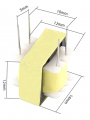
These are the transformers i plan to use. EI14 600:600

Spec from aliexpress:

Model: EI14
Material: Nickel alloy
AC impedance: 600 : 600 Ohm
Voltage ratio: 1:1
Item: Audio transformer
Inductance: 290mH (±20%)
DC resistance: 135(±%)
Windability: Double-wire winding
Primary coils: 800 turns
Secondary coils: 800 turns
Alternating-current impedance value: 600
Moisture-proof mode: open
Cooling mode: oil immersed air cooled
Frequency characteristics: intermediate frequency
Appearance structure: vertical


1729409863171.png
 

MisterBill2

Joined Jan 23, 2018
27,323
I observe in that description that there is not any hint of a power rating for the transformer. And I am not convinced about the validity of the description: " Cooling mode: oil immersed air cooled" which I do not see how that relates to the photo.
For the application as shown, it will probably be OK.

I would not expect a better description from that seller. That organization leaves out a lot of information that is important.
 

Ian0

Joined Aug 7, 2020
13,114
It doesn't look too good to me. Lmag=290mH is way too low for a full-range audio transformer. That puts its low frequency cutoff at 330Hz, because it is probably designed for telephony.
You need Lmag>4.7H to get 20Hz.
If you use it, your source will have to drive 36Ω at 20Hz, and, without knowing the volt-time constant, it might also saturate.
@MisterBill2 makes a good point - you don't often need oil immersion cooling for an audio signal transformer!
so it's a fair bet that the rest of the parameters are also made up. However, little telephone-bandwidth transformers used to be plentiful and the designs will still be out there, being sold to the unwary as full-range audio transformers.
 

MisterBill2

Joined Jan 23, 2018
27,323
Some may call it "full range" even if the ends are 40 dB down. AND, given that this is, I think, part of a large electronic organ, no "flat" response curve is any part of it.
 

Ian0

Joined Aug 7, 2020
13,114
If I were going to use an audio transformer, I'd invest in a good one: Lindahl, Sowter, OEP etc. Otherwise, I would just use a balanced line input to deal with the potential earth loop.
If, for some strange reason, the organ was an old one with a live chassis, then the average audio transformer would not provide sufficient isolation.
 

MisterBill2

Joined Jan 23, 2018
27,323
In an audio mixer panel made by a decent company, I see microphone input transformers wound on what looks like ferrite cores, about 0.5 cm diameter and about 0.5 cm tall. and what looks like #36 wire. Those mixer panels are adequate for high quality audio work. So at such a low power level it is not a problem. Consider the power generated by a good dynamic microphone: mot much, is it?
 

Ian0

Joined Aug 7, 2020
13,114
In an audio mixer panel made by a decent company, I see microphone input transformers wound on what looks like ferrite cores, about 0.5 cm diameter and about 0.5 cm tall. and what looks like #36 wire. Those mixer panels are adequate for high quality audio work. So at such a low power level it is not a problem. Consider the power generated by a good dynamic microphone: mot much, is it?
Very little, 10mV perhaps into a 600Ω load, less than a microWatt.
But a line level transformer, 0.775V into a 600Ω load or 1mW, is almost four orders of magnitude larger.
 

MisterBill2

Joined Jan 23, 2018
27,323
A good point. Hopefully the TS has used a standard hole pattern and a different transformer will also fit. OR, the TS may possibly be lucky this time. Good things do sometimes happen.
 

Thread Starter

Alex Cristian R

Joined Feb 16, 2019
36
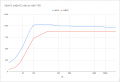
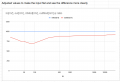
I have made some measurements on the transformer.I have used my scope and the pc sound card as sine generator.
This is what i got. Though not very precise equipment i believe the analasys is still relevant.

The response of the transformer seems to be pretty good. Although the distortion seemed to be higher at the lower end of the spectrum.

1729873968288.png


1729874080284.png
 

Ian0

Joined Aug 7, 2020
13,114
I have made some measurements on the transformer.I have used my scope and the pc sound card as sine generator.
This is what i got. Though not very precise equipment i believe the analasys is still relevant.

The response of the transformer seems to be pretty good. Although the distortion seemed to be higher at the lower end of the spectrum.

View attachment 334352


View attachment 334353
"pretty good" is subjective. My opinion of it would be "unusable", especially for an organ, which would suggest to me the importance of the lower frequencies. From your graph, it's starting to lose response and distort at any frequency below middle C.
 

MisterBill2

Joined Jan 23, 2018
27,323
Down about 30% at 80 Hz. not even 1 dB, if my math is right. But the good musicians play by sound rather than by charts. and so the work-around is built in.
 
Top