Questions about the ULN2003 datesheet

Thread Starter

Hu Johnson

Joined Dec 28, 2023
13
First, the output current of each unit can reach 500mA, so can the full load output reach 3.5A? Second, are there any limitations to the use of ULN2003? Assume the safety threshold temperature is 105°C
 

Attachments

Papabravo

Joined Feb 24, 2006
22,082
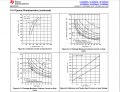
Refer to Figure(s) 6-4 & 6-5 in the datasheet:

1703824960052.png
The "D" package says that you can run a single output at 500 mA with a 50% duty cycle. I would conclude from this that you cannot run all seven outputs at 500 mA without exceeding the power dissipation capabilities of the package. With the "N" package you can have 500 mA with a duty cycle of 88% and you still can't run all of them at that level.
 

Thread Starter

Hu Johnson

Joined Dec 28, 2023
13
Refer to Figure(s) 6-4 & 6-5 in the datasheet:

View attachment 311159
The "D" package says that you can run a single output at 500 mA with a 50% duty cycle. I would conclude from this that you cannot run all seven outputs at 500 mA without exceeding the power dissipation capabilities of the package. With the "N" package you can have 500 mA with a duty cycle of 88% and you still can't run all of them at that level.
Thank you for your answer, good luck to you
 

Ian0

Joined Aug 7, 2020
13,131
First, the output current of each unit can reach 500mA, so can the full load output reach 3.5A? Second, are there any limitations to the use of ULN2003? Assume the safety threshold temperature is 105°C
No. See "Absolute Maximum Ratings -> Total Emitter Current = 2.5A"
Then look at figures 6-4 and 6-5, which give the maximum duty cycle for each type of package.
 

Thread Starter

Hu Johnson

Joined Dec 28, 2023
13
No. See "Absolute Maximum Ratings -> Total Emitter Current = 2.5A"
Then look at figures 6-4 and 6-5, which give the maximum duty cycle for each type of package.
Thank you for your answer, I have modified the circuit according to the description of the data sheet, thank you for your answer,Good luck always be with you
 

eetech00

Joined Jun 8, 2013
4,705
If I remember correctly, a few years ago I commented on a message thread in this forum where I actually experimented with the ULN2003 to see the effect of high current loads. I used a laser temperature probe. The result was ( I think) just one output got hot to the touch at 500ma. The actual physical output pin used also made a difference. So beyond 500ma TOTAL, a heat sink should be used.
 

Thread Starter

Hu Johnson

Joined Dec 28, 2023
13
If I remember correctly, a few years ago I commented on a message thread in this forum where I actually experimented with the ULN2003 to see the effect of high current loads. I used a laser temperature probe. The result was ( I think) just one output got hot to the touch at 500ma. The actual physical output pin used also made a difference. So beyond 500ma TOTAL, a heat sink should be used.
I decided to use MOSFET to drive the load. Obviously ULN2003 is not suitable for driving large current loads. Thank you.
 

Papabravo

Joined Feb 24, 2006
22,082
that's totally fine, but the cost is too high. Transistors obviously have a price advantage.
I want to know how you intend to drive the gate terminal of the MOSFET that controls your load. You keep answering other questions for reasons I cannot figure out.
 

Thread Starter

Hu Johnson

Joined Dec 28, 2023
13
I want to know how you intend to drive the gate terminal of the MOSFET that controls your load. You keep answering other questions for reasons I cannot figure out.
Give a high level to the microcontroller on the gate of the MOSFET, and at the same time, a pull-down resistor needs to be added to avoid electronic interference. This is how the DC fan is currently driven. Do you have a good driving method?Dear friends.
 

Papabravo

Joined Feb 24, 2006
22,082
Give a high level to the microcontroller on the gate of the MOSFET, and at the same time, a pull-down resistor needs to be added to avoid electronic interference. This is how the DC fan is currently driven. Do you have a good driving method?Dear friends.
Microcontrollers are not known for their ability to switch the gate of a MOSFET rapidly resulting in excessive power loss and heating of the MOSFET. This is especially true if the micro is a 3.3V device and the MOSFET has a Vgs(on) of 2-4 Volts. Read the datasheet carefully.
 

Thread Starter

Hu Johnson

Joined Dec 28, 2023
13
Microcontrollers are not known for their ability to switch the gate of a MOSFET rapidly resulting in excessive power loss and heating of the MOSFET. This is especially true if the micro is a 3.3V device and the MOSFET has a Vgs(on) of 2-4 Volts. Read the datasheet carefully.
3.3V(STM32Microcontroller)too expensive,I use an 8-bit microcontroller from Taiwan, and the logic level is 5V.
 

Papabravo

Joined Feb 24, 2006
22,082
3.3V(STM32Microcontroller)too expensive,I use an 8-bit microcontroller from Taiwan, and the logic level is 5V.
Well that is OK and many 8-bit parts run from 3.3V and lower, but you still need to check the datasheet for the MOSFET. The threshold voltage, Vgs(on), of 2-4 volts for many parts is where they begin to turn on. Keep in mind that there is a vast difference between "begin to turn on" and "fully turned on". Some parts may require 10V or more for a minimum rds(on) in the channel of the MOSFET.
 

Thread Starter

Hu Johnson

Joined Dec 28, 2023
13
Well that is OK and many 8-bit parts run from 3.3V and lower, but you still need to check the datasheet for the MOSFET. The threshold voltage, Vgs(on), of 2-4 volts for many parts is where they begin to turn on. Keep in mind that there is a vast difference between "begin to turn on" and "fully turned on". Some parts may require 10V or more for a minimum rds(on) in the channel of the MOSFET.
Thank you,Papabravo.I am using a frequently used circuit and verified component parameters to drive a DC fan. Your design habits are very good, but for me the efficiency is too low. My workload is too heavy and I don’t have much energy to do it. Researching the most suitable circuit, obviously my approach is wrong, but it is the only way to do it. Are you an electronic engineer by profession? I want to learn more good design habits from you. I am also tired of my current job.
 

Papabravo

Joined Feb 24, 2006
22,082
Thank you,Papabravo.I am using a frequently used circuit and verified component parameters to drive a DC fan. Your design habits are very good, but for me the efficiency is too low. My workload is too heavy and I don’t have much energy to do it. Researching the most suitable circuit, obviously my approach is wrong, but it is the only way to do it. Are you an electronic engineer by profession? I want to learn more good design habits from you. I am also tired of my current job.
I'm sorry for your trials and tribulations. If you choose to do things in a particular way, then there is very little I can do to help you. Even frequently used circuits and verified component parameters are subject to mistakes and oversights. It takes less time than you might imagine for checking a datasheet. I did that sort of thing for half a century and made a comfortable retirement by doing it well. I hope things go well for you.
 
Top