Question about capacitors

MrChips

Joined Oct 2, 2009
34,820
maybe stupid question but if you have a capacitor where instead of the dielectric material you have something between the plates which is totally impervious to electrical fields... would the plates still charge? the plate connected to the negative end of the battery would get full of electrons...and the other plate would lose electrons as they would drain into the positive side of the battery..no?
If you had a dielectric material whose dielectric property is zero, then you would have zero capacitance.
 

Tonyr1084

Joined Sep 24, 2015
9,744
Anything between the plates has atoms. Protons, Neutrons and Electrons. Even air has atoms. EVEN EMPTY SPACE is not empty. When an electrical field is present and polarized the electrons are pulled out of their orbit. Their desire to get back to their nucleus is what happens when the capacitor discharges. The amount of charge and how quickly it is dissipated is what capacitors are famous for. So there's nothing in existence (sept, maybe anti-matter or dark matter) that can block the electromagnetic field from charging a capacitor.
 

nsaspook

Joined Aug 27, 2009
16,330
Anything between the plates has atoms. Protons, Neutrons and Electrons. Even air has atoms. EVEN EMPTY SPACE is not empty. When an electrical field is present and polarized the electrons are pulled out of their orbit. Their desire to get back to their nucleus is what happens when the capacitor discharges. The amount of charge and how quickly it is dissipated is what capacitors are famous for. So there's nothing in existence (sept, maybe anti-matter or dark matter) that can block the electromagnetic field from charging a capacitor.
The tiny amount of matter in the vacuum of space or even a vacuum capacitor does not have sufficient atoms being polarized that would affect the nature of the electric field between the plates. The amount of energy needed to polarized vacuum would warp space due to the energy density. Schwinger Limit
1744236315927.png
1744236332231.png
It's not extra charge between the plate that is stored, it's energy in the form of an electric field. Even with the good dielectrics as we use in most capacitors today, the electrical energy is in the space between polarized molecules.

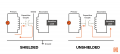
It's actually pretty easy to block electric fields. You put another plate at ground reference between them and shunt the electrical energy storage space to the shield.

https://www.maddox.com/resources/articles/electrostatic-shields

1744235181476.png
 
Last edited:

BobTPH

Joined Jun 5, 2013
11,523
Fast changing voltages get transferred more easily than slow changes - why?
I explained that in my previous post. What do you not understand about it?

Reactance is a useful abstraction, but it does not explain what is actually happening. That abstraction is called the frequency domain. My explanation is in the time domain, which is fundamental, not an abstraction.
 

PhilTilson

Joined Nov 29, 2009
154
Whilst admiring the various attempts to explain this phenomenon to the original TS, I think it just goes to show that there is, in fact, no 'simple' way of describing capacitance - or inductance, come to that. All the suggested explanations have merit, but I suspect the TS is still scratching his head! Reading through them - as one who has no problem living with the concept, having done so over many decades - I confess I can't really offer anything better! Perhaps this is why we enjoy our particular science so much!
 

BobTPH

Joined Jun 5, 2013
11,523
What is actually happening, to put it succinctly, is that, in each cycle the capacitor charges and discharges a bit, depending in the current drawn. For a slow waveform, the charge discharge cycle is deeper, for a fast waveform it is shallower. The voltage across the capacitor subtracts from the output voltage. Therefore the output voltage is lower for low frequencies and higher, approaching the input voltage for high frequencies.

This analysis is for a RC high pass filter.
 

MrChips

Joined Oct 2, 2009
34,820
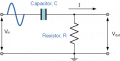
If you want to understand how the transmission properties of the capacitor is dependent on frequency, you have to include a resistor in the discussion, as in a high-pass RC filter.

1744381199369.png

The average value of Vout is zero, independent of C, R, and frequency.
The capacitive property of C wants to keep Vout the same as Vin.

1) If R is missing from the circuit, (R = ∞), Vout will always follow Vin over all frequencies.

2) If R = 0, of course, Vout = 0.

3) If R ≠ 0, then we have a situation somewhere in between conditions (1) and (2).

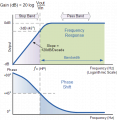
The outcome will depend on the RC time-constant (i.e. how quickly the voltage across the capacitor can charge and discharge compared with the frequency of the applied signal. In other words, the effect is dependent on the rate of change of the applied voltage, dV/dt.

1744382072653.png

If C and/or R is very large, the cut-off frequency shifts towards a lower frequency.
Conversely, if C is small, only fast changing voltages will be passed.

Reference: https://www.electronics-tutorials.ws/filter/filter_3.html
 

Thread Starter

Singh_Wireliner

Joined Apr 9, 2025
8
Perhaps the reason you cannot understand it is because it is not true.

If you had a voltmeter with infinite impedance (i.e. draws no current) and you connect it through a capacitor to an AC source, it will correctly read the AC voltage at any frequency.

Why? Because with no current flowing, the voltage across the capacitor never changes. For simplicity, assume that voltage is zero. So in your series circuit, you have the AC source minus the voltage across the voltage across the capacitor (0) and the output to the voltmeter is just the AC voltage.

Now give the voltmeter some resistance. Now when you measure the voltage the capacitor will charge and discharge through the resistor during each cycle. Any voltage across the capacitor is subtracted form the AC source, so it reads lower than it should.

The lower the frequency, the more the capacitor will charge. So at low frequencies, the capacitor voltage will get higher in each cycle, subtracting more from the AC voltage seen by the meter. Whereas, at high frequencies the capacitor has little time to charge, so less voltage is lost.

A capacitor alone does not drop a voltage dependent on frequency, it is the combination of a capacitor and resistor that does so. And that combo is called a high pass filter.
i reread your answer slowly again today and its really cleared the concept.. thanks
 
Top