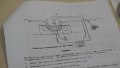
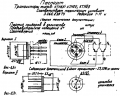
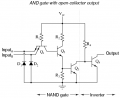
Yeah saw that one yesterday too. Not being an expert by any means I was left fairly perplexed by what seemed a rather vague explanation. I couldn't really make out what was going on in the internal schematic either. The INCH of course features 4 pins, but I couldn't make heads or tails of where they were supposed to be from the drawings.
The fact that they found the circuit worked better when the collector/emitter connections were swapped was pretty interesting though. (Just goes to show that every so often trial and error can lead to useful discoveries!)
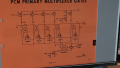
Can anyone else help shed some light on how this thing actually works? For reference, here is the multiplexer that was constructed from these unusual little devices:
To understand how this thing actually works on the inside, it would have to be explained via semiconductor physics. Which I am not qualified.
But the key aspect to understand is that this is a bipolar transmission gate, which allows an analog signal to be connected on and off.
Similar in operation, but at the semiconductor level working completely different, to the ubiquitous CMOS analog switches of the CD4066, CD405x and other devices.
Another component which cannot be explained without semiconductor physics is the UJT, and the concept of conductivity modulation.
I ignore whether conductivity modulation is also involved in this tetrode transistor.
i think this is just a relic from the time (60s) when hardware really was poor. so people were doing what ever they could to get an edge - even if it meant connecting things backwards and using hand wound magnetics. DC coupled amplifiers were a joke as gain was low and Vbe offset was a problem. so solution was to chop signal into small pieces (hence term "chopper"), remove DC bias, and run it through an AC amplifier (stable). after that signal could be processed in any way necessary - turned back into DC (rectified) if needed. so chopper transistors were simply meant to perform fast switching. inverted mode had terrible gain but at least saturation was low (1~5mV at low current). and THAT was the edge. later on the other products entered market, and allowed other solutions... like JFET (J111/J112), multiplexers etc. since solid state semiconductors were improved at unprecedented rate, today one looks with bewilderment at those old circuits using ferrite cores. chopping did not disappear, it simply took another form (without magnetics). it moved DC amplification from troublesome (on vac tubes and BJTs) to todays ultra precision (found in many OpAmps with zero drift...).
Even far more crude were the vacuum tubes. No complementary devices to start with, among a myriad other deficiencies.
Yet, something as complex as the color television, oscilloscopes, radar and computers were developed with vacuum tube circuitry, assisted with other components, like magnetic amplifiers and delay lines.

 Facebook
 Google
 GitHub
 Linkedin