Maybe a big picture description of what you are trying to do will
give more appropriate answers. Like what else do you need for
interface/design, apart from just a PWM.
And PWM clock rates, precision, deadband characteristics....just
a little more depth to question and we can do a better job helping
you.
About the only controller ICs for switch mode power supplies and motor drivers (which are sort of special purpose SMPS) that don't have drivers built in are those that actually have the power switch built in. Many of the older parts were originally intended to drive bipolar transistors but will drive MOSFET, though the drive current can be pretty low (e.g. UC3524A has 200 mA drivers, the UC3824 has 1.5 A drivers). Most that have been introduced in the past 20 years or so have been designed to drive FETs. Many are optimized for converters using high input voltage (rectified AC mains), but many will also work quite well for lower voltage input. If you want to use current mode control (an inner control loop with an out control loop to regulate voltage), select on intended for low voltage. The older types typically required a current sense voltage up up to about a volt, which causes a significant loss of efficiency in lower voltage applications.
Usually the built-in gate drivers are quite adequate for lots of applications, but not always. I've designed with a variety of controllers with built in drivers but used separate drivers because I needed more current than the built in driver could provide, or I had some other special requirement that made a separate drive superior. I would be less likely to use an external driver now than in years past because there have been a lot of new FETs with greatly improved characteristics introduced since I quit doing design.
Texas Instruments probably has the widest range of controllers, due mostly to their acquisition of Unitrode. Analog Devices also has many, in their case due to acquisition of Linear Technology. You can find lots of very good applications information from both TI and AD.
There are many PWM ICs that have the FET built-in. Depending on the power required, these can be an excellent choice, resulting in a simple efficient circuit.
About the only controller ICs for switch mode power supplies and motor drivers (which are sort of special purpose SMPS) that don't have drivers built in are those that actually have the power switch built in. Many of the older parts were originally intended to drive bipolar transistors but will drive MOSFET, though the drive current can be pretty low (e.g. UC3524A has 200 mA drivers, the UC3824 has 1.5 A drivers). Most that have been introduced in the past 20 years or so have been designed to drive FETs. Many are optimized for converters using high input voltage (rectified AC mains), but many will also work quite well for lower voltage input. If you want to use current mode control (an inner control loop with an out control loop to regulate voltage), select on intended for low voltage. The older types typically required a current sense voltage up up to about a volt, which causes a significant loss of efficiency in lower voltage applications.
Usually the built-in gate drivers are quite adequate for lots of applications, but not always. I've designed with a variety of controllers with built in drivers but used separate drivers because I needed more current than the built in driver could provide, or I had some other special requirement that made a separate drive superior. I would be less likely to use an external driver now than in years past because there have been a lot of new FETs with greatly improved characteristics introduced since I quit doing design.
Texas Instruments probably has the widest range of controllers, due mostly to their acquisition of Unitrode. Analog Devices also has many, in their case due to acquisition of Linear Technology. You can find lots of very good applications information from both TI and AD.
There are many PWM ICs that have the FET built-in. Depending on the power required, these can be an excellent choice, resulting in a simple efficient circuit.
I Think 1,5 A driver is more than enough. But in my country Indonesia more familiar (difficult to buy UC3824) with UC3842 which is current-mode control. What does it mean?
Can i make PWM Generator with UC3842? I want make it simple just open loop PWM with trimmer/potentiometer to vary the duty cycle 0-90% with 10-20 kHz frequency. I look up in internet the circuit has many trimmer which i dont know its function so i want to keep only 1 trimmer? Can any one make me this circuit?
Maybe a big picture description of what you are trying to do will
give more appropriate answers. Like what else do you need for
interface/design, apart from just a PWM.
And PWM clock rates, precision, deadband characteristics....just
a little more depth to question and we can do a better job helping
you.
My Project doesnt matter with all of that that, all i need is simple open loop PWM with vary duty cycle using 1 trimmer and the PWM IC built-in with a some kind of driver at least 1 Amp
What are you going to control the duty cycle with ? Reason I am asking
is are you going to need a processor with PWM ? Trimmer I assume a
POT ? So you need either an analog generated duty cycle or a UP that
converts pot to PWM duty cycle control digital byte/word.
The less we know what you are trying to do = less quality and breadth of advice,
in some case outright bad advice.
What are you going to control the duty cycle with ? Reason I am asking
is are you going to need a processor with PWM ? Trimmer I assume a
POT ? So you need either an analog generated duty cycle or a UP that
converts pot to PWM duty cycle control digital byte/word.
The less we know what you are trying to do = less quality and breadth of advice,
in some case outright bad advice.
Controlling duty cycle for vary output voltage in buck circuit or other power electronic, yes trimmer=POT. This circuit will be pure analog, POT will control the PWM duty cycle.
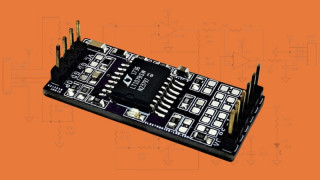
It doesn't have a built-in MOSFET driver, but otherwise the LTC6992 looks like it does what you want. For a MOSFET driver, you could use something like a MCP1406/7; I don't know of any single chip that combines an analog-controlled PWM function with a MOSFET driver.
In current mode control a voltage ramp is produced across a current sensing resistor and that ramp is what is compared with a signal from the voltage error amplifier to control the pulse width. When the switch is ON, the current in the inductor rises linearly with respect to time, and the current sense resistor converts that current to a voltage. When the voltage across the resistor exceeds the voltage from the output of the voltage error amplifier, the switch is turned off. While it is off, the current in the inductor falls linearly as its stored energy is delivered to the ouput. The switch stays off until the oscillator turns it on again.
Most general purpose switch mode controllers can be used to generate a variable duty cycle simply by setting the voltage error amplifier gain to one and instead of feeding the attenuated output of the circuit back to the error amp input you feed the error amplifier from an analog voltage which can come from a potentiometer.
With a current mode controller like the UC384x series, if you want to use it in this way you must make a ramp voltage that you feed to the current sense voltage input, instead of using an actual sensed voltage. Figure 23 of the TI datasheet http://www.ti.com/lit/gpn/uc3842 shows how to make a linear ramp using a PNP transistor as a constant-current source and an NPN transistor to buffer the ramp. The output of the NPN buffer is fed though attenuating resistors to the current sense input. No values are shown for the ramp generator resistors and capacitors because they need to be chosen to match the required frequency. You could use the normal RC circuit for the the ramp, but it is non-linear. You would connect VFB to COMP with a resistor of perhaps 100k and the PWM control voltage to the VFB input though a resistor of perhaps 1k (this ratio to keep the gain near 1). You would need a simple op amp circuit to buffer and probably offset the voltage from the pot so the gain remains constant. You wind up with rather a lot of circuitry for a simple task.
A voltage-mode controller would be easier to use, but I won't suggest any because of availability issues. If you find one you can get and think might work, I'll review the datasheet. In a voltage mode controller the ramp from the timing capacitor is internally fed to where it needs to be, though it might not be linear. The TL494, which is a very old design, is a voltage mode controller but the output driver is only rated for 200 mA.

 Facebook
 Google
 GitHub
 Linkedin