PWM AC Induction Motor Control

Thread Starter

nekojita

Joined Nov 19, 2010
170
Hi Danko,
Thanks for keeping the ideas flowing and for your contributions. I was not able to tun the optocoupler sim because I received this message shown below. My LTSPICE cannot find the ammeter. Is that an add-in? Also, are D3 and D4 needed?
Thanks, Neko
View attachment 214301
Hi Danko,
Awesome job, thanks so much. I plan to build it up to test it. :) I changed all the isolated power supplies to 5V and it works fine here at 90% duty cycle:
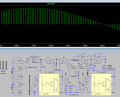
1597004804090.png
I did have a concern about needing 5 isolated power supplies but have a simple solution. AC line to USB plug-ins:
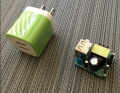
1597004978974.png
When I removed the PCB from the shell, it is only 32X27X18 mm. These modules should make for a fairly compact unit.
Any thoughts about the 5V operation?
Thanks,
Neko
 

Thread Starter

nekojita

Joined Nov 19, 2010
170
Hi Danko,
Awesome job, thanks so much. I plan to build it up to test it. :) I changed all the isolated power supplies to 5V and it works fine here at 90% duty cycle:
View attachment 214373
I did have a concern about needing 5 isolated power supplies but have a simple solution. AC line to USB plug-ins:

View attachment 214374
When I removed the PCB from the shell, it is only 32X27X18 mm. These modules should make for a fairly compact unit.
Any thoughts about the 5V operation?
Thanks,
Neko
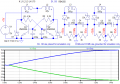
Forum,
I should have been more generous with thanks and praise for all the comments, suggestions, and help received from this Forum. Many thanks! :)
There are always several paths to a technical solution; I appreciate the learning gained from my interaction with AAC. Am looking forward to future rewarding collaborations.
Best,
Neko
 
Last edited:

Danko

Joined Nov 22, 2017
2,169
Hi Neko,
I did have a concern about needing 5 isolated power supplies but have a simple solution. AC line to USB plug-ins:
Isolation power supply, containing AC line to USB plug-in (V1), oscillator (Q1, Q2), isolation transformer (L1...L4):
1597184572894.png
About technique of miniature isolation transformer fabrication - see
https://forum.allaboutcircuits.com/...ormer-for-step-down-mains.163568/post-1437485
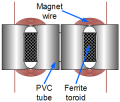
1. Evenly spread on toroid L1 and L2 coils.
2. Wind coils L3 and L4 throughout PVC tubes,
as shown on picture:
1597187510688.png
-------------------------------------------------------
EDITED: Circuit changed, improved.
 

Attachments

Last edited:

Thread Starter

nekojita

Joined Nov 19, 2010
170
Forum,
I should have been more generous with thanks and praise for all the comments, suggestions, and help received from this Forum. Many thanks! :)
There are always several paths to a technical solution; I appreciate the learning gained from my interaction with AAC. Am looking forward to future rewarding collaborations.
Best,
Neko
Hi Neko,

Isolation power supply, containing AC line to USB plug-in (V1), oscillator (Q1, Q2), isolation transformer (L1...L6):
View attachment 214538
About technique of miniature isolation transformer fabrication - see https://forum.allaboutcircuits.com/...ormer-for-step-down-mains.163568/post-1437485
Hi Danko,
What a surprise! I was starting a "formal" schematic to build from. My triangle generator didn't work well at 10kHz so I had to change opamp and biasing. It has a fairly linear triangle and with the comparator creates a full range PWM signal.

Correct me if I'm wrong here:
- V1 will be the offline module I posted to generate the initial 5V
- Q1 and Q2 create a cross coupled oscillator with opposite phase.
- D1 and D2 are zener diodes, correct? What voltage? I don't have that part in my diode library.
- D5- D8 Schottky diodes provide half wave rectification, but there is no regulation except for the limiting by D1 and D2
- The transformer could be wound tri-filar on a 2cm ferrite core with high permeability (> 200u)
- Depending on the Al of the core, the inductance ratio between the primary and secondaries will affect the 15 volt outputs
Anyway, just a few thoughts from a first look. :)
Comments?
Neko
 

Thread Starter

nekojita

Joined Nov 19, 2010
170
Hi Neko,

Isolation power supply, containing AC line to USB plug-in (V1), oscillator (Q1, Q2), isolation transformer (L1...L4):
View attachment 214560
About technique of miniature isolation transformer fabrication - see
https://forum.allaboutcircuits.com/...ormer-for-step-down-mains.163568/post-1437485
1. Evenly spread on toroid L1 and L2 coils.
2. Wind coils L3 and L4 throughout PVC tubes,
as shown on picture:
View attachment 214566
-------------------------------------------------------
EDITED: Circuit changed, improved.
Hi Danko,
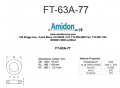
I looked at your edited circuit but don't see why it's improved. I also looked at your transformer guide on the link that you posted. In the past, I have built RF transformers using ferrite cores. Looking in my parts bin I found the cores pictured below:

1597273413920.png

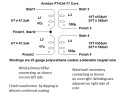
Also shown is my usual technique for toroidal transformers:

1597273463660.png
Any feedback?
Thanks,
Neko
 

shortbus

Joined Sep 30, 2009
10,050
I want to know if the PWM topology will reduce the fan hum at low speeds.
I personally think your chasing your own tail doing this. AC induction motors are usually frequency controlled not PWM'ed. Like with a VFD. Doing it with frequency not pulses keeps the noise down within both the windings and the laminations, PWM is like hitting it with each on/off pulse.

This board is claimed to be configurable to make a single phase VFD. If you go to the data sheet for it it shows how. This is just one of the many ones available on Ebay if you look many are a lot less money -
https://www.ebay.com/itm/DC-AC-Pure...785105&hash=item440f6fd91c:g:NqkAAOSwcHRcXZGW
 
Last edited:

Danko

Joined Nov 22, 2017
2,169
I looked at your edited circuit but don't see why it's improved.
Previous circuit simple was not working.
I also looked at your transformer guide on the link that you posted. In the past, I have built RF transformers using ferrite cores. Looking in my parts bin I found the cores pictured below:
Any feedback?
If you guarantee very strong isolation
at least for 1kV pulsed 10kHz voltage
between:
secondary windings,
secondary windings and primary winding,
secondary windings and ferrite core,
then your design is good for you.
 

schmitt trigger

Joined Jul 12, 2010
2,092
Nekojita;
I congratulate you on your effort to understand and solve a technical challenge.

Of course, there are far cheaper, simpler solutions. But sometimes one feels the urge to conquer a problem because, in the words of the famous mountain climber George Mallory: "Because it's there".
 

Thread Starter

nekojita

Joined Nov 19, 2010
170
Hi Neko,
Here is circuit completed:
View attachment 214912
Hi Danko,
Thanks again for your contribution! Believe it or not, my first PWM sims used LTC6992-1. Since I didn't know my operating frequency, I decided that although the LTC6992-1 uses fewer supporting components, I wanted more flexibility.
Also, the setting of the resistor values was confusing. If, and I say if because I don't know about the hum factor in driving the fan with a PWM drive. I'll probably build up my opamp PWM circuit and if I achieve POC (no hum), I'll go forward with the LTC6992. If you take the FFT of the PWM chopped waveform, there are lots of harmonics- at 10kHz and higher, don't know which will be bad actors. Question: the reason for reducing secondary inductance?
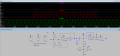
Below is what I came up with yesterday:
1597613008706.png
Please let me know what you think. :) Thanks,
Neko
 

Attachments

Danko

Joined Nov 22, 2017
2,169
Hi Neko,
Since I didn't know my operating frequency, I decided that although the LTC6992-1 uses fewer supporting components, I wanted more flexibility.
Also, the setting of the resistor values was confusing.
1597675844179.png
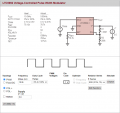
LTC6992 is flexible enough.
You can easily, in seconds,
obtain resistor values for LTC6992
using this tool.


Question: the reason for reducing secondary inductance?
Because primary is winded bifilarly, coupling coefficient changed to 1,
so secondary inductance corrected to get 15 V.
 
Last edited:

Thread Starter

nekojita

Joined Nov 19, 2010
170
Hi Neko,

View attachment 214966
LTC6992 is flexible enough.
You can easily, in seconds,
obtain resistor values for LTC6992
using this tool.


Because primary is winded bifilarly, coupling coefficient changed to 1,
so secondary inductance corrected to get 15 V.
Hi Danko,
I do like the LTC6992 and have used that calculator several times. Issue is limited resistor stock. When I was working, my lab had the full range of E192 resistor values. Now, I am lucky to have 20 values of resistors so it's series and/or parallel, and/or a pot to get the right 3 values for the 6992. As I mentioned in previous, if 10kHz is a frequency that works in producing no hum, I will go with it.

I did notice in your earlier post that you used a coupling value of .75. I assumed that was because you were expecting more leakage inductance? Bifilar winding does have lower leakage inductance but the tradeoff is interwinding capacitance. Can be a problem at high frequencies. No free lunch.:)
 

Danko

Joined Nov 22, 2017
2,169
Hi Neko,
I do like the LTC6992 and have used that calculator several times. Issue is limited resistor stock. When I was working, my lab had the full range of E192 resistor values. Now, I am lucky to have 20 values of resistors so it's series and/or parallel, and/or a pot to get the right 3 values for the 6992. As I mentioned in previous, if 10kHz is a frequency that works in producing no hum, I will go with it.
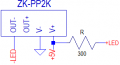
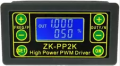
For experiments with PWM I use ZK-PP2K PWM controller.
You can drive LED of U3 (HCPL-3140) by this way:

1597772080690.png
Ebay: $7.26 free shipping
Amazon: $13.05

1597771946117.png
Specifications:
Working voltage: 3.3~30V (note that the positive and negative poles should not be reversed, otherwise it may burn out)
Frequency range: 1Hz~150KHz, the accuracy is about 2%. Motor speed control generally chooses 20KHZ
Duty cycle range: 0-100%, 1% stepping
Number of pulses: 1-9999, or infinite (display '----' stands for infinity)
Delay output time: 0.000s-9999s, the minimum can be set 1ms
Positive and negative pulse width length: 0.000s-9999s, the minimum can be set 1ms
Output load capacity: less than 8A (MOS switch tube)
Output amplitude: The amplitude is equal to the supply voltage (OUT+ is directly connected to the V+ module)
Product size: 79mm*43mm*30mm
Product Weight: 42g
 

Attachments

Thread Starter

nekojita

Joined Nov 19, 2010
170
Hi Neko,

For experiments with PWM I use ZK-PP2K PWM controller.
You can drive LED of U3 (HCPL-3140) by this way:

View attachment 215041
Ebay: $7.26 free shipping
Amazon: $13.05

View attachment 215040
Specifications:
Working voltage: 3.3~30V (note that the positive and negative poles should not be reversed, otherwise it may burn out)
Frequency range: 1Hz~150KHz, the accuracy is about 2%. Motor speed control generally chooses 20KHZ
Duty cycle range: 0-100%, 1% stepping
Number of pulses: 1-9999, or infinite (display '----' stands for infinity)
Delay output time: 0.000s-9999s, the minimum can be set 1ms
Positive and negative pulse width length: 0.000s-9999s, the minimum can be set 1ms
Output load capacity: less than 8A (MOS switch tube)
Output amplitude: The amplitude is equal to the supply voltage (OUT+ is directly connected to the V+ module)
Product size: 79mm*43mm*30mm
Product Weight: 42g
Hi Danko,
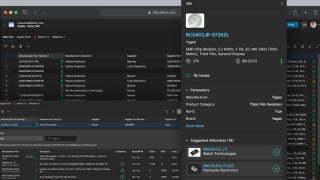
Great little module- thanks for posting! The good news is that the price is great. The bad news:
1597786037494.png
:-(
Neko
 

Thread Starter

nekojita

Joined Nov 19, 2010
170
Hi Danko,
Thanks for your continued great suggestions and support!:)Until my home AC gets repaired (1-2 weeks), all I can do is sit in front of the fan- don't feel motivated to build anything right now during this sustained and unprecedented heatwave. :-(

Also, my Hantek scope died- won't boot up. With Covid still in play in CA I am reluctant to spend money to replace it right now.
Still though, I want to build up a prototype to show POC. (or not)

For the 5V supply, I still plan to start with the offline 120VAC to 5V DC USB converter. USB output should provide 500 mA. I think it will work.
Thanks again,
Neko
 

cmartinez

Joined Jan 17, 2007
8,776
Hi Danko,
Thanks for your continued great suggestions and support!:)Until my home AC gets repaired (1-2 weeks), all I can do is sit in front of the fan- don't feel motivated to build anything right now during this sustained and unprecedented heatwave. :-(

Also, my Hantek scope died- won't boot up. With Covid still in play in CA I am reluctant to spend money to replace it right now.
Still though, I want to build up a prototype to show POC. (or not)

For the 5V supply, I still plan to start with the offline 120VAC to 5V DC USB converter. USB output should provide 500 mA. I think it will work.
Thanks again,
Neko
What type of Hantek scope do you have?
 

Thread Starter

nekojita

Joined Nov 19, 2010
170
What type of Hantek scope do you have?
Hi Danko,
I've got a Hantek 5202B. (200MHz BW 1GSA/s) Had planned to to some 100-200MHz design work but it never materialized. I like the scope except it's only 2 channels.
When I was working, my lab scope was a Keysight MSO7104B Mixed Signal Oscilloscope; big difference from the Hantek. :) Well, it is what it is, right? So, as I said earlier, I will build up the PWM circuit and post results. BTW, suggestions on connecting the line powered circuit to the scope? In the past, I've used an isolation transformer to do this. I know that this can be a dangerous connection arraignment. Any thoughts? I don't have a differential probe.
Thanks,
Neko
 
Top