PWM AC Induction Motor Control

crutschow

Joined Mar 14, 2008
38,530
I would have a window fan on in the bed room, summer and winter for the hum it created to help me sleep.
With a TRIAC dimmer, the hum turns into a buzz due to the high-frequency harmonics when it abruptly starts the waveform, which is rather annoying and not sleep inducing.
 

Danko

Joined Nov 22, 2017
2,170
Hi Neko,
Does not work at 60Hz
I do not think so:
1596567142245.png
- also don't understand the relationship between the PWM and Back signal drives.
There is no relationship between the PWM and Back signal drives.
They work independently.
Back signal should corresponds to Line voltage motor current I(Ammeter).
but don't see how create a simple practical implementation.
You already collected all information you needed for circuit creating and simulating.
 

Attachments

Last edited:

cmartinez

Joined Jan 17, 2007
8,777
Never used a dimmer or anything other than the fan, on low speed. It acted like "white noise".
I do the same thing... I need to hear the hum of some device or another to help me sleep... last year I went on a trip and stayed in a place that had neither AC nor a ceiling fan... the silence was so intense that I downloaded a noise generating app for my phone and kept it running all night.
 

Thread Starter

nekojita

Joined Nov 19, 2010
170
Hi Neko,

I do not think so:
View attachment 213991

There is no relationship between the PWM and Back signal drives.
They work independently.
Back signal should corresponds to motor current I(Ammeter).

You already collected all information you needed for circuit creating and simulating.
Hi Danko,

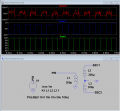
Thanks for the 60Hz update. I figured that I'd try a pulse transformer which will imitate hopefully your voltage sources in your sim. It was easy enough to setup the transformer, however, I get an unexpected result. If I ground the opposite polarity windings, all is good. If I simply connect them together with no ground, the voltage only appears in secondary 1. (SEC1) This seems absurd as the circuit is so simple.

1596656964686.png

Any thoughts?
Neko
 

Attachments

Danko

Joined Nov 22, 2017
2,170
Hi Danko,

Thanks for the 60Hz update. I figured that I'd try a pulse transformer which will imitate hopefully your voltage sources in your sim. It was easy enough to setup the transformer, however, I get an unexpected result. If I ground the opposite polarity windings, all is good. If I simply connect them together with no ground, the voltage only appears in secondary 1. (SEC1) This seems absurd as the circuit is so simple.
LTspice required reference, when measuring voltage.
We should measure potential between two points.
One of them may be ground (default).
Else result will unpredictable.
See below:
1596661311959.png
 
Last edited:

Thread Starter

nekojita

Joined Nov 19, 2010
170
LTspice required reference, when measuring voltage.
We should measure potential between two points.
One of them may be ground (default).
Else result will unpredictable.
See below:
View attachment 214075
Hi Danko,
Thanks for the explanation. What I struggle with is the grounds and neutral (AC return) compared. The common just makes sense; I should have gotten that.

I've had very little experience with offline designs; doesn't seem correct to tie AC neutral to a DC ground in a design. How to show this distinction in LTSPICE is confusing especially when building up a test circuit. I've mostly worked on low voltage circuits that were safe to the touch. :)

Like I say, for LTSPICE with only the voltage source, it is somewhat a dilemma as to how to wire a test circuit connected to the AC line.

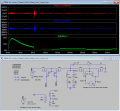
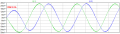
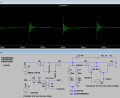
That being said, I tried inserting the pulse transformer circuit into your PWM driver. (I changed motor values to match my fan motor) I guess that I am not getting this as the results are terrible. See below and attached.

1596670912856.png

Suggestions?

Thanks,
Neko
 

Attachments

crutschow

Joined Mar 14, 2008
38,530
doesn't seem correct to tie AC neutral to a DC ground in a design. How to show this distinction in LTSPICE is confusing especially when building up a test circuit.
You can simulate isolated grounds in LTspice by connecting one ground with the ground symbol, and them connecting a large resistance (say 10meg) from that to the other ground.
That should satisfy LTspice but keep any currents between the grounds to a negligible value.
 

Thread Starter

nekojita

Joined Nov 19, 2010
170
You can simulate isolated grounds in LTspice by connecting one ground with the ground symbol, and them connecting a large resistance (say 10meg) from that to the other ground.
That should satisfy LTspice but keep any currents between the grounds to a negligible value.
Thanks for the grounds suggestion. :)
 

Thread Starter

nekojita

Joined Nov 19, 2010
170
Hi Neko,
Next step - you can use for PWM similar solution. as for back drive:
View attachment 214148
Hi Danko.
I created a back drive circuit today but planned to use transformer coupling:
1596746145063.png
Did you have a chance to look at your latest iteration at 10us and 90us pulse widths? Motor output signals do not track the pulse width. Do you think it is due to the transformer inductance values being quite large? Also, could please send me the hcpl-3140 files. I do not have this component in my library.
Thanks,
Neko
 

Danko

Joined Nov 22, 2017
2,170
Hi Neko,
I created a back drive circuit today but planned to use transformer coupling:
It should be very big transformer, because of 60 Hz frequency,
and notice - FETs required big current from gate drivers - here about 0.6A @ 10v.
Do you think it is due to the transformer inductance values being quite large?
Transformer inductance values are good for 10kHz signal (reactance of 2mH is 125.7Ω).
But PWM signal transforms with distortion - double amplitude of signal divides
between positive and negative parts in inverse proportion to their lengths.
So, transformer works good only with PWM around 50%.
Also, could please send me the hcpl-3140 files. I do not have this component in my library.
They are attached.
Did you have a chance to look at your latest iteration at 10us and 90us pulse widths?
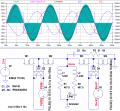
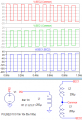
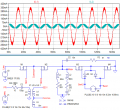
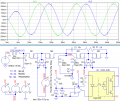
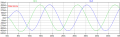
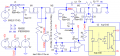
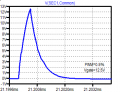
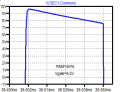
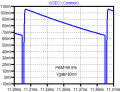
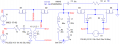
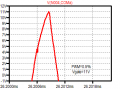
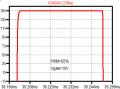
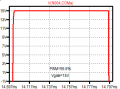
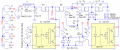
Below are PWM diagrams and fixed schematic.
PWM_0.5.PNG
PWM__99.5%.PNG
@PWM=0.5% motor current Imin=27.64mA RMS, @PWM=95.5% motor current Imax=453mA RMS,
so possible power attenuation in that PWM range is Pmax/Pmin=(Imax/Imin)^2=296 times.
1596755517945.png
 

Attachments

Last edited:

Thread Starter

nekojita

Joined Nov 19, 2010
170
Hi Neko,

It should be very big transformer, because of 60 Hz frequency,
and notice - FETs required big current from gate drivers - here about 0.6A @ 10v.

Transformer inductance values are good for 10kHz signal (reactance of 2mH is 125.7Ω).
But PWM signal transforms with distortion - double amplitude of signal divides
between positive and negative parts in inverse proportion to their lengths.
So, transformer works good only with PWM around 50%.

They are attached.

Below are PWM diagrams and fixed schematic.
View attachment 214165
View attachment 214166
@PWM=0.5% motor current Imin=27.64mA RMS, @PWM=95.5% motor current Imax=453mA RMS,
so possible power attenuation in that PWM range is Pmax/Pmin=(Imax/Imin)^2=296 times.
View attachment 214167
Hi Danko,
Thanks for sending the files. Just tried your latest iteration and am not quite seeing the same results as you posted. With the parameters as shown below, the motor voltage is not looking right.
Any thoughts?
Neko
1596830619466.png
 

Thread Starter

nekojita

Joined Nov 19, 2010
170
Hi Danko,
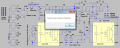
Thanks for keeping the ideas flowing and for your contributions. I was not able to tun the optocoupler sim because I received this message shown below. My LTSPICE cannot find the ammeter. Is that an add-in? Also, are D3 and D4 needed?
Thanks, Neko
1596923553649.png
 

Danko

Joined Nov 22, 2017
2,170
Hi Neko,
I was not able to tun the optocoupler sim because I received this message shown below.
In LTspice I found 10 files with name Sborka.lib, so I will send you one of them:
C:\Users\Danko\Documents\LTspiceXVII\lib\sub\Sborka.lib.
I recommend you download and install full @Bordodynov's additional library for LTspice
from http://bordodynov.ltwiki.org/.
My LTSPICE cannot find the ammeter. Is that an add-in?
See recommendation above.
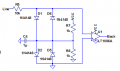
Also, are D3 and D4 needed?
D3 and D4 provide path for minus of signal to sources of M3 and M4.
 

Attachments

Last edited:
Top