PWM AC Induction Motor Control

Thread Starter

nekojita

Joined Nov 19, 2010
170
Hi Neko,

In LTspice motor with R=257 Ω and L=79 mH works good:
View attachment 219371


With disconnected right part of circuit back EMF pulses are not eliminated:
View attachment 219373

Check parts M3, M4, D1, D2, R6, R16, U6, ISO3, ISO4 and their connections.
Hi Danko,

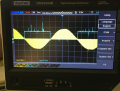
Thanks for your suggestions. Will do a point-point check tomorrow. In your photo that looks similar to my scope photo post, what was not connected or misconnected to cause this.? It looks like a missing connection from the motor to the drain of M3, correct?

Will check,

Thanks,

Neko
 

Thread Starter

nekojita

Joined Nov 19, 2010
170
Hi Danko,

Thanks for your suggestions. Will do a point-point check tomorrow. In your photo that looks similar to my scope photo post, what was not connected or misconnected to cause this.? It looks like a missing connection from the motor to the drain of M3, correct?

Will check,

Thanks,

Neko
Hi Danko,

Real quick check showed Motor node connection to M3 drain is OK. Will check other connections tomorrow morning.

Thanks,

Neko
 

Thread Starter

nekojita

Joined Nov 19, 2010
170
Dankos comments make sense. For a resisitive load, there is no back EMF from the motor; no problem. If the damper part of the circuit does not work for the inductive load, PWM will not function properly.
 

Thread Starter

nekojita

Joined Nov 19, 2010
170
Dankos comments make sense. For a resisitive load, there is no back EMF from the motor; no problem. If the damper part of the circuit does not work for the inductive load, PWM will not function properly.
cmartinez, Danko,

It works! It works! All that was wrong is that U6 output driving the gate of M4 wire was plugged into adjacent hole on the proto board so was connecting to nothing. And, no fan hum at any speed; proof of concept QED!

So a few thoughts on what to do next:

• Add a time delay relay (Solidstate?) to Line input to driver stage to ensure that +5 and iso supplies are up before the driver is switched on

• Downsize (physically) L1 and C1 but still meet circuit needs

• BOM

• Port schematic to Express Sch (Freeware)

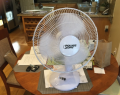
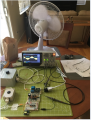
Below are photos of the waveforms, the bench setup, and the fan barely moving:

1602539530496.png
1602539691738.png
1602539737547.png

Thanks so much to you guys for sticking with me on this project and also to the other contributors for their insightful feedback. :)
More thoughts? Comments?

Neko
 

cmartinez

Joined Jan 17, 2007
8,776
More thoughts? Comments?
Here's a thought:

A fan such as the one you've shown usually works with what's called a shaded pole motor. Shaded pole motors are cheap and easy to manufacture, but they also draw a large amount of current when they start up. You may want to first apply full power to the fan and then push the power down to the level at which you want it to work.

Also, shaded pole motors have low torque, and fans normally use brass bushings instead of bearings at their axis. And nowadays brass is not used anymore sometimes because of its price, and it has been substituted by cheaper materials, even plastics.
What I'm trying to say, is that those bushings wear out very quickly and start drawing more and more torque from the motor as it ages, until it stops rotating altogether.

In your setup, what I foresee is that the fan will work fine for a few weeks, but then it will start running slower and slower due to bushing wear. And you're going to have to apply more and more power for it to keep running at the same speed.

My point is, that you may want to consider some sort of feedback so as to let your circuit know how fast the fan is rotating and compensate power accordingly.
 

MaxHeadRoom

Joined Jul 18, 2013
30,680
A fan such as the one you've shown usually works with what's called a shaded pole motor. Shaded pole motors are cheap and easy to manufacture, but they also draw a large amount of current when they start up.
What I'm trying to say, is that those bushings wear out very quickly and start drawing more and more torque from the motor as it ages, until it stops rotating altogether.
Shaded pole motors are the least efficient of any induction motor, typically 20% while running.
The bearing that used to be typical in this type of motor were porous sintered bronze which has a very low wear rate, it was often solidification of the oil that caused poorer performance.
Max.
 

cmartinez

Joined Jan 17, 2007
8,776
Shaded pole motors are the least efficient of any induction motor, typically 20% while running.
The bearing that used to be typical in this type of motor were porous sintered bronze which has a very low wear rate, it was often solidification of the oil that caused poorer performance.
Max.
Brass... bronze... I always confuse the two of them when dealing with their Spanish equivalents.

Yes, I meant to say bronze, and sintered to be precise. But the price of said material has gone through the roof nowadays. And thanks mainly to its being supplanted by crappy stuff, desktop fans have shamefully become disposable commodities.
 

Thread Starter

nekojita

Joined Nov 19, 2010
170
Here's a thought:

A fan such as the one you've shown usually works with what's called a shaded pole motor. Shaded pole motors are cheap and easy to manufacture, but they also draw a large amount of current when they start up. You may want to first apply full power to the fan and then push the power down to the level at which you want it to work.

Also, shaded pole motors have low torque, and fans normally use brass bushings instead of bearings at their axis. And nowadays brass is not used anymore sometimes because of its price, and it has been substituted by cheaper materials, even plastics.
What I'm trying to say, is that those bushings wear out very quickly and start drawing more and more torque from the motor as it ages, until it stops rotating altogether.

In your setup, what I foresee is that the fan will work fine for a few weeks, but then it will start running slower and slower due to bushing wear. And you're going to have to apply more and more power for it to keep running at the same speed.

My point is, that you may want to consider some sort of feedback so as to let your circuit know how fast the fan is rotating and compensate power accordingly.
Hi David,

Good points! The only speed target is really subjective, i.e., what airflow makes me comfortable. I'm sure this fan is an el cheapo from you know where. The fan it replaced lasted me more than 30 years with an occasional drop of oil on the bushing.

I'll see how it goes and decide if the controller needs more sophistication.

Thanks,

Neko
 

Thread Starter

nekojita

Joined Nov 19, 2010
170
Brass... bronze... I always confuse the two of them when dealing with their Spanish equivalents.

Yes, I meant to say bronze, and sintered to be precise. But the price of said material has gone through the roof nowadays. And thanks mainly to its being supplanted by crappy stuff, desktop fans have shamefully become disposable commodities.
Hi Max,

Thanks for your comments. I know my old fan had bronze bushings, but I would suspect that this el cheapo fan likely has some type of hard polymer bushings. :)
Neko
 

Thread Starter

nekojita

Joined Nov 19, 2010
170
Hi Max,

Thanks for your comments. I know my old fan had bronze bushings, but I would suspect that this el cheapo fan likely has some type of hard polymer bushings. :)
Neko
All,

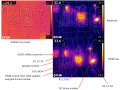
I made temperature rise tests today to see if there were any glaring hot spots using my FLIR C2 camera. Temp rise looks manageable but now I know the hot spots if I go to SMT components. Below are IR shots at ambient with no power applied, at min PWM pulse width, and max PWM pulse width:

1602627161961.png
Thoughts? Comments?

Thanks,

Neko
 

Thread Starter

nekojita

Joined Nov 19, 2010
170
All,

I made temperature rise tests today to see if there were any glaring hot spots using my FLIR C2 camera. Temp rise looks manageable but now I know the hot spots if I go to SMT components. Below are IR shots at ambient with no power applied, at min PWM pulse width, and max PWM pulse width:

View attachment 219532
Thoughts? Comments?

Thanks,

Neko
Hi Danko,

I'm assessing what I can do to reduce parts count and cost for the PWM controller. I simulated your isolated DC- supply and don't get an output- Q1 and Q2 don't seem to oscillate. Attached is the converter pulled fro one of your earlier posts.
Could please take a look to see why there is no output?

Thanks,

Neko
 

Attachments

Thread Starter

nekojita

Joined Nov 19, 2010
170
Hi Danko,

I should have thought of that, thanks. Why can't I simply subtract the 15V from the common I tried this but it didn't work.

Thanks,

Neko
Hi Danko,

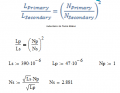
So, the grounding scheme worked, thanks. I would like to find a commercially available transformer for the iso supplies. I spent a lot of time on Digikey and Mouser looking at pulse transformers and can't find a transformer to replace the one that was in one of your earlier posts using your iso supply designs. From what I calculate, the turns ratio needs to be ~ 2.9 from primary to secondary. See calculation below:

1602736191558.png
Could you identify a commercially available transformer that would work for the iso supplies?

Thanks,

Neko
 
Top