Puzzled by opamp behavior

Papabravo

Joined Feb 24, 2006
22,084
I used to have a 'mad' software friend who once opined that: "There's something about every system the sucks!" Maybe it applies to opamps as well.
 

AnalogKid

Joined Aug 1, 2013
12,188
The LM324 and its dual sibling the LM358 were unique and magical devices back in the early 70's. Designed from the ground up to run on a TTL logic power supply at very low power levels, they included some compromises and consequences.

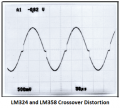
One of the ways power was reduced was by eliminating almost all static current through the output stage. The result is that there is a small signal voltage window when both the upper and lower output transistors are off. That is what you are seeing, zero current into or out of the load because both current paths are off.

Other compromises include a relatively low static current through the input differential pair, causing higher noise and increased harmonic distortion due to non-constant transconductance.

ak
 
Last edited:

Audioguru again

Joined Oct 21, 2019
6,826
The graph in post #5 shows a plus and minus 6V supply and a typical maximum output of 7V p-p which is less than your 53 years old 741 opamp.
The LM324 quad and LM358 dual produce crossover distortion, hiss noise and poor performance above only 2kHz because they are "low power" and are missing the parts needs which use a normal amount of power.
 

Attachments

Thread Starter

ApacheKid

Joined Jan 12, 2015
1,762
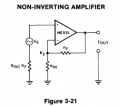
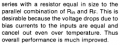
It's just balancing the input bias current. Not exact but it's what we used as the rule of thumb to cancel the imbalance. The op amps with jfet inputs is very low so the resistor is not needed but for a bjt input, and the op amp is not internally compensated (usually listed as "precision op amp), then the resistor is a good idea.

See attached...
This is interesting and lo-and-behold, as I was studying the op-amp chapter in the book Practical Electronics for Inventors, it started to mention this and explained the problem well.

Although I'm not a professional (but did study the subject at college for two years) in my opinion this is a very good book for someone who wants to learn this well without needing a degree in math, a very good book, lots of interesting information and a good complement to AOE.

The title struck me as a bit tacky when I first saw it, but that's misleading, it is a serious book that goes just as deep as AOE but not quite as wide, the title might put some people off taking it too seriously which is a shame.
 

SamR

Joined Mar 19, 2019
5,512
Thanks for reminding me of that book, which I have. Currently working my way through the Texas Instruments Handbook of Operational Amplifier Applications (Rev. B). I'll give the PRACTICAL ELECTRONICS FOR INVENTORS a go when I'm done with it. The TI Handbook is a much better read, for me at least, than Walt Jung's Op Amp Applications Handbook - Walt Jung 2005 - PDF Drive which I also have been looking at. Here is another one you may find interesting OP AMPS Design, Application, and Troubleshooting - PDF Drive. One of the Elsevier Science books.
 
Last edited:

SamR

Joined Mar 19, 2019
5,512
For one thing it is only 94 pages instead of 900+ although I did enjoy reading Walt's history of the op amp going back to the original tube circuits. The TI text is succinct but clear and doesn't "ramble around". Kind of hard to cover differentiator and integrator amps without getting into differential equations due to the dV/dt but they manage to lay it out algebraically. The layout style is also very clear and well-illustrated. Just, to me, it is much easier to read and understand book. The Analog Devices Linear Circuits Design Handbook also looks like a promising good read. More in depth than the TI but well laid out as well albeit another 900+ pages. I like PDF documents, particularly if it is not just a scanned in photo. The PDF reader built into Win 10 Edge browser allows me to highlight and annotate the document as I wish. Something I loathe to do to a book. Even for books I already own, I find it easier for my tired and bad old eyes to read off the monitor than in print and I've built quite a library of PDFs. More than I will probably ever find time to read.
 
Last edited:
Top