Push pull drive question

MrAl

Joined Jun 17, 2014
13,704
MrAl that's right cuz we'd never trust simulator for new design:eek:! Just for studying existing circuits and then only with a grain of salt cuz it doesn't get more real than reality:D

MrAl That's right:)! I use two IR thermometers to make sure transistors stay within 2°C on separate heat sinks:).

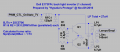
MrAl I'm sry for like just assuming everyone on here has followed all our posts:oops: So anyhow appropriate semiconductors give totally bogus simulation:mad::rolleyes: So HP just humors Ltspice with semis that give faithful results but uses appropriate components in real life circuit. So in the real circuit, diodes in Delon rectifier stage are just 3 series connected 2CLG30kv/20ma rectifiers on each side. FYI here's pic of low power royer circuit which is what circuit of this thread is based on so you can see HP's notes:)

MrAl All I can say is circuit ran all night (10 hrs really) and no shift in BJT parameters so current must be ok?
Hello again,

That's great news !

That means that something we dont see on the schematic must be limiting the base emitter current. I am starting to suspect the coupling factor. Also, the temperature readings sound good too but a current measurement is still in order.

A couple questions:
What kind of diodes are you using on the output circuit for rectification?
What is the average current going to the center tap of the transformer?

There has been a lot of confusion about what was said, what was not said, who was getting "educated" (chuckle) and who was maybe not getting "educated" (bigger chuckle) but i think the main operating character is obvious for this simple circuit. What is not obvious yet is what is limiting the base emitter reverse current, which we all agree is what must also happen or else the diodes blow out.
 
Greetings, @MrAl --- Thanks for your interest...

Assuming @Aleph(0) is correctly prototyping the suggested circuit sans 'enhancements', I can answer your questions pending her reply:

What kind of diodes are you using on the output circuit for rectification?
It's exactly as Aleph explains in post #32 -- to wit:
diodes in Delon rectifier stage are just 3 series connected 2CLG30kv/20ma rectifiers on each side.
Note that attainment of acceptable transient 'immunity' sans external 'sharing' resistors/caps requires 'stacking' the rectifiers to >70kV (hence three 30kV units per 'leg') -- For further component info/context please see my notes on the image attached to said post...

What is the average current going to the center tap of the transformer?
'Idling power': (output ≅ 500uA @50kV {25W}) ≅ 40W input @ 30V -- Hence ≅ 1.3A (62.5% efficiency)
'Full power' (output ≅ 7mA @45kV {315W}) ≅ 450W input @ 30V -- Hence ≅ 15A (70% efficiency)

To be clear: I do not advocate 'serious' application of the circuit in question! - It was/is offered as a very low power EHT source for non-destructive testing of rebuilt LOPTs against flash-over, etc. -- Far superior driver designs include current mode PWM and (variants) upon the (so called) 'Mazilli Royer' topologies (among others) -- That said, I too am interested in this discussion!:cool:

Best regards
HP:)
 

MrAl

Joined Jun 17, 2014
13,704
Greetings, @MrAl --- Thanks for your interest...

Assuming @Aleph(0) is correctly prototyping the suggested circuit sans 'enhancements', I can answer your questions pending her reply:


It's exactly as Aleph explains in post #32 -- to wit:
Note that attainment of acceptable transient 'immunity' sans external 'sharing' resistors/caps requires 'stacking' the rectifiers to >70kV (hence three 30kV units per 'leg') -- For further component info/context please see my notes on the image attached to said post...


'Idling power': (output ≅ 500uA @50kV {25W}) ≅ 40W input @ 30V -- Hence ≅ 1.3A (62.5% efficiency)
'Full power' (output ≅ 7mA @45kV {315W}) ≅ 450W input @ 30V -- Hence ≅ 15A (70% efficiency)

To be clear: I do not advocate 'serious' application of the circuit in question! - It was/is offered as a very low power EHT source for non-destructive testing of rebuilt LOPTs against flash-over, etc. -- Far superior driver designs include current mode PWM and (variants) upon the (so called) 'Mazilli Royer' topologies (among others) -- That said, I too am interested in this discussion!:cool:

Best regards
HP:)
Hi there,

Well thank you for that informative reply there. That is what i believe makes a forum great.
I went back and looked at the post you referred to and yes now i see that there were the 30kv rectifiers being used. I may have overlooked that. The diodes on the schematic had me wondering how it would work at all, the 1N914's (ha ha) as certainly that 914 does not stand for 91.4kv (chuckle).

I also see what you said about some of the 'language' being used, and i agree that some words are best left out of civil discussions unless there is a second hand use of the word and is unavoidable. In fact, some words are considered impolite to use in friendly conversation and especially professional conversation even though they are not considered 'curse' words per se.

So onward with the quest for the absolute best converter circuit :)

I might add one additional little point of view regarding the original question, if it helps. That is, we can regard that feedback winding as a tiny tiny 'battery' that reverses polarity now and then, but more than that, as it is reversing it goes through it's span of voltages which must pass through zero (0v as measured across the WINDING itself, not referenced to ground yet). As the voltage passes through zero in one polarity mode, it goes through the range like 0.1v, 0.2v, 0.3v, etc. There is a little current flowing through both junctions due to the capacitances, but as it gets to around 0.4v one transistor BE diode starts to act as a lower impedance than the other. As the voltage climbs a tiny bit more, the impedance of that one diode gets lower and lower, while the other diode, being reversed biased, continues to be a high impedance. A quick model of this point in time might be a 1k resistor in series with the battery positive terminal and a 1 meg resistor in series with the negative terminal. This means the positive terminal of the battery will be closer to ground and thus the positive end starts to clamp closer to ground, by some 0.5v at that point, while the negative end is free to go down to whatever negative voltage the winding ratio enforces.
I think that 'slow motion' and slow changing bias voltage view shows exactly what happens as the winding starts to switch polarity.
 
Last edited:

Thread Starter

Aleph(0)

Joined Mar 14, 2015
597
Assuming @Aleph(0) is correctly prototyping the suggested circuit sans 'enhancements', I can answer your questions pending her reply:
HP I set circuit up just like you drew it (and also for dual pull up experiments) so your info is right:cool:! But I say if you want to make circuit super safe you should remove resonance capacitor cuz then load > 600uA totally swamps osc out!

I also see what you said about some of the 'language' being used, and i agree that some words are best left out of civil discussions
MrAl You're right but I'm in _house of glass_ to complain cuz of my ribald sense of humor:oops: HP's always saying there's a bar of NaOH soap with my name written all over it:eek:!

For the rest of your post I can say that voltage waveform actually measured at ether base in real world is 53khz moderately distorted sinusoid with swing from about -8v to +0.7v with respect to emitter (which is grounded from perspective of V1 supply):)

I too am interested in this discussion!:cool:
HP Is that roundabout way of saying you don't totally understand either:eek::p?!
 
I say if you want to make circuit super safe you should remove resonance capacitor cuz then load > 600uA totally swamps osc out!
That's not a bad idea - especially as determination of optimal capacitance is highly critical and often accomplished only via rather tedious 'trial and error' --- That said, it bears repeating that while 600uA poses little risk of ventricular fibrillation to a healthy individual, 30 watts is still 30 watts! -- Additionally, there are the 'special' hazards attending RF and charged filters Caps... -- Point being: personal safety is down to technique - as opposed to 'baby proofed'/'crippled' designs! -- The desirability of low power drive in this application concerns mitigation of damage should flash-over occur...

HP Is that roundabout way of saying you don't totally understand either:eek::p?!
Yes and no... I was of the 'stance' that B-E junction avalanche effectively 'grounded' the 'negative end' of the feedback coil while the "pull-up" resistor facilitated startup -- Though I'm (now) intrigued with the observations/assertions of others to the effect that the function of said resistor may be more complex than merely supplying initial bias... Moreover, I suspect feedback current is self-limiting by the nature of the circuit - while I confess to having given little serious thought to the matter such seems reasonable when one considers the implications of junction tfr and trr upon circuit operation (Spec oscillator 'activity') -- An illustration of the operational effects of 'hard' saturation/avalanche may be had by noting the marked 'feebleness' of operation under conditions of very high feedback current (e.g. during non-resonant operation) ...

Very best regards
HP:)
 
Last edited:

MrAl

Joined Jun 17, 2014
13,704
Hi,

It's also interesting that most circuits like this use two resistors one for each base. Using one doesnt seem to throw everything into an unsymmetrical unbalance for this circuit though. I have to wonder if that doesnt have something to do with the particular transistors being used.
What we might do is try some different types of transistors.

Also, i dont think it would hurt to try the real life circuit with two resistors and see if we can find any differences.

Just to note, i've also worked with similar circuits that had two feedback windings instead of just one. One winding per transistor base. That was using higher power transistors though too for more primary current.
 
It's also interesting that most circuits like this use two resistors one for each base.
Indeed - à la many CCFL inverter and 'Defib charger' designs...

Also, i dont think it would hurt to try the real life circuit with two resistors and see if we can find any differences.
We're on it:) -- @Aleph(0) will (may:rolleyes:) be attempting that 'presently' (With reference to post #32 on this thread):cool:

Just to note, i've also worked with similar circuits that had two feedback windings instead of just one. One winding per transistor base. .
Aye! - In my experience, schemes featuring a tapped feedback winding are common (tap to a "B+"/Gnd resistive 'divider' serving as a bias network and each 'end' to the appropriate base) -- Though I'm bound to say I've found such arrangements sorely wanting in the ways of performance and stability...

That was using higher power transistors
FWIW - Truly high power applications (e.g. induction heaters/'furnaces', '10kW+' power converters, etc...) tend to 'favor' the so called 'Mazzilli' (primary derived feedback) topology and its ilk -- which BTW, as a practical matter, seldom operates in 'ZVS mode' -- quite despite the ardent assertions of what a certain, much-maligned, pundit might appropriately term 'low information hobbyists':rolleyes::D

Very best regards
HP:)
 
Last edited:
Around here, it is commonplace to, "rape" a car or appliance
#12 That sounds like dude in this song;) So I know it takes all kinds to make world but I say falling in lust with a car can lead to embarrassing injuries:eek:!

:D
@#12 and @Aleph(0) I couldn't help thinking of your remarks when I saw the following in the "Sheriff's Blotter" column of a local (i.e. 'Arrowhead' Minnesota region) weekly:

The Herald said:
8:45 p.m., Grand Marais: Caller from East Highway 61 said
he believes someone is messing with his car.
Thus it seems 'mechanophilia' is not confined to the South!o_O:D

Sorry! - Just couldn't resist:)
HP:)
 
Last edited:

Thread Starter

Aleph(0)

Joined Mar 14, 2015
597
@Aleph(0) will (may:rolleyes:) be attempting that 'presently' (With reference to post #32 on this thread):cool:
HP I promise to breadboard dual resistor circuits and also @Bordodynov 's circuit so I can post results b4 Wednesday night. Sry for delay:(!

@#12 and @Aleph(0) I couldn't help thinking of your remarks when I saw the following in the "Sheriff's Blotter" column of a local (i.e. 'Arrowhead' Minnesota region) weekly:

Thus it seems 'mechanophilia' is not confined to the South!o_O:D

Sorry! - Just couldn't resist:)
HP:)
HP UR2 funny but I say you should link or post pic of print article cuz _2 funny_ can = _too funny too be believed_;)

One can always depend on females to take any possible sexual interpretation and run it into the ground.
#12 if you like to play identity politics card I say guys are totally more sexually socialized than women! So for examples look at who 99% of pornography is marketed to or at predominantly female imagery in advertising trying to target guys;) Anyhow I say ppl are just ppl and gender politics is a blind alley:rolleyes:
#12 I hope you know I was just joking when I took quote out of context cuz I know you were just explaining colloquial use of word:)
 
HP UR2 funny but I say you should link or post pic of print article cuz _2 funny_ can = _too funny too be believed_;)
Here ya go! :) --- Please scroll down to the last item under 'Nov 8' (right side of page) -- BTW, I accept your pending apology for questioning my veracity!:rolleyes::rolleyes::rolleyes:

One can always depend on females to take any possible sexual interpretation and run it into the ground.
Seems there's plenty of that to go around regardless of gender;) -- For example:
It's just lumens to me. Nobody comes around my house at night because it's the best lit house in a quarter mile radius. The way you describe it, I might be setting the mood for sex???
--Emphasis added--
But then perhaps 'mood' bears a 'narrower' connotation in Dixieland?:D:p

#12 I hope you know I was just joking when I took quote out of context cuz I know you were just explaining colloquial use of word:)
Ditto! -- All's intended in good humor!:):):)

Best regards
HP:cool:
 

Thread Starter

Aleph(0)

Joined Mar 14, 2015
597
Here ya go! :) --- Please scroll down to the last item under 'Nov 8' (right side of page) -- BTW, I accept your pending apology for questioning my veracity!:rolleyes::rolleyes::rolleyes:
Questioning your what:eek::D?!
Sry HP but you set that up cuz it reminded me of Molly Sudgen+Billy Burden exchange from G&F courtroom scene:D! Being serious I didn't doubt you but cuz other ppl might think it was to pat I thought you should cite cuz it's funnier when they know for sure it was really in paper:) HP now I'm asking since when are you reading small town papers? Ha ha! you dare tell me I have too much time on my hands:p

HP I'll be breadboarding Royer circuit like I said above so in meantime I'm asking you to plz trace schematic for ccfl oscillator (like you mentioned earlier on thread) cuz that way ppl will know topology is reliable and accepted:)

PS HP plz really trace it from pcb don't just link example from web cuz actual verified example of working design is incontrovertible:) HP also plz look on EHT thread cuz I'll have request there that would be OT on here:cool:
 
I'm asking you to plz trace schematic for ccfl oscillator (like you mentioned earlier on thread) cuz that way ppl will know topology is reliable and accepted:)

Here's the schematic as traced and re-checked ad infinitum!:rolleyes: -- Note that the principal differences (with reference to the low-power LOPT driver discussed elsewhere on this thread) are merely implementation of dual bias resistors and omission of the collector 'snubbers'... Curiously, contrary to my experience with most circuits of this sort, this design 'modulates' the positive 'rail' (as opposed to the emitter return) --- In any event it would seem the widespread use of the feedback scheme seen here (and, indeed, in every 'oscillatory' CCFL inverter I've encountered) supports my hypothesis that feedback current is self-limited owing to an inversely proportional relationship between oscillator 'activity' and base drive -- That said, I'm maintaining am open mind on the subject!:cool: (post continued below image)

dellFP.png


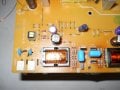
FWIW (little enough, I imagine:oops:o_O) here's an image of the physical circuit...
DellPCB - Copy.JPG
Best regards
HP:)
 
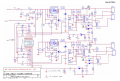
@Aleph(0) et al -- Dig this! - I've found the following manufacturer-published schematic of the circuit partially (and imperfectly:oops:) 'reverse engineered' in post #54 -- 'Affirmation' notwithstanding - I'm bound to say that despite my 'intuitive sense' that feedback current is self limiting in such configurations (as explained elsewhere in this thread) I'd be more comfortable with a quantitative understanding of said (alleged) phenomenon:confused: - Unfortunately certain parameters are unpublished and, hence, unreliably apprehended/modeled...
DellSch.png
Best regards
HP:)
 
Last edited:

MrAl

Joined Jun 17, 2014
13,704
Hello again,

Some interesting circuits given here, thanks for posting them.
I see the dual base resistor scheme being used so i guess there is a preference for that idea.
I also see a smaller primary to bias winding ratio too which reduces available reverse base current. Unfortunately we cant see the second circuit winding ratios.

Aleph:
From what i remember reading years ago, supposedly female and males alike can appreciate the appearance of a female that is considered attractive in society, but only (mostly) females can appreciated the appearance of a male that is considered attractive in society. That is what i always assumed was the reason for the predominance of females in (non nude) advertising.
 
Hello @MrAl -- Many thanks for your continued interest in this matter:)
Unfortunately we cant see the second circuit winding ratios.
Please be advised: The schematics shown in post #54 and post #56 depict the same circuit!:)
--- Having reversed-engineered a small portion the circuit and posted my 'findings' (along with measurements of the inductors, etc) to post #54, I later discovered an 'on-line' resource for the entire, manufacturer supplied, schematic and posted same to #56:)

Best regards
HP:cool:
 
Last edited:

Thread Starter

Aleph(0)

Joined Mar 14, 2015
597
Well....?:rolleyes:

Impatiently taping fingers...
HP;)
HP I'm sry for more delays cuz MMK cap just melted when I was trying twin resistor circuit (which I say wasn't to do with different setup just polyester dielectric isn't suited for resonance cap so it just happened to fail when it did).

Anyhow I'm back to square one with original circuit trying to find right capacitance using MKP and FKP which don't heat at all but finding resonant like you say _sweet spot_ is so hard cuz just close is same performance as way off so there's nothing to go by and value of dead cap is no help ether cuz lower ESR of polypropylene shifts everything:( HP If you have any suggestions I could use the help! So I have tomorrow through weekend free so I'll keep at it:rolleyes:

HP don't you dare try to say I'm just stalling cuz if I was disingenuous puke I could have just made up plausible figures to post! So plz just be patient cuz sometimes conscientious job takes more time when $#!% happens:(!
 
Top