Push button flashing light circuit

Thread Starter

christiannielsen

Joined Jun 30, 2019
389
Thank you for schematic and the two diodes solution.

The LED is going in to a Door bell and it will be illumination 24/7. How long will it last with this circuit compared to a LED driver?
 

AnalogKid

Joined Aug 1, 2013
12,158
I'm confused. If the LED is going to be on "24/7", then what are all of those parts for?

And why do you think you need the expense of an LED driver? With a single LED (of *any* type) and a fixed DC supply, why not just 1 resistor?

ak
 
Last edited:

Thread Starter

christiannielsen

Joined Jun 30, 2019
389
Please read #1 again if you are confused. The circuit will run 24/7... And because the LED only will be OFF for 9 short moments when pushing the button, I consider the LED to be ON 24/7.

The reason why I think I need an LED driver is because I've read that LED Driver will extend the life of the LED. Because the LED is lit 24/7 I expect the load to be more stressful to the LED than if I only turned the circuit on once in a while.
 

sghioto

Joined Dec 31, 2017
8,634
The reason why I think I need an LED driver is because I've read that LED Driver will extend the life of the LED.
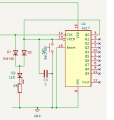
Not in this case as the current required is small. A single resistor R5 to set the brightness level should suffice eliminating RV1 and possibly even Q1 as the 4017 can source over 5 ma at 12 volts.
1698953184475.png
 

AnalogKid

Joined Aug 1, 2013
12,158
The reason why I think I need an LED driver is because I've read that LED Driver will extend the life of the LED.
That may be true for some specific situations, but as a general rule - no. Read the datasheet, operate the part within its forward voltage, reverse voltage, current, and temperature boundaries, and you will get its standard lifetime, which is years. Operate it at less than it's recommended current and the lifetime increases.

ak
 
Last edited:

AnalogKid

Joined Aug 1, 2013
12,158
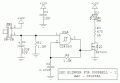
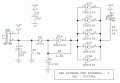
First of three concept schematics. U1 is a quad NAND gate with Schmitt Trigger inputs.

R1-C1 sets the time the LED is blinking. R2-C2 set the blink rate. C3 is the power supply decoupling cap. When C1 is discharged, U1 pin3 is continuously high and the LED is on. When C1 is charged up through SW1, U1A starts to oscillate, periodically turning off Q1 and the LED. The LED blinks as long as the button is held on, and for approx. 10 seconds after the button is released.

ak


LED-Blinker-Doorbell-1-c.gif
 
Last edited:

AnalogKid

Joined Aug 1, 2013
12,158
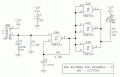
Third concept schematic. By changing to a hex gate, you now have five gates in parallel driving the LED. Since the gates are simple inverters, D2 is added to inhibit the oscillator.

ak

LED-Blinker-Doorbell-3-c.gif
 

AnalogKid

Joined Aug 1, 2013
12,158
Had to add a 5.1v zener though.
That's why I stuck with 400x. My favorite CMOS line is the 74AC variety (+/-24 mA output current), but again, 5 V.

Also, despite what the datasheet says, I've found that HC parts, like 400x parts, are better at sinking current than sourcing.

And speaking of sourcing - the TS wants the LED to be ON continuously between button presses, not off.

crutschow will be happy about R4 being in series with C1.

ak
 
Last edited:

AnalogKid

Joined Aug 1, 2013
12,158
Any small-signal NPN transistor will work in place of the 2N7000. Add a resistor in series with the base, anything in the 2.2K to 7.5K range.

Can you post a link to the datasheet for the LED you want to use?

ak
 

Thread Starter

christiannielsen

Joined Jun 30, 2019
389
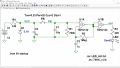
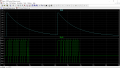
I would love to see a animation/simulation on how the circuit works if anyone has such a program.
I may have to look into what a schmitt trigger is too.

 
Top