PS for 3.7v and 9,216 amps

strantor

Joined Oct 3, 2010
6,875
Thinking aloud, more thinking required, but if the modules are attached to 15mm or 22mm copper pipe which is also used to supply current, and 4608 is 64 x 72 is there a way to have 64 modules connected in parallel and dropping 270V evenly across 72 lines. Water pumped through the pipes takes away the heat to be managed by truck radiator(s) with fan cooling?
 

strantor

Joined Oct 3, 2010
6,875
Re-evaluating this for a grid/array instead of a straight line, and for plate/sheet instead of rectangular copper busbars.

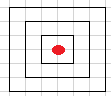
A symmetrical grid would look something like this:


1692989797009.png


I made a new spreadsheet to calculate this.

Some notes on the spreadsheet:
  • Each small square above represents a device drawing 2 amps.
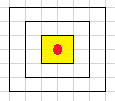
  • Power is injected into the very center.
    1693031459547.png
  • All 9216 amps from all 4608 devices flow through the 4 squares in the very center (the first "shell")
    1693034389358.png
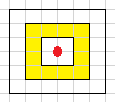
  • The second "shell" carries the current of all devices except the 4 in the center, so 4604 * 2 = 9208 Amps.
    1693034364606.png
    (and so on)
    The further you get from the center, the less current.
  • It does not matter how far you space the devices apart, you get the same voltage drop, because as you increase the distance between them you also proprtionally increase the cross sectional area available for current flow.
    • If the devices are spaced 0.5" apart then the plate will be 2ft 8" x 2ft 8"
    • If the devices are spaced 6" apart then the plate will be 32ft x 32ft
    • In either case:
      • if the plate is 0.25" thick and made of copper, there will be only 0.0156V drop from the center injection point to devices along the outer perimeter and only 137W will be dissipated in the plate
      • if the plate is 0.25" thick and made of steel, there will be only 0.1365V drop from the center injection point to devices along the outer perimeter and only 1,198W will be dissipated in the plate
      • if the plate is 0.0403" thick (18ga / 1.024mm) and made of aluminum, there will be only 0.1495V drop from the center injection point to devices along the outer perimeter and only 1,312W will be dissipated in the plate
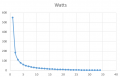
  • The bulk of the voltage drop and watt loss is concentrated at the injection point
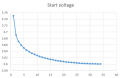
    • The voltage drop tapers off exponentially as you get further from center
      1693033404715.png
    • The difference in watts dissipated is even more dramatic
      1693033454718.png
  • The spreadsheet only calculates one half of the picture; supply, or return, not both.
    • Actually 2 plates would be needed and the voltage drop would double.
    • The plates could be stacked one on top of the other with an insulator in between, and with holes drilled in the top plate to make + and - connections from one side.


The grid situation according my new calculations isn't nearly as dire as the straight line situation. It is so incredibly different that I am actually baffled and questioning if I have made some error in this spreadsheet. But I have gone over it many times and I can't find anything wrong with it. If anyone else can point out an error I would be curious to see what it is.
 
Last edited:

dendad

Joined Feb 20, 2016
4,641
If your "modules" are LEDs, wire a number of them in series and run on higher volts.
Just remember, LEDs are current devices, not voltage so the power supply needs to be a constant current one not constant voltage.
This is a further example of why more details are needed so the power supply design can be worked out.
It is quite intersting how so many times the projects are "secret", but usually quite common in practice.
 
Last edited:

BobTPH

Joined Jun 5, 2013
11,573
If your "modules" are LEDs, wire a number of them in series and run on higher volts.
This is why “secret” projects get such bad advice and usually end in frustration on both sides. I had related the 3.7V to the nominal voltage of Li Ion batteries, but it could just as well be an LED forward voltage.

Since we have no idea what the real problem is, the solutions we propose are likely way off base. If you can’t disclose enough information to suggest solutions, you should not bother asking.
 

BobTPH

Joined Jun 5, 2013
11,573
Just out of curiosity I looked up the wattage needed for LED lighting of a professional football or baseball venue, and 34KW is right in the ballpark. But it is typically divided among 6 or 8 poles with about 5KW each.
 

strantor

Joined Oct 3, 2010
6,875
This is why “secret” projects get such bad advice and usually end in frustration on both sides. I had related the 3.7V to the nominal voltage of Li Ion batteries, but it could just as well be an LED forward voltage.

Since we have no idea what the real problem is, the solutions we propose are likely way off base. If you can’t disclose enough information to suggest solutions, you should not bother asking.
I wish I could give this more than one thumbs up.

If your "modules" are LEDs
Surely not as simple as that? I will be quite disappointed if there is anyone out there who thinks a LED matrix is in any way novel, patentable, or worth obfuscation in the face of people trying to help.
 

BobTPH

Joined Jun 5, 2013
11,573
Surely not as simple as that? I will be quite disappointed if there is anyone out there who thinks a LED matrix is in any way novel, patentable, or worth obfuscation in the face of people trying to help.
Especially if he thinks you power them all in parallel. But I will not be surprised if it turns out to be the case.

When you have what you think is a brilliant innovation, the first thing you need to do is make sure it is not already done. The second thing is to wonder why not.
 

strantor

Joined Oct 3, 2010
6,875
When you have what you think is a brilliant innovation, the first thing you need to do is make sure it is not already done. The second thing is to wonder why not.
Again with valuable pearls of wisdom!

I know exactly what you're talking about, but someone who hasn't spent their entire post-toddler life lying awake at night involuntarily conceiving fantastical "new technologies" might not. So I will spell it out.

When I have "strokes of brilliance," I dig, and what I typically find can be broken down by frequency roughly into the following categories:
  • 30% it was done already 100 years ago and was made obsolete by better technology before I was born.
  • 20% it is already a patented product currently for sale. I just didn't know about it.
  • 5% it's as common as hammers and door stops, everyone is making it, somehow I was oblivious to its existence.
  • 10% it is in development by some company already and I was just a year or two too late.
  • Someone already thought of it 50 years ago but the processes required to make it didn't exist or were cost prohibitive.
    • 7% that is still the case.
    • 3% it seems that is no longer the case, and I can't find any obvious reason why it never got made. May be a viable thing to manufacture now. Danger Will Robinson- you may only be investing money in finding out the not-obvious reason why it wasn't being produced.
  • Someone already thought of it 50 years ago but it failed because there was no market for it.
    • 15% that would probably still be the case.
    • 5% it seems that might no longer be the case, and I can't find any obvious reason why nobody is making it. May be a viable thing to manufacture now. Again, Danger Will Robinson.
  • I actually had a novel idea. It may be worth investing in. It seems obvious and I can't come up with any explanation as to why nobody has done it already.
    • 3% I can't convince myself it will be successful. Either I can't see that there will be a market for it or that I will be able to sell it for more than the cost of making it.
    • 1% I start to go forward with it and find the fly in the ointment along the way.
    • I actually develop a new product that I can sell.
      • 0.66% but it doesn't sell.
      • 0.33% but it DOES sell. This has happened ONE time for me.
There should probably be a bullet in that list for "I find that a patent shark is sitting on it" but that has never actually happened to me.
 
Top