Propagation of a pure electric field

Thread Starter

cbecket13

Joined Nov 15, 2014
106
Well yes, plasma waves (something I deal with daily) can be longitudinal because there is a media (electrons/ions) for them to travel. I think most of us agree in the 21st century that there is no magical aether that EM waves travel in so longitudinal scalar waves are impossible (except in the minds of some Tesla fans). Now c is not a limit for everything electromechanical in Maxwell equations but it is for single interactions. For instance you can change the polarization current density 'as a group' faster than light speed to generate EM waves but the waves themselves can't travel FTL so you generate a electromagnetic shockwave similar to a sonic boom.
http://casa.jlab.org/seminars/2004/slides/singleton_040629.pdf

If this is useful for anything only time will tell.
The qm people definitely do not agree with you that there is no (virtual) ether. What do you think their quantum soup is? Another name to replace a name for the same thing that fell into disrepute. Your statement about the polarized vacuum similarly serves the same function as the ionized plasma, or, if you prefer, the virtual soup. Is it a rationalization, or is your space polarizable or not? If so, it serves the same function as the ionizible plasma. If not, your argument for the vacuum capacitor mechanism collapses. We'll discuss it over a soda on Monday.
 

t_n_k

Joined Mar 6, 2009
5,455
I'm not really moving this to magnetism, which I know would be much worse for all, but take two magnets, put them like pole to like pole and push.

Is there any way, anything I can interpose between them that can eliminate that repulsion ?
Presumably a sufficiently large sheet of highly permeable magnetic material orthogonal to the dominant field. The repulsion would become attraction on either side.
 

nsaspook

Joined Aug 27, 2009
16,503
The qm people definitely do not agree with you that there is no (virtual) ether. What do you think their quantum soup is? Another name to replace a name for the same thing that fell into disrepute. Your statement about the polarized vacuum similarly serves the same function as the ionized plasma, or, if you prefer, the virtual soup. Is it a rationalization, or is your space polarizable or not? If so, it serves the same function as the ionizible plasma. If not, your argument for the vacuum capacitor mechanism collapses. We'll discuss it over a soda on Monday.
They are not words for the same thing. There is a substance of space but it's not some special classical, deterministic luminiferous aether as the original Maxwell era theories used. It's like the name virtual 'particle', there is no particle there, only fields and these fields IMO are the substance of space with matter the excitations of those fields that are not seen as a wave function but are operators that create/annihilate particles. It's not perfect and doesn't explain away everything but it's an insight that makes some thing clearer.
http://theory.caltech.edu/people/jhs/strings/str114.html

Of course I can send energy into a plasma of matter to change its structure , use fields to manipulate and shape the ions in the plasma to form waves, bunches or send then moving into space if needed by creating a field gradient across almost pure vacuum using plates like a capacitor for a voltage potential. In most cases there's no need to get into QM or relativity to explain any of this until the energy gets into the meV range but the corrections for that are simple in the systems I use (Cavity resonator RF Linacs).

From the Aether_theories wiki
So the only similarity of this relativistic aether concept with the classical aether models lies in the presence of physical properties in space. Therefore, as historians such as John Stachel argue, Einstein's views on the "new aether" are not in conflict with his abandonment of the aether in 1905. For, as Einstein himself pointed out, no "substance" and no state of motion can be attributed to that new aether. In addition, Einstein's use of the word "aether" found little support in the scientific community, and played no role in the continuing development of modern physics
 
Last edited:

studiot

Joined Nov 9, 2007
4,998
And my poor vacuum capacitor and spherical plate capacitor continue to languish in neglect. They are like weight and age - nobody wants to talk about them.

Some physics PhD on another forum, I can't really remember where/when said he had absolutely no idea how to calculate capacitance in separated conductive spheres of unequal size and using separation. Is that true? Nobody knows how to do that? Is somebody, somewhere embarrassed about that?
cbecket you are jumping about the subject too much to follow properly.
I have done you the courtesy of answering two of your points directly.
Please return this by addressing my points when you reply and not introducing other material.

As regards your spherical capacitor there is no difficulty here.

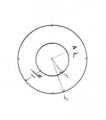
Consider two conductive spherical shells of radius a and b respectively.

spcap1.jpg

Now connect a battery between the two shells to supply charge to each.
The total charge, Q, will distribute itself evenly over the outer surface of the inner sphere and the inner surface of the outer sphere.
The Electric field between the two will be the same as if there was a charge Q located at the centre of the spheres by Maxwell's second equation, also known as Gauss' Law in this case.

This field has radial symmetry and is given by

\({E_r} = \frac{Q}{{4\pi \varepsilon {r^2}}}\)

when a<r<b

This leads to a potential difference, V, between the shells, as the work per unit charge to move a unit charge from radius b to radius a in that electric field.
Note the potential field is a scalar field and the electic field is a vector field.

\(V = - \int\limits_b^a {{E_r}} dr\)

\( = \frac{Q}{{4\pi \varepsilon }}\int\limits_b^a {\frac{{dr}}{{{r^2}}}} = \frac{Q}{{4\pi \varepsilon }}\frac{{b - a}}{{ba}}\)

The total capacitance is then Q/V

\(C = \frac{Q}{V} = 4\pi \varepsilon \frac{{ab}}{{b - a}}\)

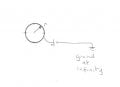
If we now let the outer shell receed to infinity so that b tends to infinity in the above the total capacitance of a single sphere, radius a becomes

\(C = 4\pi \varepsilon a\)

spcap2.jpg

"Applying Faraday's law of induction to plane waves, we find , implying that an electrostatic wave must be purely longitudinal." Wikipedia. I really should stay away from there.
Yes you really should stay away unless you can do vector calculus.

Your conclusion is completely wrong.

That equation says that the cross product of the unit vector k with the Electric field Vector E is a constant times the Magnetic field vector B.

This cross product cannot be in the direction of either k or E, but must be in the direction of B.
k of course cannot be in the direction of either E or B so must be in the direction of propagation.

So this equation quite definitely says that both the electric and magnetic waves are transverse.
 
Last edited:

BR-549

Joined Sep 22, 2013
4,928
Post # 132, 142.

Of course distance will moderate the field.

I believe that if you put two magnets(opposite polarity) between and perpendicular to the first two, the opposing field directly between the two primaries, should be diverted.

The magnetic flow should be orthogonal between all poles.

By varying the secondaries in and out, the field of primaries should vary in magnitude.

Would that work?
 
Last edited:

Thread Starter

cbecket13

Joined Nov 15, 2014
106
Actually, in that instance I was referring to the separated spheres case. I referred to the "shell" type case in the context of the exclusion of a magnetic field. Sorry you went to all that work. I don't see in your post your treatment of the cancellation of the magnetic field issue.

Sophistry is not a substitute for clarity. Nobody picked up my NFC question.

Also, no one has treated the issue of transverse EM wave issuing from (the plane) of a flat conductive plate.
 

studiot

Joined Nov 9, 2007
4,998
Actually, in that instance I was referring to the separated spheres case. I referred to the "shell" type case in the context of the exclusion of a magnetic field. Sorry you went to all that work. I don't see in your post your treatment of the cancellation of the magnetic field issue.
I've had enough messing about.

You very clearly referred to a spherical plate capacitor and I copied that from your post.

Capacitors are not magnetic devices, except unintentionally.
 

Thread Starter

cbecket13

Joined Nov 15, 2014
106
Presumably a sufficiently large sheet of highly permeable magnetic material orthogonal to the dominant field. The repulsion would become attraction on either side.
I believe that is true also. The complication being that the field repulsion is not actually canceled, but rather the field lines (hoping that terminology is correct) are diverted and take the easier path, passing through the high permeability material.

What I guess I was getting at was the question of whether or not there is an analogous "shielding" problem between the capacitor plates.
 

Thread Starter

cbecket13

Joined Nov 15, 2014
106
I guess nobody sees what I'm getting at, or have given up on it, which is fine. What I am trying to understand and which no one has yet to illuminate (or should I say everyone has illuminated with different explanations) is an understandable "how" to the action between and including capacitor plates. That may be my fault, I accept that.

Let me try another way.

Suppose I have a giant closed-end syringe in outer space (vacuum). The syringe starts out pushed all the way in, for example in the zero volume enclosed state. Let's make the syringe plate and its body conductive, but not actively charged, although I'm not sure it matters. The end which would usually be used for the hypodermic to draw and inject fluid is closed as a flat plate.

The plunger head is also a flat plate and they begin in contact with no volume in the gap between them (plunger pushed all the way in). The "seal" between the plunger plate and the tube body is so tight that absolutely nothing can enter or exit through that interface. At the same time the interface is frictionless.

I have a motive engine that has sufficient power to fill and evacuate the syringe. Now I begin to draw out the plunger plate of the syringe. Will my action be impeded or encouraged (or neither) by the developing "vacuum" within the syringe? If additional "vacuum" appears in the gap, how did it get there? How does the problem change (if at all), if I make the tube and the plunger rod non-conductive and the two plates conductive?

Let's exclude external current being applied to the plates, forming an effective capacitor, for now.
 
Last edited:

nsaspook

Joined Aug 27, 2009
16,503
I have a motive engine that has sufficient power to fill and evacuate the syringe. Now I begin to draw out the plunger plate of the syringe. Will my action be impeded or encouraged (or neither) by the developing "vacuum" within the syringe? If additional "vacuum" appears in the gap, how did it get there? How does the problem change (if at all), if I make the tube and the plunger rod non-conductive and the two plates conductive?
Have you had any formal education in vacuum (space void of matter) technology and principles?
 

Thread Starter

cbecket13

Joined Nov 15, 2014
106
Have you had any formal education in vacuum (space void of matter) technology and principles?
You are very polite, but no, I have not. As I said early on, think of me as having just squeaked by in "Physics 101 for Business Majors." I appear to have some talent in stimulating discussion, however. That is a heretofore undiscovered facility, apparently. I have found your posts quite enjoyable, incidentely.
 

Thread Starter

cbecket13

Joined Nov 15, 2014
106
You are very polite, but no, I have not. As I said early on, think of me as having just squeaked by in "Physics 101 for Business Majors." I appear to have some talent in stimulating discussion, however. That is a heretofore undiscovered facility, apparently. I have found your posts quite enjoyable, incidentely.
But I am familiar with the Casimir effect, if that counts for anything.
 

nsaspook

Joined Aug 27, 2009
16,503
You are very polite, but no, I have not. As I said early on, think of me as having just squeaked by in "Physics 101 for Business Majors." I appear to have some talent in stimulating discussion, however. That is a heretofore undiscovered facility, apparently. I have found your posts quite enjoyable, incidentely.
Thanks, talking to you and drinking gin both make me light-headed. Enjoy the holiday.
 

t_n_k

Joined Mar 6, 2009
5,455
I believe that is true also. The complication being that the field repulsion is not actually canceled, but rather the field lines (hoping that terminology is correct) are diverted and take the easier path, passing through the high permeability material.

What I guess I was getting at was the question of whether or not there is an analogous "shielding" problem between the capacitor plates.
Perhaps Kelvin's guard ring capacitor might be a useful starting point.
As a fascinating aside it appears the ground placements have no effect on the capacitance value for the aforementioned device - notwithstanding the variation in the field profile created among the various electrodes in relation to actual ground points.
 

Thread Starter

cbecket13

Joined Nov 15, 2014
106
Perhaps Kelvin's guard ring capacitor might be a useful starting point.
As a fascinating aside it appears the ground placements have no effect on the capacitance value for the aforementioned device - notwithstanding the variation in the field profile created among the various electrodes in relation to actual ground points.
Here's a basic schematic and some background on Kelvin's guard ring capacitor, if, like me you are unfamiliar with the concept. At least one person out there will be thankful it didn't pop up on Wikipedia (at least initially).
http://caxapa.ru/thumbs/455452/Multi-terminal_capacitor_sensors.pdf
 
Thread starter Similar threads Forum Replies Date
A General Electronics Chat 9
Top