Project help: Metronome with 555 timer and screen display

MrChips

Joined Oct 2, 2009
34,829
Ah so! This is not for a music metronome.
Therefore I would not include the CD4017 part. I will alter my design to run on a 3V button cell.
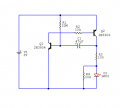
Also, there is a simple circuit that uses only two transistors.
This is the basic circuit. R1 and C1 will have to be changed for your bpm range.
1742505454328.png
 

Tonyr1084

Joined Sep 24, 2015
9,744
Still not certain of how loud the - um - beep - needs to be. Is it a beep as produced as a tone or is it a click or tick or a clang of something? If it is going to be a speaker (not for underwater use) then how big is it? How much power does it require to make a suitable volume click or beep? Do you have a beeper? Would you be building one?
 

Thread Starter

Kypping

Joined Mar 19, 2025
5
Still not certain of how loud the - um - beep - needs to be. Is it a beep as produced as a tone or is it a click or tick or a clang of something? If it is going to be a speaker (not for underwater use) then how big is it? How much power does it require to make a suitable volume click or beep? Do you have a beeper? Would you be building one?
Volume would be relatively low. My intent is to mount it on a headband or something similar so it would be right next to my head/ear and relatively easy to hear at low volume.

Beep type I was thinking something similar to the tone you hear on a pulse / heart rate monitor in a hospital. Nothing to offensive / high pitch.

Beeper wise I hadn't narrowed it down. Figured with it being lower volume it could be encased in the 3d printed housing and thus protected from the elements / water.
 

Thread Starter

Kypping

Joined Mar 19, 2025
5
Ah so! This is not for a music metronome.
Therefore I would not include the CD4017 part. I will alter my design to run on a 3V button cell.
Also, there is a simple circuit that uses only two transistors.
This is the basic circuit. R1 and C1 will have to be changed for your bpm range.

View attachment 345033
yeah, apologies. I could have been clearer in my initial overview. Didn't realise you guys would get right into the nitty gritty!
 

Ya’akov

Joined Jan 27, 2019
10,244
Welcome to AAC.

For running cadence a thought strikes me. If you do use an MCU, you could include an IMU (Inertial Measurement Unit) which is the thing you find in a smart phone or watch to, among other things, track steps.

You could then have one tone indicating the cadence, and a different pitch indicating footfalls. When the two tones were in sync, it would mean you were hitting the target cadence. Alternatively, an unsync'd cadence would have one pitch and it would change to another when sync'd.

Building with discerete components is could be a good exercise—but the project itself really calls for an MCU, no matter how complex you want to make it.
 

Tonyr1084

Joined Sep 24, 2015
9,744
My intent is to mount it on a headband or something similar so it would be right next to my head/ear and relatively easy to hear at low volume.
Beep type I was thinking something similar to the tone you hear on a pulse / heart rate monitor in a hospital. Nothing to offensive / high pitch.
Beeper wise I hadn't narrowed it down.
This helps a lot. Thanks for the answer.
So you want a sharp brief tone, not loud, just a presence you can hear without it disturbing your sleep. Will have to think on that part for a bit. But it sounds like something DC powered and only powered for maybe 10mS (Milli-Seconds), maybe a little longer but probably not much longer. To say the least - short. Very short.
My intent is to mount it on a headband or something similar so it would be right next to my head/ear and relatively easy to hear at low volume. • • • Figured with it being lower volume it could be encased in the 3d printed housing and thus protected from the elements / water.
Edited your comment about protecting it from the elements and it being on your head. That's going to be the hard part, making it small enough to wear on your head next to your ear. Small battery, small circuitry, protected from the elements.

Going back to the piezo - that'll produce a click that's not loud but easily enough heard. For sure the electronics are going to have to be small SMD components. (SMD = Surface Mounted Device). Going to have to think about this one a bit. Perhaps an MCU might be the better approach. But programming and using a very small variable resistor (Pot) is something beyond my knowledge. Think I've done all I can. Stepping out for a bit. May have some input later.
 

AnalogKid

Joined Aug 1, 2013
12,145
An integrated piezo beeper, the kind with a built-in oscillator, takes a while to start making a tone after DC is applied. "a while" is only a few milliseconds, so this is not a problem for a microwave oven telling you the coffee is warm; but might be one as the beep time gets shorter. One solution for this is to go back to a bare piezo element and drive it with a gated oscillator. One possible drawback is that an integrated beeper drives the piezo element at its resonant frequency so you get maximum loudness with minimum size and current.

In this application, driving an bare element with something near its resonant frequency should be good enough. The circuit in #18 can do this by making the B gate another oscillator circuit, gated on and off by the A gate.

ak
 
Top