Project help: Metronome with 555 timer and screen display

Thread Starter

Kypping

Joined Mar 19, 2025
5
Hi All,

New to the forum and circuits in general. I've been working through various tutorials with Arduino / bread boards etc. but would like to progress to my own project and looking for some guidance.

Project Details:
  1. Design a metronome circuit with variable beep/tick rate (bpm). bpm Adjusted with buttons (up/down) or potentiometer and a power button
  2. A further goal would be to add a small screen to display the bpm
  3. I'd like to establish the circuit and move to PCB design to produced a small (watch size pcb)
  4. I'll then design and 3d print housing for the PCB

This is a very high level summary but does it seem reasonable?...particularly the intended size being fairly small.

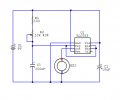
From what I have read / watched it looks like the circuit can be achieved with a 555 timer, buzzer, resistors x2 , capacitors x2, buttons x3 and a screen however I'm struggling to put it together.

I achieved the design with an arduino (no screen) and code but thinking that might make the overall pcb larger than required. Would like to do it with no code if possible.

Generally just looking for some guidance on the initial design and any resources that are relevant to my particular project. Searching for buzzer related examples brings up a whole host of resources that are less relevant to my design. I expect spending more time on learning 555 timer will be the way to go but any guidance would be welcomed.

Thanks
Kip
 
Without MCU to set the timing (bpm) with buttons, not a pot, you need a counter IC + R2R DigitalToAnalog converter or something similar.

Btw, if you plan to involve a display to project you will need to use MCU anyway, without MCU would be true challenge, so why bother with 555?

The PCB size with Mcu will be certainly smaller.
 

Thread Starter

Kypping

Joined Mar 19, 2025
5
Hi Michal,

Thanks for the info.

Lack of an MCU is all due to my lack of experience to be honest so this is exactly the type of comment I am looking for to better understand how I can work towards this goal.

Thank you!
 

Tonyr1084

Joined Sep 24, 2015
9,744
The following is being un-recommended after I drew out a drawing and saw my error. This can be ignored.

Formulating an idea now. Quad 2 Input NAND gate. Two gates (gates A & B) to form a clock pulse, a couple diodes, a fixed resistor, a variable resistor and a capacitor. That clock pulse should be high for the length of the beep. The variable resistor controls how long between the beeps.

The other two gates (gates C & D) do this: Gate C has one of the inputs held high. The other input is the clock pulse. When the clock pulse (short as it is) goes high - gate C outputs a logic low. Gate D, both inputs tied to gate C output inverts the signal to a logic high.

This will result in an intermittent high pulse the length of the clock pulse and remain silent during the period between clock pulses. However, you haven't told us what you're using for the beep. Depending on your answer, more circuitry may be necessary.

Here's how this works: The first two gates form the clock pulse. That pulse goes to the third gate which goes low only when both its inputs are high. When both inputs are high (during the clock pulse) the output goes low. This needs to be inverted, so the last gate functions as an inverter. The timing you wish will determine the components to be used. And if the beeper or buzzer you choose draws more current than the gates are able to deliver then you'll need a transistor or FET to control the beeping device.
 
Last edited:

Tonyr1084

Joined Sep 24, 2015
9,744
I agree.

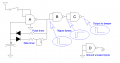
Here's my version of using a dedicated chip to drive your beeper:
Screenshot 2025-03-20 at 9.05.40 AM.png
The moment you switch it on you get a short high pulse. The duration of that short high pulse is set by the Pulse Timer resistor, diode and cap. Once the cap reaches a charge level gate A will change state and will output a logic low, which then drains the cap through a limiting resistor and a pot. The pot controls how long it takes to drain the cap, thus giving you the period of time between pulses. Each pulse will remain constant, to whatever period you set it to in the Pulse Timer circuit. Gate B cleans up the output from gate A and inverts the signal, giving you a logic low for the beep period and then go high for the rate timer circuit. This would mean your beeper would be on for the long haul and only off for a short period of time. You don't want that. That's what gate C fixes - it inverts that signal and then can be used to drive your beeper circuit. Gate D is unused and the inputs should be grounded (or held high - doesn't matter). The output should remain open or tied to ground through a very high value resistor. But even that wastes power. I'd prefer to leave it open. That way regardless of its state no current is flowing.

Voltages and component values are all left blank because we don't know how long you want the beep to occur or how frequently it occurs. We also don't know how much current your beeper is going to consume, so it's likely you'll need more circuitry on the output to handle a higher current than what the gates can source or sink.
 

AnalogKid

Joined Aug 1, 2013
12,045
Tony, you can get rid of the two diodes if you configure the circuit to be a standard symmetrical square wave oscillator (A) followed by a differentiator between B and C. The net change is minus two diodes, plus one small capacitor. With this change, the two sets of timing components can be scaled independently, making it easier to find a fit with parts you already have.

You can parallel C and D for more current into the beeper.

You don't show it but he IC must have hysteresis, such as a CD4093.

AND - Reference Designators - !

ak
 

AnalogKid

Joined Aug 1, 2013
12,045
And another thing - consider a sounder device that does not have a specific tone. A metronome should be a click, not a beep. One way to do this is to change from a piezo beeper (the kind with a built-in oscillator) to a bare piezo element.

ak
 

Tonyr1084

Joined Sep 24, 2015
9,744
Tony, you can get rid of the two diodes if you configure the circuit to be a standard symmetrical square wave oscillator (A) followed by a differentiator between B and C. The net change is minus two diodes, plus one small capacitor. With this change, the two sets of timing components can be scaled independently, making it easier to find a fit with parts you already have.
I'm not familiar with that arrangement. Went with what I know. But independent timing sounds appealing.
You can parallel C and D for more current into the beeper.
Yeah, I thought of that. But without knowing the current requirements - it went the way it did.
You don't show it but he IC must have hysteresis, such as a CD4093.
Can't think of everything. That's why this website is so good.
AND - Reference Designators - !
This is how I think in terms of logic. Knowing what's going on at a given point helps me keep track of what I am trying to accomplish. They're unconventional, but they work for me. A Truth Table is harder to visualize, at least for me it is. And making wave forms for all nodes would be more time consuming.
 

Tonyr1084

Joined Sep 24, 2015
9,744
consider a sounder device that does not have a specific tone. A metronome should be a click, not a beep. One way to do this is to change from a piezo beeper (the kind with a built-in oscillator) to a bare piezo element.
That I didn't think of. But then you need to discharge it between clicks. No ? ? ? And if you alternate its input between C & D then you get a click when C goes high and D goes low, then another click when C goes low and D goes high.
 

AnalogKid

Joined Aug 1, 2013
12,045
AND - Reference Designators - !
This is how I think in terms of logic. Knowing what's going on at a given point helps me keep track of what I am trying to accomplish. They're unconventional, but they work for me. A Truth Table is harder to visualize, at least for me it is. And making wave forms for all nodes would be more time consuming.
Not sure what you are referring to. I'm suggesting that you add a unique reference designator to each component (R1, C2, etc.), not just the gates. Even without component values they make a huge difference is discussing how a circuit functions, where to make measurements or changes, etc.

ak
 
Last edited:

Tonyr1084

Joined Sep 24, 2015
9,744
Not sure what you are referring to. I'm suggesting that you add a unique reference designator to each component (R1, C2, etc.) Even without component values they make a huge difference is discussing how a circuit functions, where to make measurements or changes, etc.
OK, yes, now I follow you. Thought you were referring to the snippets of wave forms at various locations.
That is done by the driver when the pulse returns to 0 V.
Showing my age. Forgot that part. Yup! Will work that way. Thanks again for keeping me honest.
 

Tonyr1084

Joined Sep 24, 2015
9,744
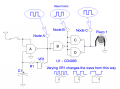
As per input from other AAC Members:
Screenshot 2025-03-20 at 11.37.49 AM.png
Node A may not be as clean as desired. U1B cleans up the clock and inverts it. U1C & U1D (in parallel with each other) inverts the signal again, though this might not be necessary. It's possible in this configuration to parallel B, C & D since the wave form is symmetrical. Paralleling the three remaining gates will have more current capability than just one gate or two gates paralleled.
 

Tonyr1084

Joined Sep 24, 2015
9,744
OK, I DO have other things to do, so this is my last entry until maybe tonight. Or earlier - who knows?!
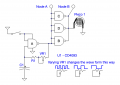
Screenshot 2025-03-20 at 11.46.18 AM.png
B, C & D are paralleled. I think this will work. But again, we still don't know the TS wattage requirements. Wattage is also known as "power". Power (or watts) is calculated by multiplying voltage times amperage. Another unknown is the timing period the TS seeks.
 

Thread Starter

Kypping

Joined Mar 19, 2025
5
OK, I DO have other things to do, so this is my last entry until maybe tonight. Or earlier - who knows?!
View attachment 345027
B, C & D are paralleled. I think this will work. But again, we still don't know the TS wattage requirements. Wattage is also known as "power". Power (or watts) is calculated by multiplying voltage times amperage. Another unknown is the timing period the TS seeks.
I have to say....i am blown away by the level of engagement and input from everyone. This is amazing. I've just caught up with most of the posts and have alot to digest.

@Tonyr1084 thanks for the welcome and the numerous posts/edits. Super helpful.

You asked about intended use in an earlier post. In short, I'll be using it as a metronome/timer for steps per minute (runnning/walking cadence)...possibly swimming strokes per minute but waterproofing is a stretch goal. Basically a beeper for run cadence (roughly 140-180bpm) and swim stroke rate (1-80bpm). There are existing alternative methods to track this...watches etc. but I like to tinker.

In terms of power I'd like to use a coin cell battery so relatively low voltage. Beeping would be on for the duration of the exercise session.

Thanks again for all of the input. I hadn't expected such a flurry of responses and perspectives on how to approach it.

AAC is awesome
 
Top