Production Counter - Project Help

Thread Starter

mischa_lyons

Joined Jul 14, 2017
2
Hi Everyone!

First post here so I have read through the rules and done a search but have come up empty.

So I need to make a production counter for a project at work. I have not had any luck finding anything off the shelve as most of these are either two big or just a simple counter and lack the 'target' and 'efficiency' segments.

So first off what my goal is. I need to make a Production Counter. My idea is to have 2 rows of 3x 7 segment led displays.


The first will display the 'Target' (Adjustable value) per hour the second the 'Actual' (measured value) per hour these will me measuring the input on a industrial chest ironer and folder, the signal is coming from a PLC providing a 24vdc pulse signal.

Additional I need 3 outputs that will be activated as below. These will control indicated led's for a quick visual indication of efficiency.
- If the productivity is under 60%
- If the productivity is under 80%
- If the productivity is upper 80%

Now my basic understanding of electronics I can make a 7 segment led count that's no problem. I just need ideas on how to get them to display a average based on say a sample of the clock input? Then also get 3 outputs based the difference when comparing the target and actual values.

Advance thank you and I hope I have explained myself well enough!
 

wayneh

Joined Sep 9, 2010
18,091
Let's suppose for a moment that the electronics are all working as intended. Assume success. Your needs don't sound too complex, so I think it's a fair assumption.

You have continuous data coming in from each machine, a pulse of some kind indicating completion of another cycle. How do you want to process that data? You could react as quickly as once each cycle or as slowly as, for instance, a daily moving average.

Personally, I would use data acquisition hardware to watch my machines and pull all the data into Excel or other software to process the data and produce color-coded rankings, alerts, alarms, whatever you want. If your process is under control, you want to establish what your ±2 standard deviation control limits are and look for assignable causes for any machine that is an outlier.

Most data acquisition equipment also has outputs, so that you could control LEDs or alarms or whatever from your computer.
 

BR-549

Joined Sep 22, 2013
4,928
Not too sure if I got it. But if I do......counting the requested cycles.....instead of the completed cycles.....is going to mess your efficiency numbers up. I'm assuming you want to count the number of completed cycles, per unit of time. And use that for your speed number. You need to know when the iron presser has finished a cycle.
 
Whatever you want to count and however you want to count it yiou are probably best getting the PLC to do it and then reading the data you want to display from the PLC.

I cant comment on the accuricy of data or even its usefulness but reading pulses and displaying data isnt hard, particularly if you have a PLC in thr mix to start with.

What PLC is it?
Is there an HMI to interact with it?
Are there any spare outputs and or data connections?
Whats your budget?

Of course you could use a cheap microprocessor, Arduino / Pic / PI and probably many more.
You could use a second PLC, perhaps with a Modbus display module.
You could even use a guy with a clicker and a blackboard...

There will literally be 10's if not hundreds of ways to do what you want and if budget is a concirn then look at the display first...
One display that shows all the figures in sucsession will be much cheaper than 2 or 3 displays.
Using a serial display RS232 or RS485 will be easier and probably controllable from most modern PLC's, possibly the ones you have running the machine now.

Happy to help with details if you can give some...

Al
 

AnalogKid

Joined Aug 1, 2013
12,071
When you start into storing or comparing multi-digit numbers, a uC qickly rises to the top. It can be done in all hardware, but you're probably looking at a dozen chips or more. Part of the problem are the comparisons / level testing; upi can't use integrated multi-digit counters because you can't get at the internal binary numbers.

ak
 

strantor

Joined Oct 3, 2010
6,875
Since you've already got a PLC in the mix, use it. It can do the math easily. Then you just need a display. Several options for display if you use serial output. Connected PC displays value, HMI displays value, LED panel (ex red lion) displays value, etc.
 

Thread Starter

mischa_lyons

Joined Jul 14, 2017
2
Thanks for all the reply's guys! I'm not going to pretend to understand all of it. :p

I don't think I gave a good enough description of what I wanted to do so here is a bit more info.

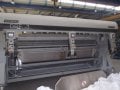
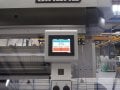
Below is a picture of the DRF that has 3 loader stations with counters on each. The operators load sheets into the clamps on each loader station, when the clamps rise up with the sheet a 24vdc signal is produced. This is the signal I want to count on each individual station. This is a new model pictured with a different PLC (B&R Automation) and we cannot use these displays with the old PLC (Schneider PLC). We also prefer not to touch the existing PLC. The only thing I want to touch existing to the machine is the 24vdc signal.

P7210022.jpg P7210009.jpg

Price is not really a massive concern, these machines are worth quite a bit. A individual micro controller at each loader with its own LCD would not be a bad way of doing it, I just have never done much more then much around with a Pi haha. The programming is were I would have to learn, but this is just a side project really as the customer is buying the above machine with the new displays and wants them on his old one to.

Sorry about the slow reply. Work is killing me and I have very little time to work on this but though a post on here was a good start. :)
 

JohnInTX

Joined Jun 26, 2012
4,787
For a few pieces in industrial environments, I kind of like off-the-shelf industrial terminals. Lots of outfits make them but I've used Two Tech and found them to be pretty bulletproof. You get a library of routines that you use to program in C (or 2BASIC, they say!). The nice thing is you don't have to beat yourself up designing industrial-quality hardware for a small qty install. Here's an example:
http://www.2t.com/psmt.asp
Spec sheet:
http://www.2t.com/pdfs/PSMT.pdf

What you are asking is not a big deal software-wise but if you roll your own, you still need to fully engineer the hardware, debug it, build and support it, do compliance etc..

Just my .02
 
Top