Problems understanding Hot, Neutral and Ground in AC circuits

Thread Starter

PauloConstantino

Joined Jun 23, 2016
266
When I was about 13 my dad decided to take an old washing machine motor and turn it into a lawn mower. His home made mower had no ground circuit. Whenever I cut the grass - if I were bare foot I could feel a definite tingle through my hands and my feet.

Back in the 80's I was working for a company that made Oil Well Drilling Electronics. One of the projects we were working on was a Porosity tool. It had a special chip that operated at giga hertz range. When the board was tested it tested fine. When it was installed into the module it failed. The question was perplexing to the engineers. It was by accident that one afternoon I happened to have my hand on the module (a very large steel drilling collar) and happened to be touching one of the rivets on a power strip. I noticed a charge. When measured the voltage was about 65 volts. That meant that when the operator put the soldering iron to the board - the iron was properly grounded and so was the module, but the power cord the work station was plugged into had a faulty ground. The grounded soldering iron completed a circuit to ground and was blowing out the chip.

When one source is properly grounded and the end user (soldering iron, work station) are not - things start to go wrong. They had computers and all kinds of monitoring devices hooked up trying to determine the failure mode. Discovery of the live current by accident actually solved the mystery.

Can you get a shock from an improperly grounded appliance? Yes. Stray voltage wants to go somewhere; and it will follow the path of least resistance.

In your illustration, yes, you will read voltages at all points shown. Voltages will be different at different distances and moisture and mineral content. However, I find it hard to believe that 5,000 miles away you'll be able to pick up any sign of that particular circuit. You may find voltages from other sources. Static voltages can be in some surprising places. And if you've ever studied lightning strikes you may be aware that there are several tendrils of electricity reaching down while at the same time several more reaching up. When one meets - THAT becomes the path of least resistance to ground (earth). Still, if you happen to be caught in one of the tendrils that don't complete the circuit you can still get a serious hit by the lightning. Many people who've been hit by lightning and survived have been struck by this very form of it.

But lets keep it simple. Grounding the generator AND grounding the appliance means if there's a voltage leakage (or a bare wire comes in contact with the casing) the voltage will flow through ground - not you. And hopefully pop the breaker.

Yes, ground and neutral are the same thing. Only, neutral is the intended return circuit. Ground is there as a back up plan.

Thank you Tony. That is greatly appreciated.
 

Thread Starter

PauloConstantino

Joined Jun 23, 2016
266
I think that if you can't explain something so that a child can understand, you don't really understand it.

This thread has had 84 replies now, and I still don't understand what is happening.

Someone has said this:

"A neutral conductor is a conductor that USUALLY and NORMALLY has no potential or voltage on it. We took the potential off of it by grounding it"


What I don't see is, what does it even mean to "remove" the potential from the neutral wire by grounding it?? if you physically bury the wire 10 metres deep inside the earth, what effect will that have on the voltage in relation to the hot wire as opposed to the case where you DIDN'T bury the wire into the ground and never bothered to ground anything ? Come on someone explain this to me in a correct logical way without going about transformers or how it works in your country. I want to know the theory.

I am a mathematician and mathematicians are not practical, we are theoretical. I want to know what happens to the electrons, to the charge ad to the voltage on both wires as soon as you ground one of them... That's what I need to know. Please!
 

be80be

Joined Jul 5, 2008
2,395
A good ground is 5 to 10 ohm's . You could scale this down and play with the idea.
Get a big tub fill with dirt get two transformers one line voltage to 24 volt one 24 to 2 tap at 12 volts and test it out.
You could test soil of different kinds but you need to still be careful.
 

be80be

Joined Jul 5, 2008
2,395
"A neutral conductor is a conductor that USUALLY and NORMALLY has no potential or voltage on it. We took the potential off of it by grounding it"
There is a lot left out here some grounds are not good and you can become a better ground but that's in a live circuit.
In a city you have 1000's of grounds I fixed a house not to long ago that anything metal would knock you on your butt if you touched it and don't take a shower. the plumber had changed the water line that came into the house to pvc pipe it was the only ground in the house the old transformer at the pole had lost grounding of the neutral this gave the metal that was tied to ground up to 90 volts.
A good ground works because it has low resistance so even with the neutral being grounded if you can be less resistance you will get shocked
things like that happen when there is improper grounding.
 
Honestly, you have to start completely over. Electron flow in a wire analogy breaks down pretty quick. The water analogy help to understand voltage, current and resistance and that's about all.

It's actually the flow of charge. Ben Franklin got something wrong and we never re-wrote history (see conventional current/electron current).

One time we can actually talk about electrons is in say an electron beam in a vacuum.
The do get emitted by heating a material, they can get focused and accelerated.

Your intent is to define electricity at too low of a level.

Loose the concept of circulating electrons:

See https://en.wikipedia.org/wiki/Charge_carrier
 
I can and have, waved a wire in the air an generated a current. Why? Physics? Why does it happen?

Do people, in general, have to worry about it? No. Did I have to worry about in my work? Yes.
 

Thread Starter

PauloConstantino

Joined Jun 23, 2016
266
Honestly, you have to start completely over. Electron flow in a wire analogy breaks down pretty quick. The water analogy help to understand voltage, current and resistance and that's about all.

It's actually the flow of charge. Ben Franklin got something wrong and we never re-wrote history (see conventional current/electron current).

One time we can actually talk about electrons is in say an electron beam in a vacuum.
The do get emitted by heating a material, they can get focused and accelerated.

Your intent is to define electricity at too low of a level.

Loose the concept of circulating electrons:

See https://en.wikipedia.org/wiki/Charge_carrier


Tell me where my diagram breaks down? The flow of electrons is equivalent to a flow of positive charge, so I don't see how that can be wrong?

I drew a picture of what I understand and I really need someone to analyse it and tell me what they think.
 

tranzz4md

Joined Apr 10, 2015
315
I'm sure Crutchow is either checked out, or laughing as hard as myself. Go to his first couple reply posts, and THINK about what he said.

My only additional comment regards the current policy of the CMPs of the NFPA: the term "Neutral" has been entirely and absolutely replaced by "grounded conductor" (and that is NOT "grounding" or "ground" conductor).
 

Thread Starter

PauloConstantino

Joined Jun 23, 2016
266
It breaks down because the charge on an electron is negative:

https://en.wikipedia.org/wiki/Electron
I think you are not getting it this time :p An electron moved one way is equivalent to a proton moving the opposite way.
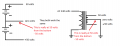
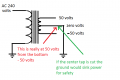
Nevermind.

Can you answer me this?

If I take a DC battery now, not connected to anything but two wires on its ends, can I say that one of the wires has more electrons than the other wire ?
 

be80be

Joined Jul 5, 2008
2,395
This is it in a nutshell
power1.png
power2.png
If the op reads this its good stuff.
The metallic body in the earth is often referred to as an electrode even though it may be a water-pipe system, buried strips or plates, or wires. Such combinations of metallic bodies are called a grid. The earth resistance we’re concerned with is the resistance to current from the electrode into the surrounding earth. To appreciate why earth resistance must be low, you need only use Ohm’s Law: E = R x I where E is volts; R, the resistance in ohms; and I, the current in amperes. Assume that you have a 4000-V supply (2300 V to ground) with a resistance of 13 Ω (see Fig. 7). Now, assume that an exposed wire in this system touches a motor frame that is connected to a grounding system which has a 10-ohm resistance to earth. By Ohm’s Law, there will be a current of 100 A5 through the fault (from the motor frame to the earth). If you happen to touch the motor frame and are grounded solidly to earth, (by standing in a puddle) you could be subjected to 1000 V (10 Ω x 100 A). As you’ll note from point 2 in the following, this may be more than enough to kill you instantly. If, however, the earth resistance is less than 1 Ω, the shock you’d get would be under 100 V (1 x 100) and you’d probably live to correct the fault.
link to pdf http://www.weschler.com/_upload/sitepdfs/techref/gettingdowntoearth.pdf
 
Last edited:
Be80Be:

I think the TS from the other side of the pond where distribution is less complicated than in the US.

Distribution of AC power is a whole nother ball game.

For a first order, take on residential distribution you want:

The plumbing and gas fixtures in your house to be at the Earth's potential.
You want a single point to handle fault currents.
You want a single point ground/Neutral reference.
You want your TV, cable and Telephone to reference the same point.

Some systems in the US actually have two different grounds. One a reference and one safety. We're not considering swimming pools, sub-panels, hospitals and radio transmitters here or power in different buildings.
 

wayneh

Joined Sep 9, 2010
18,121
I have drawn this picture... Can anyone tell me if this is the actual reason why the Neutral wire is neutral?
No, it isn't, if I read your diagram correctly. You are showing a flow of current to ground, and none is required. The EMF that generates power to move current around is between the two poles of the generator, not between one to the other and ground.

Before the neutral is connected to ground, it's identical to the hot wire, but of course opposite polarity at any moment. Once it's connected to ground just as we are, we label it neutral because there is still no (or little) EMF to drive current from it through our bodies. If we touch the other wire, we get zapped!
 
Top