Problems understanding Hot, Neutral and Ground in AC circuits

BobaMosfet

Joined Jul 1, 2009
2,211
Dear all,

I have started studying electronics a few weeks ago and I am confused about the concepts of the Hot, neutral and ground wires.

I will explain what I understand and what I don't understand and I will ask for your help in clarifying what I don't understand please.

Let's say we are generating AC in the following way:


So far so good, as we can see, that wire loop has two ends.

Now consider the following badly drawn circuit:
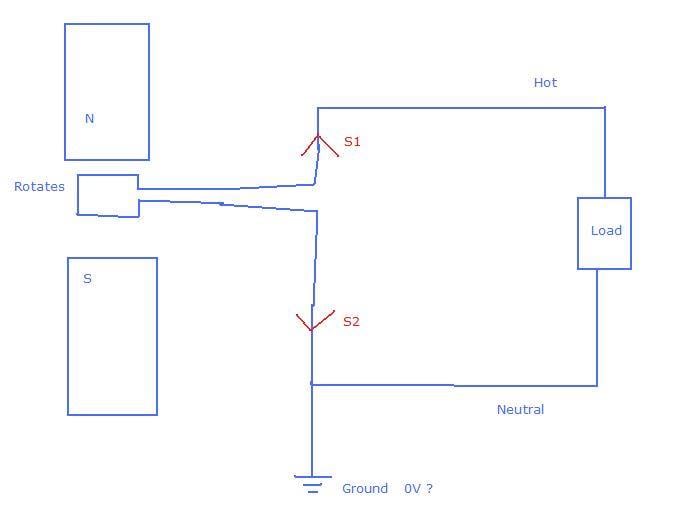


Let's say the AC generator generates an amplitude of 50V, so it oscillates between -50V and 50V.
Here are my difficulties.

1) If we connect one of the ends of the AC generator to Earth Ground, that is, an actual Rod inside the earth, let's say 5 metres, then what is the voltage on that rod really? Is it 0 relative to the AC generator?

I have marked the diagram with the labels S1 and S2 in order to talk about the direction of the current in each AC half cycle.
2) What is the voltage in the "Neutral" wire? Is it 0? But if it is 0, then what about the voltage coming from the AC generator itself?


I don't even know what it is that I don't understand here. This concept of neutral wire doesn't make sense to me.

I guess the biggest question for me is, once you add a ground to an AC circuit, how do you define the voltages? With respect to what? If the current is flowing in one direction, what point do you use to mark a positive voltage and what point to mark a negative voltage, what about 0 voltage?
Oh dear, if someone could please help me with this, I would be grateful until the day I die!

Best wishes


Paulo


Please have a look at my drawing, does it make some sense? It's for the first half of a full AC cycle.
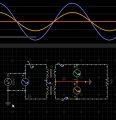
Here is an image that hopefully will Help. The 'ground' symble beside the mouse-pointer is there because the simulator requires it. Ignore that. This circuit represents what a pole transformer delivers to a house on a single phase in the USA.
240-120VAC.jpg
240VAC on primary side, 120VAC on each (upper & lower half) of the secondary side. Notice the waveforms. Orange & Green overlap exactly, that's why you don't see green. But you can see their amplitude in relationship to the original 240VAC amplitude.

The ground-symbol on the secondary side is actually neutral. In a load-center in the USA, ground and neutral are tied together at the load center, not before. So in a home or business, most office equipment can't tell the difference. Breakers (for safety) can-- and usually watch for voltage showing up on the neutral or ground, which indicates a short to ground.
 
Last edited:

wayneh

Joined Sep 9, 2010
18,119
For an AC supply, the hot wire voltage will go positive and negative with respect to the neutral/earth connection.
Don't know why you say it's at a "lower potential"?
I read it as meaning that one wire or the other will always be below earth potential, except at the zero crossings. He didn't mean one specific wire would always be negative, rather one of the two.
 

Thread Starter

PauloConstantino

Joined Jun 23, 2016
266
The more answers I get the more confused I am!

Someone just said that the earth doesn't receive or provide charge at all ? How can that be ? If the hot wire is at a voltage different than 0, and you stick it into the earth, won't charge flow between the two? At least that's what will happen if I touch the hot wire. if I stick the hot wire into the earth, What will happen?
 

BobaMosfet

Joined Jul 1, 2009
2,211
The more answers I get the more confused I am!

Someone just said that the earth doesn't receive or provide charge at all ? How can that be ? If the hot wire is at a voltage different than 0, and you stick it into the earth, won't charge flow between the two? At least that's what will happen if I touch the hot wire. if I stick the hot wire into the earth, What will happen?
At this point, I think electricity or electronics is not the field for you.
 

BR-549

Joined Sep 22, 2013
4,928
Paulo............I believe I understand your problem. Please refer to the diagram in post #19. This will only work with that circuit, it will NOT work with a mains supply. Because the mains supply is reference to ground already.

Disconnect the ground. Get your meter out. A pretend meter will work, if you understand potentials and currents.

Start up your generator. To measure the voltage across the load, you will have to put the meter leads across the load. Red lead on top and black lead on bottom of load symbol. You will read an RMS of the supply ac voltage.

Now, remove the black meter lead, and connect it to ground. What voltage do you read on the meter? 0.

Put the black lead back on the bottom of the load. You will see the voltage again. Now take the red meter lead and connect it to ground. What voltage do you read? 0.

Now, take the red meter lead and put it back on top of load. You will see the supply voltage.

Now....while the generator is on...and you are reading the voltage across the load, connect a jumper from the bottom end of the load....to ground.

Did the meter reading change? No. Disconnect the ground from the bottom of load and put the ground at the top of load. Did the meter reading change? No.

Do you see what is happening here? It's a matter of reference. The ac generator has two output poles. Referencing one of these poles to ground does not effect power transmission.

The pole that we selected as ground, becomes a NEUTRAL conductor.

A neutral conductor is a conductor that USUALLY and NORMALLY has no potential or voltage on it. We took the potential off of it by grounding it.

But it still has the current potential. This can be most dangerous. Some idiot will measure a neutral and see no voltage on it..................and think it is safe to touch or to disconnect.

IF, or as soon as it is disconnected, the neutral will receive and establish the full "hot" voltage. This voltage is supplied thru the load.

That hot voltage will now be between the neutral and ground, You do not want to be between them.

All power generation is symmetrical (balanced) and gives us two equal potentials. (+ and - poles) By grounding one of the potentials, we can deliver the same amount of power with one potential. This gives us safety and a common reference of ground for the other potential.
 

BobaMosfet

Joined Jul 1, 2009
2,211
lol, nooo. I understand DC electricity, digital logic and all that. I've only now started to deal with AC and i haven't found any clear explanation so far.
I don't understand why you're having the difficulty. The only difference between DC and AC is polarity change and time-factor beings to play into things.
 

Thread Starter

PauloConstantino

Joined Jun 23, 2016
266
I don't understand why you're having the difficulty. The only difference between DC and AC is polarity change and time-factor beings to play into things.
I don't know myself what the hell is going on. I know what AC is in relation to DC. I always try to understand things too deeply and sometimes I get confused. Electricity is full of conventions. Can you explain AC to me in terms of electrons and charge?
 

Thread Starter

PauloConstantino

Joined Jun 23, 2016
266
I don't understand why you're having the difficulty. The only difference between DC and AC is polarity change and time-factor beings to play into things.

I know that the only difference is polarity change. If we have an AC circuit without any ground connections, I can understand everything perfectly. if you tell me now that one end is connected to ground, that confuses me because what happens to the current and charge? Does it flow into the ground ???
 

wayneh

Joined Sep 9, 2010
18,119
I believe the part you are struggling with most is the concept that all voltages are relative.

As BR-549's thought-experiment shows, there is no electromotive force between the generator and ground, and therefore there is no voltage between them and no current flows. The generator can, however, develop an EMF between it's poles. Anything touching both poles will feel that electric field and the voltage between the poles.

If one of those poles is also connected to ground, then the voltage on the other pole can also be referenced to ground.

If neither pole is connected to ground, voltages versus ground could be anything. One pole of your generator could be said to be at one million volts and the other at one million plus the EMF of the generator. An imaginary reference like that is not very useful but is perfectly valid, just as valid as declaring earth ground is zero volts.
 

MaxHeadRoom

Joined Jul 18, 2013
30,690
I know that the only difference is polarity change. If we have an AC circuit without any ground connections, I can understand everything perfectly. if you tell me now that one end is connected to ground, that confuses me because what happens to the current and charge? Does it flow into the ground ???
I think I mentioned this before, if a single connection it is just a reference point, no current flows in it.
I am not sure how it is now but years ago in a UK residential supply the service company did not supply a ground conductor, just live and neutral, the neutral was grounded at the supply transformer star point, the local ground connection could be a metallic water main pipe if available, and was kept separate from the supplied neutral.
In the event of a fault path to ground, the current would flow from the earthed ground conductor back through earth to the neutral point of the transformer.
Which essentially was a short from live to neutral blowing a fuse or breaker.
So up to that point no current would flow to ground, only in the event of a ground fault.
Max.
 

Thread Starter

PauloConstantino

Joined Jun 23, 2016
266
WAYNEH !

"If one of those poles is also connected to ground, then the voltage on the other pole can also be referenced to ground. "

is that because if one of them is connected to ground, then the ground becomes kind of an all encompassing fluid that can be used to measure voltages on the hot wire, or anywhere else for that matter ?
 

EM Fields

Joined Jun 8, 2016
578


Please have a look at my drawing, does it make some sense? It's for the first half of a full AC cycle.

Here's your drawing, embellished a little:
Earth ground.png
Since the earth is only connected to your circuit at a single point, there's no potential difference, anywhere, to drive charge into / through the earth.

Another way of looking at it might be that you have a lamp connected across a battery, that it's lit, and that the battery's minus terminal is connected to a ground rod driven deep into the earth. Under those conditions, why would charge be transferred into the earth and the battery depleted at a greater rate than caused by the lamp?
 

Thread Starter

PauloConstantino

Joined Jun 23, 2016
266
I've done an experiment with a simulator. As soon as I connected 2 grounds to the circuit, it stopped. is it because I short circuited the circuit through the earth ?


crutschow

Joined Mar 14, 2008
38,537
I know that the only difference is polarity change. If we have an AC circuit without any ground connections, I can understand everything perfectly. if you tell me now that one end is connected to ground, that confuses me because what happens to the current and charge? Does it flow into the ground ???
Nothing happens to the current and charge and no significant current flows into the ground because there's no complete circuit. You always need two connections for a voltage to cause current to flow.
Try to understand that ground is just a reference point, nothing else.
Certainly if you touch the hot wire with the neutral grounded than current will flow through the ground and you will get shocked. But that's because there now is two connections which makes a complete circuit.
I don't see why that's hard to understand. :rolleyes:
 

Thread Starter

PauloConstantino

Joined Jun 23, 2016
266
Nothing happens to the current and charge and no significant current flows into the ground because there's no complete circuit. You always need two connections for a voltage to cause current to flow.
Try to understand that ground is just a reference point, nothing else.
Certainly if you touch the hot wire with the neutral grounded than current will flow through the ground and you will get shocked. But that's because there now is two connections which makes a complete circuit.
I don't see why that's hard to understand. :rolleyes:
Your answer is enlightening to me. So the earth is such a great conductor that it will transport charge if there's a complete circuit through it ? That's crazy. Why should that happen if the earth is neutral? Are there so many free electrons like that ???

You mentioned that if I touch the hot wire and the other end is grounded, than I will get shocked because there is now a complete circuit. Great. What if the other end is not actually grounded, will I not get a shock? What if the neutral is grounded 10000KM away from me ? Will I still get a shock?
 

Thread Starter

PauloConstantino

Joined Jun 23, 2016
266
I think I finally got it!

using a ground only allows for measuring voltages everywhere on the circuit by putting one end of the metre on something connected to the earth and the other end wherever you want to measure voltages ?

is that it ???????? is it ???????????? omg !


Someone please confirm if this is right
 
Top