I have clk signal with frequency 100khz I need to generate another pulse at the positive edge of the clk for 1 micro second on and 9 micro second off ,can I use one shot timer or there is another idea more accurate.?
The PLL would generate 1MHz locked to the 100kHz, then use that as the clock for a '4017 decade counter. Any of the outputs from that chip will give you the signal you want - one cycle of the 1MHz high and nine cycles low.
I have clk signal with frequency 100khz I need to generate another pulse at the positive edge of the clk for 1 micro second on and 9 micro second off ,can I use one shot timer or there is another idea more accurate.?
How accurate is your 100kHz clock, how accurate do you need the width of the 1μs pulse to be, and how much delay can you stand between the rising edge of the clock and the rising edge of the 1μs pulse?
How accurate is your 100kHz clock, how accurate do you need the width of the 1μs pulse to be, and how much delay can you stand between the rising edge of the clock and the rising edge of the 1μs pulse?
A 555 one-shot timer would be an obvious choice except they don't work well down to a 1μs period.
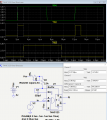
Below is the LTspice simulation of a 74HC123 one-shot timer which should do what you want.
The 74HC is fast enough to give a reliable 1μs pulse.
The 5k ohm pot U2 allows adjustment of the pulse width to 1μs.
Note that the unused inputs on the other one-shot in the package should be tied to ground.
A 555 one-shot timer would be an obvious choice except they don't work well down to a 1μs period.
Below is the LTspice simulation of a 74HC123 one-shot timer which should do what you want.
The 74HC is fast enough to give a reliable 1μs pulse.
In the actual circuit you may have to tweak the value of R1 to get an exact 1μs pulse width (you could change R1 to a 5kΩ pot in series with a 2.5kΩ resistor if you want it to be adjustable).
Note that the unused inputs on the 74HC123 should be tied to ground.

 Facebook
 Google
 GitHub
 Linkedin