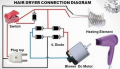
In the diagram the motor is 120 volts (assuming 120VAC service). Powering a motor designed for 120 volts (AC or DC) will hardly rotate the motor at all. And if the motor is designed for DC service (as is the case with the full wave bridge rectifiers) the motor will not run. Period. 12VAC will eventually overheat the motor and could cause excitement in the household. i.e. smoke and flame.
In the diagram the motor is 120 volts (assuming 120VAC service). Powering a motor designed for 120 volts (AC or DC) will hardly rotate the motor at all. And if the motor is designed for DC service (as is the case with the full wave bridge rectifiers) the motor will not run. Period. 12VAC will eventually overheat the motor and could cause excitement in the household. i.e. smoke and flame.
The bridge rectifier driving the motor is in series with the heating element, which will limit the current through the low voltage motor. As long as it is connected as shown in the diagram, it will run without a smoothing capacitor (and without smoke and flame!).
It is quite common to run on full wave rectified DC, no capacitor, There are many instances as an example,
the 120Hz ripple is not a problem.
If it is in fact a 120v motor, most likely a Universal type. Even if 230v as used in Sri-Lanka
What I'm looking at is line power (in red) goes to the switch. Presumably it's a SPDT switch, perhaps with center off. In one configuration it passes 230VAC (as @MaxHeadRoom points out Sri Lanka) Full Wave AC to both the heating element and the bridge rectifier (BR) and on to the motor. No current limiting shown.
In the other configuration 230V Half Wave pulsed DC is sent to both the heating element and the BR. Either way the motor is designed to run on 230 volts DC. Since it's a DC motor, and with making great assumptions, a permanent magnet motor, AC will be problematic for the motor if run without rectification.
NOW, as for the question "Powering up a 12V DC motor with A/C - Does it need a smoothing Cap just after the Bridge?"
First, no, you don't need a smoothing cap.
Second, 12 volts DC will hardly spin that motor at all. And to edit an earlier comment I made about smoke and flame - it's highly unlikely the motor will ever get hot enough to become a problem. The ONLY thing the TS will experience from trying to run this motor on 12VDC will be dissatisfaction. It just won't work. The motor will be getting only 5% of the needed voltage.
Indeed! In that diagram the motor is certainly a DC PM motor. Will it run on 12 volts DC?? I have run a high power, high speed, brush type, 120 volt motor on 12 volts DC and it turned about 100RPM, no load. BUT that was a decent quality motor. Will the motor of a 230 blow dryer run on 12 volts DC? Maybe, but not at a useful speed.
If the circuit drawing is correct, then the motor voltage applied in that application is the rectified mains voltage, unfiltered, so either 120 or 230 volts. So there is not a lot of question, EXCEPT: where did the 12 volts come from?? OR is that just a wish??
NO, the motor IS NOT in series with the heater in the circuit showing in post #1. Consider that a series connection of motor and heater would not allow the blower only mode!! Also, follow the circuit on that wiring diagram. SOME of the early hair dryers did use a series scheme. Back in 1971. But with the cool mode a series scheme does not work, can not work. Even if there is a series resistor not shown, it would not be a 12 volt motor.
My typo! I intended to state that " The bridge rectifier driving the motor is usually in series with the heating element ". The way it is shown in the diagram will certainly create some smoke!

 Facebook
 Google
 GitHub
 Linkedin