Powering a 5V/1.5A Wifi camera by tapping into 12V landscape lighting wires

Thread Starter

neviln

Joined Mar 20, 2016
5
A few years ago, I installed landscape lighting that I got from Amazon. Unfortunately, after just 6 months, 8 of 10 lights were dead due to water pooling inside them, so I took them down but left the wiring in place. After some researching, I learned that the moisture/condensation issue was fairly common in areas where the weather/temperature/humidity fluctuates a lot, so I never ended up getting replacement lights.

Fast forward to present day....I purchased two PTZ wifi/IP cameras and am hoping to power them from the landscape wiring that's still currently installed along the backyard fence (which is connected to 12V transformer, but isn't powering anything).

SPECS:
Cameras: 5V / 1.5A
Transformer Output: 12V / 120W
Landscape Wiring: 14/2 wire

I did some searching & most results mentioned using a step-down "buck" converter, but I had some questions I was hoping to get help with:
•1) Is there any way to accomplish this without having to use a buck converter (ie. using bare bone components like resistors, capacitors, etc..)?
2) If a buck converter is required (or is most efficient), can I use one from a bunch of old 12V car cigarette lighter phone chargers I have laying around since they output 5V?
3) If the answer to #2 is yes, but the concern is the low current rating (0.5A) of the old chargers, is there any way to modify/join one or more of them to allow for more current?

Any help with the questions above or suggestions/ideas on the fastest/easiest way to accomplish this is greatly appreciated.
Thank you
 

Thread Starter

neviln

Joined Mar 20, 2016
5
Do you know if the landscape lighting is 12Vac or 12Vdc. It will make a difference.
Excellent point....I hadn't even thought of that.

I just checked the transformer and all it says is"Paradise 120W Outdoor Transformer, GL33120". Then I checked the user manual, but it doesn't mention AC or DC anywhere; it just keeps referring to everything as 12V fixtures, like:
•"For use with 12 volt low voltage outdoor landscape lighting system only."
•"Be sure that the total cumulative wattage of all 12 volt fixtures connected to the transformer is equal to or less than 120 watts."
•"For low-voltage lighting fixtures of 12V to 15V."

EDIT: I found an online store selling that model # and in the specs it says that it's AC.
 
Last edited:

ronsimpson

Joined Oct 7, 2019
4,664
It is 12Vac.
A full wave bridge and a large capacitor will make 16 or 17 volts. Unregulated. Maybe as high as 20V without a load.
can I use one from a bunch of old 12V car cigarette lighter phone chargers
Most of the car chargers work just fine at 15V when the car is running. They probably will work to 20V. Many of those have a 40V IC and 35V capacitors. But who knows what is in your chargers.
1720234141288.png
If you don't understand ask more questions,
 
Be careful; I do not know about the "load regulation" of your transformer. It is possible that the voltage when lightly loaded might be much higher than 12VAC. In my opinion, you need a bridge rectifier to filter capacitor to a 5V output buck regulator board of some sort. The capacitor and buck regulator probably should handle at least 35VDC maximum input, and even that is not guaranteed.
 

DickCappels

Joined Aug 21, 2008
10,661
Using a buck converter load regulation of your unregulated DC supply will probably not be an issue beyond being sure the negative peak of the unregulated voltage (assuming that we are talking about a positive power supply) does not drop so low that the buck converter drops out of regulation.

1.5 Amp load and a 1.2 amp transformer suggests that you need a buck converter.

I would not bother making discreet converter-unless there is a difficulty obtaining an integrated converter or controller.
 
1.2 amp transformer suggests that you need a buck converter.
Given 12V and 120 VA it sounds like a 10 Amp transformer. We can assume that this is for a pure resistive load, so maybe 6-7 Amps DC maximum out of a bridge rectifier followed by a bulk filter capacitor. But this still significantly exceeds the stated load requirements. Regardless; a buck regulator module seems to make the most sense. Second place would be perhaps a SEPIC converter but there is no advantage over a buck. A dissipative linear regulator would produce a lot of heat and would be a problem.
 

Thread Starter

neviln

Joined Mar 20, 2016
5
It is 12Vac.
A full wave bridge and a large capacitor will make 16 or 17 volts. Unregulated. Maybe as high as 20V without a load.
I'm still fairly new to to electronics, so I apologize in advance for any mistakes and for all my questions.
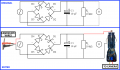
I found a circuit diagram for a full bridge rectifier (top image) and then edited it (bottom image) to show how I think I should be connecting it to the landscape wires and car charger.
Untitledd.png

1) Is this the correct way I everything should be connected?
2) If so, what values should I use for the capacitor and the bleed resistor? And can I use any diodes so long as they are rated for 12V, or should I use a specific type?

Most of the car chargers work just fine at 15V when the car is running. They probably will work to 20V. Many of those have a 40V IC and 35V capacitors. But who knows what is in your chargers.
Most of the car chargers were old ones used to charge Blackberry devices. The majority are rated 5V/0.5A but there are a few rated for 5V/1A.
 

Thread Starter

neviln

Joined Mar 20, 2016
5
If you do that make sure you have low AC leakage to earth AND connect your power supply common (Ground) point to solidly to Earth. Just in case.
Sorry, I don't understand what you mean by "have low AC leakage to earth". Is this a feature of some transformers or is this something I would need to do manually?
 

Thread Starter

neviln

Joined Mar 20, 2016
5
Easiest would be to just buy a 4-5A 12VDC supply that operates from the line voltage (examples) and connect it in place of the transformer you have.
I liked the simplicity of this idea, but wouldn't this also eliminate the possibility of being able to connect any landscape lights in the future?
And just for my own curiosity, if one was to go this route, wouldn't a 4A / 5VDC power supply be even easier as the cameras could be connected directly and not require the full bridge rectifiers; or am I missing something?
 
5V x 1.5A = 7.5 watts. Camera
15V from full wave bridge x 0.5A = 7.5 watts.
The 0.6 or 0.7 A to run the buck PWM will not load the transformer much. The transformer will not even notice the load.
I have a 2A car charger.
Yes this is true. But it is important to note that (without "power factor correction") the RMS current load on the transformer will exceed the DC current into the buck regulator. This is because the load current into the bridge rectifier is pulsating. Actual "power factor" might be 60% - 70%.
 
I'm still fairly new to to electronics, so I apologize in advance for any mistakes and for all my questions.
I found a circuit diagram for a full bridge rectifier (top image) and then edited it (bottom image) to show how I think I should be connecting it to the landscape wires and car charger.
View attachment 326333

1) Is this the correct way I everything should be connected?
2) If so, what values should I use for the capacitor and the bleed resistor? And can I use any diodes so long as they are rated for 12V, or should I use a specific type?


Most of the car chargers were old ones used to charge Blackberry devices. The majority are rated 5V/0.5A but there are a few rated for 5V/1A.
One thing: 10 uF IS WAY TOO SMALL. In very broad terms: If you have 50 Hz power, 1/2 cycle is 10 mSec. The capacitor might need to support 2A for 7 mSec, and the p-p ripple should be maybe 2V or less. So C= I*dT/dV or 7 millifarads = 7000 uF. That is the formula, so go ahead and adjust it if my input numbers are off. Another consideration: If your ripple voltage is too large, even if the valley voltage is high enough you may exceed the limit for the capacitor ripple current. So it is best to be somewhat conservative in choosing C1, especially if you have not really figured this out thoroughly.

This can be done well with simulation and in fact I simulated it with an HP55 programmable calculator during the 1970's. It can be simulated in Excel or with any circuit simulator.

It would be best to figure this out on Faraday, but today is Saturday so we missed that. But I do hope to get some blackberries next month. :)
 

crutschow

Joined Mar 14, 2008
38,423
I liked the simplicity of this idea, but wouldn't this also eliminate the possibility of being able to connect any landscape lights in the future?
Yes.
I didn't know that was a consideration.
if one was to go this route, wouldn't a 4A / 5VDC power supply be even easier as the cameras could be connected directly and not require the full bridge rectifiers
Yes, the original transformer and any other circuitry is not needed.
 

MisterBill2

Joined Jan 23, 2018
27,358
I suggest just adding a bridge rectifier at each position where a camera will be installed, along with a filter cap AFTER the five volt regulator. that will allow for an unknown voltage drop in that long underground wire., and also allow several 12 volt lights. Yes, the caps will need to be bigger than 10 mfd. But polarity in the connections to the underground wires will not matter.
 

DickCappels

Joined Aug 21, 2008
10,661
Sorry, I don't understand what you mean by "have low AC leakage to earth". Is this a feature of some transformers or is this something I would need to do manually?
You need to test your power supply by running a 1,000 ohm resistor to earth from the “ground” connection on the output of your power supply to a solid earth connection. If the AC RMS voltage exceeds 20 volts you should consider the power supply a shock risk.

It would also be a good idea to permanently connect the “ground” connection of the output of your power supply to a solid earth connection. That way, if you go outside to troubleshoot your equipment you will not be likely to be electrocuted.
 

Alec_t

Joined Sep 17, 2013
15,112
Most of the car chargers were old ones used to charge Blackberry devices. The majority are rated 5V/0.5A but there are a few rated for 5V/1A.
If each of your two cameras draws 1.5A (as per spec), then none of those old chargers has enough current capability.
 

MisterBill2

Joined Jan 23, 2018
27,358
The circuits shown in post #10 , but with a suitable regulator IC before the filter cap, are what I am suggesting. Regulating the pulsing voltage will reduce regulator heating, and also the required voltage of the following filter cap. The big benefit is allowing the original wiring to power 12 volt lights as wanted. But the regulators will need to have an adequate current rating for those cameras.
 
Top