Power Supply - switch between 2V3 and 3V3

Thread Starter

bug13

Joined Feb 13, 2012
2,002
Hi guys

I need to switch between 2V3 and 3V3 to a load, maximum 100mA draw, 3V3 input. Only need to switch once or twice a day.

Here is what I plan to do it, it seems to work in my simulation, but is there any reason I shouldn't do that in a real world?
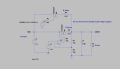
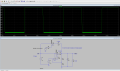
  • In the simulation I am switching every 100ms so I don't wait for too long for the result
  • R_Sense are just for me to measure current easier
  • M1, U2, R1, R2 and V2 is my attempt to simulate a LDO
  • I attempt to switch between 2V3 and 3V3 by shorting out a LDO voltage regulator (good or bad idea??)
Thanks guys!!

Capture.PNG
Capture2.PNG
 

RichardO

Joined May 4, 2013
2,270
The biggest danger I see in your design is that the 2.3 volt regulator may not like having 3.3 volts applied to its output.

I have looked at the spec's for a number of regulators and none said what would happen under your conditions. :(
 

Thread Starter

bug13

Joined Feb 13, 2012
2,002
The biggest danger I see in your design is that the 2.3 volt regulator may not like having 3.3 volts applied to its output.

I have looked at the spec's for a number of regulators and none said what would happen under your conditions. :(
Thank you for taking your time to have a look for me.
 

MisterBill2

Joined Jan 23, 2018
27,164
Actually, I had done the research some time ago for my own design. I am glad I could pass on what I learned.

This circuit is far more complex than it needs to be is the main reason for not doing it this way. The stability of the output depends on most of the components is the other reason. It would be more effective and more reliable and stable to use a voltage regulator IC with remote sensing ability. TI, Linear Technology, Analog devices, are at least 3 sources that have large amounts of assistance on line for these types of challenges.
 

Thread Starter

bug13

Joined Feb 13, 2012
2,002
This circuit is far more complex than it needs to be is the main reason for not doing it this way. The stability of the output depends on most of the components is the other reason. It would be more effective and more reliable and stable to use a voltage regulator IC with remote sensing ability. TI, Linear Technology, Analog devices, are at least 3 sources that have large amounts of assistance on line for these types of challenges.
I am not attempting to do my own LDO linear voltage regular at all. The above circuit just me can't find a linear voltage regular in LTSpice, that me randomly made one up, see what happened if I short out the input and the output.
 

MisterBill2

Joined Jan 23, 2018
27,164
What solution did you come up with at the end? What did you use?
I was assisting another individual, and after that advice he did get some assistance from TI and what I eventually got was a "thank you very much" from the individual. The one time that I had to do something like that, the power supply had already been selected, purchased, and installed, all by others. All I had to do was solve the problem of needing to change the output voltage a bit, without spending money. Fortunately that power supply had what is called a "margining" input. That allows adjust the output a small amount by switching in an external resistor. You can probably do something similar using an LM317 adjustable voltage regulator and one of the FET devices to connect a second resistor in parallel with the voltage setting resistor. There is a lot of application information available about the LM317
 

MisterBill2

Joined Jan 23, 2018
27,164
I was assisting another individual, and after that advice he did get some assistance from TI and what I eventually got was a "thank you very much" from the individual. The one time that I had to do something like that, the power supply had already been selected, purchased, and installed, all by others. All I had to do was solve the problem of needing to change the output voltage a bit, without spending money. Fortunately that power supply had what is called a "margining" input. That allows adjust the output a small amount by switching in an external resistor. You can probably do something similar using an LM317 adjustable voltage regulator and one of the FET devices to connect a second resistor in parallel with the voltage setting resistor. There is a lot of application information available about the LM317
 

Thread Starter

bug13

Joined Feb 13, 2012
2,002
I was assisting another individual, and after that advice he did get some assistance from TI and what I eventually got was a "thank you very much" from the individual. The one time that I had to do something like that, the power supply had already been selected, purchased, and installed, all by others. All I had to do was solve the problem of needing to change the output voltage a bit, without spending money. Fortunately that power supply had what is called a "margining" input. That allows adjust the output a small amount by switching in an external resistor. You can probably do something similar using an LM317 adjustable voltage regulator and one of the FET devices to connect a second resistor in parallel with the voltage setting resistor. There is a lot of application information available about the LM317
Our supply voltage is 3.6V lithium battery, we need to artificially drop the voltage to 2.3V when battery drop to 3 ~ 3.1V, to trigger a low battery alarm of a module (we have no control of the module).

If we wait for the battery to drop to 2.3V, the lithium battery will be cut off before it drop to 2.3V, or it drop too fast and it won't allow the module to set off an low battery alarm.

LM317 can't meet the LDO requirement, and draw too much standby current (4mA if I remember correctly)

PS: The rest of the circuit needs about 3V
 

MisterBill2

Joined Jan 23, 2018
27,164
Our supply voltage is 3.6V lithium battery, we need to artificially drop the voltage to 2.3V when battery drop to 3 ~ 3.1V, to trigger a low battery alarm of a module (we have no control of the module).

If we wait for the battery to drop to 2.3V, the lithium battery will be cut off before it drop to 2.3V, or it drop too fast and it won't allow the module to set off an low battery alarm.

LM317 can't meet the LDO requirement, and draw too much standby current (4mA if I remember correctly)

PS: The rest of the circuit needs about 3V
OK, I did not understand your application adequately. You are correct in that the LM317 linear regulator will not be at all the working choice for this application. Another choice, if all that you want to do is simulate a drop in the battery voltage, would be to switch in and out a series silicon diode. A 1N4000 or 1N4001 will drop about 0.7 volts, depending on the current. Or you can use a schottkey diode or two in series, and then just shunt the diodes with the FET when the higher voltage is needed. That is as simple as I can get, if simple is part of your goal. BUT, if you are using a power supply to simulate the 3.6 volt battery, using the margining input would work very well.
 

Thread Starter

bug13

Joined Feb 13, 2012
2,002
OK, I did not understand your application adequately. You are correct in that the LM317 linear regulator will not be at all the working choice for this application. Another choice, if all that you want to do is simulate a drop in the battery voltage, would be to switch in and out a series silicon diode. A 1N4000 or 1N4001 will drop about 0.7 volts, depending on the current. Or you can use a schottkey diode or two in series, and then just shunt the diodes with the FET when the higher voltage is needed. That is as simple as I can get, if simple is part of your goal. BUT, if you are using a power supply to simulate the 3.6 volt battery, using the margining input would work very well.
Hi MisterBill2

I should have given more info about my application to give you the full picture.

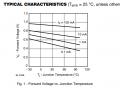
I can't find temperature vs voltage drop for 1N4000/1, but I did find 1N4148, their temperature vs voltage drop worries me. On standby, my current draw is in 10uA range, when the module is working, it can draw up to 100mA. Don't want me circuit works in summer and stop working in winter :)

I guess I have to use two different voltage regulator, and switch them with some mosfets.

1N4148:
Capture.PNG
 
Last edited:

ebp

Joined Feb 8, 2018
2,332
The circuit, as shown, should be OK with the output forced to Vin since the error amp is powered from Vin and the FET won't care (body diode). What will happen is that the error amplifier will be driven to saturation, which will slow the recovery time, but that likely is not a problem. If you intend to try to build the circuit you should simulate with good models for all the parts. There is no frequency compensation in the circuit which can lead to serious stability issues.

With many bipolar 3-terminal regulators the output should not be driven more than a little above the input supply. The standard way of coping with this is to put a diode, in some cases a Schottky, across the regulator, anode to output for a positive reg. This provides a path around the reg. This should also be done if there is substantial capacitance at the output of the regulator and a possibility of rapid drop of the input supply voltage. Applying 3.3 V to the output of a 2.3 V regulator is probably safe for most regulators, especially since the input supply is the same for both, but the data sheet should be consulted.

Beware of older LDO regulators that use PNP pass transistors. Because the base drive for the pass transistor flows to ground, if the regulator can't regulate because the input supply is too low but still above the minimum, the base current can be quite high - up to tens of milliamps for some. Many newer LDOs use a MOSFET instead of a bipolar transistor for the pass element, so they don't suffer from this problem.

All silicon PN junction diodes will have a temperature co-efficient of around -2 mV to -2.2 mV/°C. Initial forward voltage drop at a particular current and temperature can vary considerably from one diode to another of the same type. One might be 0.6 V at say 20°C and 100 mA and another might be 0.7 V under the same conditions. This difference is roughly equal in magnitude to what you would expect from a 40-50°C change in temperature. A 1N4148 can easily handle your 100 mA load current, but note the high forward voltage. At 100 mA a 1N4001 would have a lower forward voltage and a V vs t slope probably quite similar to that for the 1N4148 at 10 mA.

The ADP3331 with R2 split in two and the resistor connected to ground shorted to switch voltage looks like a good solution. Beware of the switch adding capacitance. This can lead to stability issues because it introduces a phase shift. If works against the "noise reduction" circuit shown in the data sheet. Reducing the values or R1 and R2 proportionally reduces the effect of unwanted capacitance, but also increases the current consumption. Note that the 3331 is shown as using a PNP pass transistor and may suffer from the problem I mentioned above. Read the data sheet very carefully.
 

MisterBill2

Joined Jan 23, 2018
27,164
The circuit, as shown, should be OK with the output forced to Vin since the error amp is powered from Vin and the FET won't care (body diode). What will happen is that the error amplifier will be driven to saturation, which will slow the recovery time, but that likely is not a problem. If you intend to try to build the circuit you should simulate with good models for all the parts. There is no frequency compensation in the circuit which can lead to serious stability issues.

With many bipolar 3-terminal regulators the output should not be driven more than a little above the input supply. The standard way of coping with this is to put a diode, in some cases a Schottky, across the regulator, anode to output for a positive reg. This provides a path around the reg. This should also be done if there is substantial capacitance at the output of the regulator and a possibility of rapid drop of the input supply voltage. Applying 3.3 V to the output of a 2.3 V regulator is probably safe for most regulators, especially since the input supply is the same for both, but the data sheet should be consulted.

Beware of older LDO regulators that use PNP pass transistors. Because the base drive for the pass transistor flows to ground, if the regulator can't regulate because the input supply is too low but still above the minimum, the base current can be quite high - up to tens of milliamps for some. Many newer LDOs use a MOSFET instead of a bipolar transistor for the pass element, so they don't suffer from this problem.

All silicon PN junction diodes will have a temperature co-efficient of around -2 mV to -2.2 mV/°C. Initial forward voltage drop at a particular current and temperature can vary considerably from one diode to another of the same type. One might be 0.6 V at say 20°C and 100 mA and another might be 0.7 V under the same conditions. This difference is roughly equal in magnitude to what you would expect from a 40-50°C change in temperature. A 1N4148 can easily handle your 100 mA load current, but note the high forward voltage. At 100 mA a 1N4001 would have a lower forward voltage and a V vs t slope probably quite similar to that for the 1N4148 at 10 mA.

The ADP3331 with R2 split in two and the resistor connected to ground shorted to switch voltage looks like a good solution. Beware of the switch adding capacitance. This can lead to stability issues because it introduces a phase shift. If works against the "noise reduction" circuit shown in the data sheet. Reducing the values or R1 and R2 proportionally reduces the effect of unwanted capacitance, but also increases the current consumption. Note that the 3331 is shown as using a PNP pass transistor and may suffer from the problem I mentioned above. Read the data sheet very carefully.

I am quite relieved that somebody had a much better solution than I had. Of course, not understanding the whole application makes giving a good answer a lot more challenging. My experience has been more with industrial systems, mostly in auto plants, where power availability is seldom a concern.
 

ebp

Joined Feb 8, 2018
2,332
Bill, it has been my experience in many web forums (fora?) that one of the biggest problems to giving good answers is that the original question is terse, not very well written and lacking detail. You come up with an answer and the original poster comes back and says, "Oh, but ..."

I used to fairly regularly participate in a forum at a Chinese vendor site - they sell lots of electronic bits and pieces, but also underwear. I quit as a regular contributor after spending quite a lot of time on a question for which I had to look up a bunch of stuff on the way some of the products involved were typically built. I offered solutions based on the vendor's products and that I thought were within the capabilities of the questioner. After all this, the OP came back and said he needed to be able to buy bits at the local hardware store.

I doubt if I'll hang around AAC for much longer. It's been interesting and a diversion while I've been a bit under the weather, but I can see I could burn up a lot of time here.
 

MisterBill2

Joined Jan 23, 2018
27,164
Bill, it has been my experience in many web forums (fora?) that one of the biggest problems to giving good answers is that the original question is terse, not very well written and lacking detail. You come up with an answer and the original poster comes back and says, "Oh, but ..."

I used to fairly regularly participate in a forum at a Chinese vendor site - they sell lots of electronic bits and pieces, but also underwear. I quit as a regular contributor after spending quite a lot of time on a question for which I had to look up a bunch of stuff on the way some of the products involved were typically built. I offered solutions based on the vendor's products and that I thought were within the capabilities of the questioner. After all this, the OP came back and said he needed to be able to buy bits at the local hardware store.

I doubt if I'll hang around AAC for much longer. It's been interesting and a diversion while I've been a bit under the weather, but I can see I could burn up a lot of time here.
I am a quite recent joiner, not completely sure how I found this group. What I have chosen to do is visit the questions that have the fewest answers, and then, if the question makes sense to me, I respond with an answer. A year ago I fixed a refrigerator for a missionary in Thailand that way. But in that case the person was able to describe the symptoms quite well, and somehow managed to present a copy of the circuit diagram that was totally legible. That was an interesting project. I solved his problem from here in the rust belt of Michigan in only about 4 exchanges of emails. Of course, that missionary did have a multimeter that he knew how to operate.
So there are chances to help folks who are able to be helped. I suggest that being more selective could reduce your level of frustration, as it has done for me.
 

ebp

Joined Feb 8, 2018
2,332
Yes, the questions certainly pour in at a fast and furious pace here. I've just been kind of shotgunning experimentally. So far, I haven't found anything particularly frustrating. I get the impression that most people who ask for help eventually get what they need. The McGyveresque aspect of trying to guide someone with limited resources to a result is kind of fun.
 

ebeowulf17

Joined Aug 12, 2014
3,307
Yes, the questions certainly pour in at a fast and furious pace here. I've just been kind of shotgunning experimentally. So far, I haven't found anything particularly frustrating. I get the impression that most people who ask for help eventually get what they need. The McGyveresque aspect of trying to guide someone with limited resources to a result is kind of fun.
I can totally understand not wanting to lose all your free time to this site, but for what it's worth, your presence is appreciated.

One of the things I like about this forum is that there are fewer bogus answers, and when bad advice does come in, it's generally corrected in a good-natured way, not in a punishing way. The result is a site with a generally positive, helpful attitude and usually good, helpful advice. People like you contribute to that on a much higher level than the average person on this forum.

For my part, I come here for help quite a lot, and I also come to try to learn through troubleshooting other people's problems. I find the exercise of trying to solve all these weird problems to be very educational. If I'm wildly uncertain, I'll just follow a thread. If I think I can figure out the answer, I'll jump in with my best attempt (nearly always with disclaimers about my uncertainty.) I don't speak up too terribly often when I've got it wrong, but when I do mess up, more experienced members set me straight. Either way, I learn lots in the process... and hopefully I don't mess up too many people along the way, thanks to the safety net.

Anyway, my rambling description of my experiences here is simply meant to encourage you, and others with good knowledge and a good attitude, to stick around if you can.
 

ebp

Joined Feb 8, 2018
2,332
This forum does seem to be vastly better than many in terms of the way people answer. In most of what I've looked at, people who post answers seem to be genuinely trying to help and usually succeeding. If all forums were like this one, the internet would be a much, much better place.

Computer-related forums seem to be uniformly horrible. Someone asks a sensible, well thought out and presented question about how to do some task, and gets a bunch of replies like "you shouldn't do that, you should do this" where "this" is frequently related only by virtue of being another possibility within the known universe.
(for another example, if you browse the questions people ask about products on Amazon, you'll find all sorts of "I don't know" replies)
 
Top