Power polygon and matching ground

Thread Starter

Eyal0

Joined Mar 26, 2024
17
For power polygon that primarily carry DC, how critical is it that it is located above a ground plane?

If it is important, how crucial is it that the polygon completely overlaps the ground plane beneath it?

Additionally, if overlap is important, how significant is it that the ground plane remains continuous and is not split by traces?
 

crutschow

Joined Mar 14, 2008
38,316
According to Google:
Power Polygons are a set of translucent plastic shapes that can be used to teach geometry, area, perimeter, patterns, logic, and fractions.

What is a "power polygon" in a circuit?
 

Thread Starter

Eyal0

Joined Mar 26, 2024
17
Sorry, I meant power plane, but it is not the whole layer, just a polygon. a region of copper, intended for power.
 

nsaspook

Joined Aug 27, 2009
16,250
How crucial is it that the (sic) power plane completely overlaps the ground plane beneath it?

It depends on what is happening (electromagnetically) at the point, much too broad a question. With proper bypassing at the signal frequency (higher) it could electrically be a shield like the ground plane or needs to be at very low impedance for power reasons.
 
Last edited:

ronsimpson

Joined Oct 7, 2019
4,646
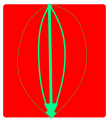
In my opinion: If we inject dc current at the top center and take it out bottom center, current will flow by the 1/resistance in the path. There will be no current in the corners and the copper area of the corners will have no effect.
1738526118653.png
At high frequencies:
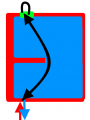
Green is where Red is connected to Blue. Red & Blue are two different layers of copper. High frequency ac current is connected at the bottom.
Current flows along the black path in both layers. Red current will not go directly up. The two currents will want to flow together.
1738526790606.png
I don't know if this answers the question. HF ac and dc effects are different.
 

nsaspook

Joined Aug 27, 2009
16,250
In my opinion: If we inject dc current at the top center and take it out bottom center, current will flow by the 1/resistance in the path. There will be no current in the corners and the copper area of the corners will have no effect.
View attachment 341768
At high frequencies:
Green is where Red is connected to Blue. Red & Blue are two different layers of copper. High frequency ac current is connected at the bottom.
Current flows along the black path in both layers. Red current will not go directly up. The two currents will want to flow together.
View attachment 341771
I don't know if this answers the question. HF ac and dc effects are different.
I would just say the current flows in all possible paths as a response the EM energy flow on the plane. You move EM energy across the conductor and current happens as a response as a system.. There are infinitely many paths they can take, with each path having its own resistance for the total. It doesn't follow the shortest path. It follows all paths which create a circuit. Sure, there is a point where the fringe flow usually can be ignored, but not in all cases.
 
Last edited:

Thread Starter

Eyal0

Joined Mar 26, 2024
17
I meant power plane, but it is not the whole layer, just a polygon. A copper region intended for 2.8V DC from an LDO. It supplies up to 50 mA to an MCU and other components.

Please have a look at the images from my design. Hope it helps.
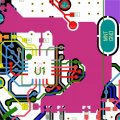
The board is 2 layers. The pink region is the polygon, it is placed on the top layer only. The white region is GND. It is placed on the top layer as well as the bottom layer. For the sake of our discussion, I'm referring to the bottom white region, under the pink one.
Please keep in mind that my question is general, this is just for demonstration.


Top layer only:
pink.jpg


Bottom layer only:
white.jpg


Both layers:
both.jpg
 
Top