Facebook
 Google
 GitHub
 Linkedin
I'm trying to build an 8 channel triac switch with dimming and fan speed control. I've gone through quite a few articles and a few on this site too. The switch is based on this circuit design:
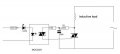
The triac is a BT-136 600D. Ac voltage is 240V, 50 Hz.
* Would the same circuit work for resistive loads too?
* I tried connecting a 5W LED lamp to this, it blinks even when the gate is not on. Is this because of the capacitor and resistor leaking current into the load?
I tried using the following circuit from: http://www.electronics-tutorials.ws/power/triac.html. The resistor I used was 10k instead of the 100Ω. And lamp was 5W Led light. The light came on, but the resistor got fried in seconds.

Calculating the power (ignoring Vgt and Vtm), Vs = 240, R = 10000: 240 * 240 / 10000 = 5.76W. Of-course it burnt, I do not know if 6W resistors are available. But anyways its too much power to be wasted for running a 5W led.
The highest value of R that I can use would be (I gt = 15mA for BT-136 from datasheet): 240/0.015 = 16k. Power at this value is: 240 * 240 / 16k = 3.6W, which is still very high. I've tried looking for articles which tell me about power for this resistor, but does not seem to be there. I read another article in this site which said R should be lower if we expect the trigger to on early, which is true for my circuit too. I should be able to trigger in any of the quadrants for dimming and speed control. Then power is much higher:
If I assume 20V then R = 20/0.015 = 1333. Max power = 240 * 240 / 1333 = 43W. It way too much to waste.
Are my calculations correct? Am I missing something big?
* After this I computed power for the first circuit when the triac is off:
C = 100nF, F = 50Hz. Impedance = 31,831. Total impedance = 31,831 + 2,200 = 34,031. Current = 240/34000 = 7mA. Power = 240 * 0.007 = 1.68W. Again very high power when the circuit is off? Is this expected? The led light operates at 20mA current and I'am assuming this 7mA leakage is causing the blink, even when the light is off.
I'm planning to remove the snubber and attach the capacitor and resistor in parallel to the load for fans and leave the lights out. Is that ok? What should the power for that be?
I've seen quite a few circuits which suggest 180Ω for the resistor without snubber.
I'm now pretty confused about how I should reduce power and get it to work for the several loads. Any help is much appreciated?
I'm doing this part of a home automation project for my friend's home and I'll be connecting about 40 switches in her home to these triacs. Most of the loads are lights and a few are fans. I'm hoping not to consume too much power of this circuit per switch and make the system inefficient.
The triac is a BT-136 600D. Ac voltage is 240V, 50 Hz.
* Would the same circuit work for resistive loads too?
* I tried connecting a 5W LED lamp to this, it blinks even when the gate is not on. Is this because of the capacitor and resistor leaking current into the load?
I tried using the following circuit from: http://www.electronics-tutorials.ws/power/triac.html. The resistor I used was 10k instead of the 100Ω. And lamp was 5W Led light. The light came on, but the resistor got fried in seconds.
Calculating the power (ignoring Vgt and Vtm), Vs = 240, R = 10000: 240 * 240 / 10000 = 5.76W. Of-course it burnt, I do not know if 6W resistors are available. But anyways its too much power to be wasted for running a 5W led.
The highest value of R that I can use would be (I gt = 15mA for BT-136 from datasheet): 240/0.015 = 16k. Power at this value is: 240 * 240 / 16k = 3.6W, which is still very high. I've tried looking for articles which tell me about power for this resistor, but does not seem to be there. I read another article in this site which said R should be lower if we expect the trigger to on early, which is true for my circuit too. I should be able to trigger in any of the quadrants for dimming and speed control. Then power is much higher:
If I assume 20V then R = 20/0.015 = 1333. Max power = 240 * 240 / 1333 = 43W. It way too much to waste.
Are my calculations correct? Am I missing something big?
* After this I computed power for the first circuit when the triac is off:
C = 100nF, F = 50Hz. Impedance = 31,831. Total impedance = 31,831 + 2,200 = 34,031. Current = 240/34000 = 7mA. Power = 240 * 0.007 = 1.68W. Again very high power when the circuit is off? Is this expected? The led light operates at 20mA current and I'am assuming this 7mA leakage is causing the blink, even when the light is off.
I'm planning to remove the snubber and attach the capacitor and resistor in parallel to the load for fans and leave the lights out. Is that ok? What should the power for that be?
I've seen quite a few circuits which suggest 180Ω for the resistor without snubber.
I'm now pretty confused about how I should reduce power and get it to work for the several loads. Any help is much appreciated?
I'm doing this part of a home automation project for my friend's home and I'll be connecting about 40 switches in her home to these triacs. Most of the loads are lights and a few are fans. I'm hoping not to consume too much power of this circuit per switch and make the system inefficient.