Potential Equalization Conductor in workbench, medical and Static

Status
Not open for further replies.

drjohsmith

Joined Dec 13, 2021
1,613
In my unique all battery usages, all equipment are battery operated, so even if I connect the equipment to ground, no mains danger. But my concern is if the unit is connected to ground, and my hands have statics and I touched the input leads of the differential amplifier or the ADCs, then it has more chance of causing ESD damage than if the device is not connected to earth?
so this is not your system with the dodgy mains adapter?

static protection in medical devices is a complicated regulatory and engineering problem,

lets just assume your not making medical devices, and the manufactureres that do have static under controlled.
 

Thread Starter

Secan

Joined Sep 20, 2024
205
As a first step, remove the electrostatics on your hands.
Yes. But after removing the static. And I connect the input leads to my body, and I stand up and move my feet, then I'd get static again from the say carpet. If the unit is connected to ground, then the static can travel to the amplifier chips and damage it more easily? right? or no and why not?

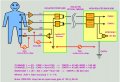
Because if it doesn't cause more ESD risk by grounding it, then grounding the EEG unit has advantage in that it can eliminate residual capacitive coupling. My application needs ultra low noise almost CERN application. In the following grounding can said to eliminate some capacitive coupling. From Metting article "High Quality recording of bioelectric events. Part 1. Interference reduction, theory and practice. "

metting capacitive coupling.jpg
 

drjohsmith

Joined Dec 13, 2021
1,613
Yes. But after removing the static. And I connect the input leads to my body, and I stand up and move my feet, then I'd get static again from the say carpet. If the unit is connected to ground, then the static can travel to the amplifier chips and damage it more easily? right? or no and why not?

Because if it doesn't cause more ESD risk by grounding it, then grounding the EEG unit has advantage in that it can eliminate residual capacitive coupling. My application needs ultra low noise almost CERN application. In the following grounding can said to eliminate some capacitive coupling. From Metting article "High Quality recording of bioelectric events. Part 1. Interference reduction, theory and practice. "

View attachment 354365
do not ground medical equipment unless the medical equipment manufacturer say so .

do not modify medical equipment,

do not randomly copy bits of information from Web to design medical equipment.,

nothing anyone says here can be used in legal proceedings or litigation,
 

MrChips

Joined Oct 2, 2009
34,839
Capacitance and capacitance coupling are two different things.

Every object has capacitance. Your body has capacitance. A metallic spoon has capacitance. Our planet Earth has capacitance. (The capacitance of the Earth is about 710 μF). They all have the capacity to hold an electric charge.

Capacitance coupling refers to the ability to transfer non-zero frequency electrical information across a vacuum, air, or any dielectric material.
 

drjohsmith

Joined Dec 13, 2021
1,613
hopefully to finish this post @Secan

re static on inputs, and your worry about damaging purchased medical equipment.

obviously , manufacturer's have this well under control, and id hate to think that you were designing medical equipment based upon web trawling,

you are inquisitive , which is good start, much easier to teach than some one who ignores .

a technique that could be used on equipment is to have low capacitance, medical grade tranzorbs and tvs diodes,
look them up .
you could use these to strap every input to the equipotential plane , that way the inputs never rise / fall outside limits, so no damage can be done

its basically as is done on rf circuits, usb et all but to a much higher class.

obviously this is not design advice, but gives you an idea that medical equipment is a very special area of design,
 

Thread Starter

Secan

Joined Sep 20, 2024
205
hi
I belive this might have come from one of your other posts , where you were amongst many other things discussing your house wiring, circuit breakers, current in your wires having momentum so it flowed after voltage was removed , and about ecg .

your understanding is right
and wrong ,
primarily in that your extrapolating .

an analogy , would be if some one asked us what PI is.

we could answer,
Just over 3
around 22/7
3.141592654....
the ratio of parts of a circle

etc.

all. are right , in the right circumstances.
which number would you use if you were working out planetary intercepts, might not be the one you use to guess how much ribbon you need to wrap around the old oak tree !

so, lets take step back.

if no current can flow, then no damage can be done to a circuit.
the classic example is in anti static protection, where every thing is at the same potential due to extensive bonding between all parts .

there is zero need for an earth connection,
the classic example is a space ship, they equie bond every thing, there is no wire going back to the earth, and all is well.

btw: you've mentioned Faraday shielding before,
this is similar , but different, so lets not go there...

now you mention about having millions of volts on your finger, what happens when you touch the esd se sensitive part.
ok then current will flow , and probably damage the electrical part

which is why we dont do that .
anything thats bought onto the equi potential bench new , needs to become equipotential,
the classic way of doing this is a wrist strap, with a resistance in it. you might be at millions of volts, but your capacitance is low, so low charge,

you would typically connect into equi potential are at a point that the current flow is not crossing a sensitive part and is at low current , uA , due to the resistor .
Other electronic experts I asked were totally not familiar with using potential equalization conductor (PEC) in medical. When you say you must wear wrist strap before joining the equipotential connection, did you mean the wrist strap must be connected to earth first to discharge then connect to the PEC or directly connect the wrist strap to the PEC where the resistor will slowly make you equipotential with the connection (but the surge slightly raising the potential of the whole connection)?

About " you could use these to strap every input to the equipotential plane , that way the inputs never rise / fall outside limits, so no damage can be done ".. is this designed inside the unit or external add on? so I know how to google it or ask others.

Many thanks for all the useful tips enough to let me know how to ask others.
 

drjohsmith

Joined Dec 13, 2021
1,613
Other electronic experts I asked were totally not familiar with using potential equalization conductor (PEC) in medical. When you say you must wear wrist strap before joining the equipotential connection, did you mean the wrist strap must be connected to earth first to discharge then connect to the PEC or directly connect the wrist strap to the PEC where the resistor will slowly make you equipotential with the connection (but the surge slightly raising the potential of the whole connection)?

About " you could use these to strap every input to the equipotential plane , that way the inputs never rise / fall outside limits, so no damage can be done ".. is this designed inside the unit or external add on? so I know how to google it or ask others.

Many thanks for all the useful tips enough to let me know how to ask others.
if you want more info on medical design, then as I understand it , the forums can not answer you.

as for the others you mention, talk with them .

my last input on this postvascits now answered is to triple enfasise
a. do not connect patients to earth
b. do not modify medical equipment , even opening them can leave you open to miss conduct trial if you use that equipment on patients and things go wrong , or you miss diagnose.
c. nothing said here can be used to design or impliment medical equipment
 

MrChips

Joined Oct 2, 2009
34,839
You are going around in circles.
Here is advice I will provide you.

1) Create a verifiable connection to Earth ground.
2) Wear an anti-static wrist strap to remove any static build up on your body.
3) Remove anti-static build up on all electronic equipment in the same manner, for example, by touching such equipment with your bare hands.
4) Before using any biomedical equipment, follow the manufacturers guidelines, in particular, with regards to grounding, both for battery operated and mains operated equipment.
5) Connect ECG, EEG, EMG electrodes as recommended by the manufacturer.
6) Before applying power to ECG, EEG, EMG equipment, remove the anti-static wrist strap.
7) Do not engage in any physical activity that can create charge build up, for example, don't remove socks, don't go to the toilet and come back. This is not meant to be a joke.
 

MrChips

Joined Oct 2, 2009
34,839
Other electronic experts I asked...
We do not routinely visit other sites, hence we cannot comment on what other "experts" are telling you.
Please do not cross-post comments from other sites because we do not monitor such comments.

Here on AAC, each member has established a reputation, both good and bad. Responses are heavily peer reviewed.
There are sufficient true experts here on AAC that we can judge for ourselves what information and opinions are to be trustworthy.
 

Thread Starter

Secan

Joined Sep 20, 2024
205
You are going around in circles.
Here is advice I will provide you.

1) Create a verifiable connection to Earth ground.
2) Wear an anti-static wrist strap to remove any static build up on your body.
3) Remove anti-static build up on all electronic equipment in the same manner, for example, but touching such equipment with your bare hands.
4) Before using any biomedical equipment, follow the manufacturers guidelines, in particular, with regards to grounding, both for battery operated and mains operated equipment.
5) Connect ECG, EEG, EMG electrodes as recommended by the manufacturer.
6) Before applying power to ECG, EEG, EMG equipment, remove the anti-static wrist strap.
7) Do not engage in any physical activity that can create charge build up, for example, don't remove socks, don't go to the toilet and come back. This is not meant to be a joke.
I'm NOT manufacturing any device but just replicating an important experiment using the same device. I just can't duplicate/construct an electromagnetically shielded room so doing everything I can to make sure no unnecessary interference. In your number "3) Remove anti-static build up on all electronic equipment in the same manner, for example, but touching such equipment with your bare hands.". Did you mean "by touching" or "but touching", because "but touching means I shouldn't touch the equipment with bare hands".

I got your steps but why did you say "6) Before applying power to ECG, EEG, EMG equipment, remove the anti-static wrist strap."? In the manual, they say to connect the participants in the earthing socket.

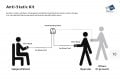
antistatickit.jpg

And most important. In the back panel of the unit is a potential equalization conductor, the manual just says to connect it to potential equalization conductor of the room where the unit is used. Does it mean connecting to the above earth bonding socket?

The technical support doesn't know. He just told me maybe just touch the potential equalization conductor with finger before touching electrode and not connecting any wire to the conductor. This is because the unit is now only for research use and not for medical. It is not rated for medical anymore because it would cost so much money for them to certify it when the usage is only for research (Brain Computer Interface (BCI) and not medical at all. So please tell me what would happen if I continued using the antistatic wrist band while using the unit. And what would happen if I connected the antistatic wrist band to the unit back potential equalization conductor while in use. I want to understand the logic and principles so I understand the theory of use.
 

MrChips

Joined Oct 2, 2009
34,839
Here is what I wrote, with information now added:
1) Create a verifiable connection to Earth ground.
Did you do this?

2) Wear an anti-static wrist strap to remove any static build up on your body.
Connect the anti-static wrist strap to the Earth ground in (1).

3) Remove anti-static build up on all electronic equipment in the same manner, for example, by touching such equipment with your bare hands.
Yes, touch it with your finger. It does not matter if the unit is for research or medical use. The same rules apply.

4) Before using any biomedical equipment, follow the manufacturers guidelines, in particular, with regards to grounding, both for battery operated and mains operated equipment.
It does not matter if the unit is for research or medical use. The same rules apply when connecting electrical apparatus to a human. The equipment must be isolated from AC mains supply.

5) Connect ECG, EEG, EMG electrodes as recommended by the manufacturer.
Follow what the manufacturer says. It does not matter if the unit is for research or medical use. The same rules apply.

6) Before applying power to ECG, EEG, EMG equipment, remove the anti-static wrist strap.
Follow what the manufacturer says. It does not matter if the unit is for research or medical use. The same rules apply.
The EEG unit needs a reference electrode. Hence, disconnect the wrist strap from your Earth ground (1). Follow the manufacturer's instructions for the proper placement of the reference electrode. If the manufacturer says to connect the wrist strap to a earth bonding point that it has provided, then do so.

7) Do not engage in any physical activity that can create charge build up, for example, don't remove socks, don't go to the toilet and come back. This is not meant to be a joke.
 

Thread Starter

Secan

Joined Sep 20, 2024
205
Here is what I wrote, with information now added:
1) Create a verifiable connection to Earth ground.
Did you do this?
Yes.

2) Wear an anti-static wrist strap to remove any static build up on your body.
Connect the anti-static wrist strap to the Earth ground in (1).

3) Remove anti-static build up on all electronic equipment in the same manner, for example, by touching such equipment with your bare hands.
Yes, touch it with your finger. It does not matter if the unit is for research or medical use. The same rules apply.

4) Before using any biomedical equipment, follow the manufacturers guidelines, in particular, with regards to grounding, both for battery operated and mains operated equipment.
It does not matter if the unit is for research or medical use. The same rules apply when connecting electrical apparatus to a human. The equipment must be isolated from AC mains supply.

5) Connect ECG, EEG, EMG electrodes as recommended by the manufacturer.
Follow what the manufacturer says. It does not matter if the unit is for research or medical use. The same rules apply.
Done above.

6) Before applying power to ECG, EEG, EMG equipment, remove the anti-static wrist strap.
Follow what the manufacturer says. It does not matter if the unit is for research or medical use. The same rules apply.
The EEG unit needs a reference electrode. Hence, disconnect the wrist strap from your Earth ground (1). Follow the manufacturer's instructions for the proper placement of the reference electrode. If the manufacturer says to connect the wrist strap to a earth bonding point that it has provided, then do so.

7) Do not engage in any physical activity that can create charge build up, for example, don't remove socks, don't go to the toilet and come back. This is not meant to be a joke.
Item 6) is the question. The reference electrode is floating, it is NOT connected to the unit casing nor potential equalization conductor. There is no ground connection at the unit. So should I connect my antistatic wrist band to the potential equalization conductor at the back of the unit (see below, the triangle symbol with circle inside) or earth? The technical support doesn't know and doesn't understand proper connection since it is not for medical use but just BCI so he just ignores it. Here is the back of the unit.

equi1.jpg


And where will I connect the potential equalization conductor if the wrist band will be connected to earth. The manufacturer didn't provide any earth bonding point.
 
Last edited:

Thread Starter

Secan

Joined Sep 20, 2024
205
Disconnect the anti-static wrist strap from Earth ground.
Connect it to the potential equalization connector.
Yes. This is what I've been trying to understand. So I'll connect the anti-static wrist strap to the unit back potential equalization conductor. Note there is no potential equalization conductor in the room. According to drjohsmith. The potential equalization conductor in general is not meant to be earthed to prevent earth fault situation. So now i'll will be potential equalization with the unit casing since I'll connect to it WITHOUT earthing.

But here is the concern. If I connect the anti-static wrist band to the earth ground only while using the unit, the waveform has less interference noise. Can my body grounding to earth shunt the capacitive coupling in my body? If yes, what if I just connect my anti-static wrist band to earth and just don't connect anything to the unit back potential equalization conductor?
 

Thread Starter

Secan

Joined Sep 20, 2024
205
Tackle one problem at a time.

(1) (2) (3) is to remove static build-up.

(4) (5) (6) is for patient safety.

EMI suppression is a different matter.
Ok if I connect my anti-static wrist band to the unit back potential equalization conductor only after I followed steps 1 to 3 discharging the static. So how do you do EMI suppression? how do I shunt the capacitive coupling in my body? The unit doesn't have common DRL that should have done it.

Btw.. in case I got static while using it. So the static will travel from my wrist band to the unit casing, the charges will be scattered in the unit casing, can this become source of surge to the circuit inside? What if the unit is just floating without connecting the casing to me? The technical support said they never encounter any surge damage from the inputs, and most use the unit floating without connecting the casing potential equalization conductor (most don't know how to use it). Maybe this is the safest to do? Just floating the unit? or would interference be lessened if I am in equipotential with the casing? Any principle of this?
 

MrChips

Joined Oct 2, 2009
34,839
As I said, tackle one problem at a time.

The first problem is to deal with ESD, (1) (2) (3).
How are you going to develop ESD at 80% R.H.?

(4) (5) (6) is about patient safety.
Do not ignore or defeat this. The unit and patient must be isolated from AC mains.

Now we deal with EMI suppression.
I did not design the g.USBamp and hence I do not know how it is connected internally.
ECG units usually use instrumentation amplifiers with high CMRR. Also they use a reference electrode on the right leg.

The g.USBamp is different. It has 16 single ended input channels. Hence EMI suppression is problematic.
The unit was designed in Austria and the User Manual is lacking with some errors in the English text.

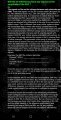
It states in section 4,
Each group has its own reference socket R and ground socket G. The 4 ground sockets and reference sockets can be connected. The calibration signals are also available on the push-pull connector on group D. The DRL socket is for internal testing usage only.
It does not give examples on how to use the reference socket R and ground socket G.
Neither does it give information on when to use the DRL socket.

My advice would be to not defeat or override patient safety (4) (5) (6).
Experiment with R and G connections. Contact the manufacturer and get more information on how to use R, G, and DRL.

Forget about capacitive coupling on the body because that is just a red herring.

Turn off all lights and other electrical devices in your room, or even in the building. As a test to find the source of the EMI, try testing outdoors using batteries. Do not use switching power supplies.
 

Thread Starter

Secan

Joined Sep 20, 2024
205
As I said, tackle one problem at a time.

The first problem is to deal with ESD, (1) (2) (3).
How are you going to develop ESD at 80% R.H.?

(4) (5) (6) is about patient safety.
Do not ignore or defeat this. The unit and patient must be isolated from AC mains.

Now we deal with EMI suppression.
I did not design the g.USBamp and hence I do not know how it is connected internally.
ECG units usually use instrumentation amplifiers with high CMRR. Also they use a reference electrode on the right leg.

The g.USBamp is different. It has 16 single ended input channels. Hence EMI suppression is problematic.
The unit was designed in Austria and the User Manual is lacking with some errors in the English text.

It states in section 4,


It does not give examples on how to use the reference socket R and ground socket G.
Neither does it give information on when to use the DRL socket.

My advice would be to not defeat or override patient safety (4) (5) (6).
Experiment with R and G connections. Contact the manufacturer and get more information on how to use R, G, and DRL.

Forget about capacitive coupling on the body because that is just a red herring.

Turn off all lights and other electrical devices in your room, or even in the building. As a test to find the source of the EMI, try testing outdoors using batteries. Do not use switching power supplies.
I know topics of bioamplifier is taboo here because oscilloscope is the tool of the trade by most people here. So let's discuss it briefly with one major question at bottom if lack of DRL is drastic if the unit is battery operated only.. And I'll just find bioamplifier forum to ask other questions in super details to avoid being off topic.

First about the DRL. in the g.USBamp. it is just output from the DAC (Digital to Analog converter) for internal test. There is total lack of DRL in for decreasing common mode.

DRL dac.jpg

Also the g.USBamp and other bioamplifiers (like Biosemi) don't use any instrumentation amplifiers. If it is instrumentation amplifier, the R or reference is the In- and this is used in unipolar montage where all the In+ are measured against one In-. In instrumentation amplifier, they tied up all the In-. right? The ground is just the amplifier reference common mode pickup. I just read the Biosemi web site when googling about DRL. The following would give us idea of how modern bioamplifiers use ADCs to subtract common mode.

I think the g.USBamp uses something like the following except there is no DRL

Why should I start with rereferencing for Biosemi EEG data? - FieldTrip toolbox

biosemi illustration.JPG


The above is from the Biosemi unit (I don't own this). In the case of the g.USBamp (which I owned). I guess it's same setup except no DRL and the ground is connected to the 1X amplifier reference?

In the following is detail (Biosemi) how the common mode is recorded and just subtracted in software. Here the g.USBamp and Biosemi share the same technique. If you will google. You will see more than 90% of university uses the g.USBamp, So it is extremely popular and they use it as the top reference where others are compared.

BioSemi EEG ECG EMG BSPM NEURO amplifiers systems

biosemi reference.jpg


I don't want to disturb out mostly oscilloscopes users at All about Circuits so let us not belabor it. Just please tell me. When the bioamplfier is battery operated. The common mode is not like the mountain described in the first URL but only perhaps like a table where the lego is measured? Or quoting it:

"Why is the common mode relevant
We want to measure the differential signal, i.e., the voltage difference between two electrodes. The common-mode signal itself isn’t interesting, but it makes measuring the difference more difficult. Let’s use an analogy to explain this: imagine trying to measure the height of a LEGO brick sitting on top of the Mount Everest. So you measure the top of the brick and the ground level right next to it, to determine the height as the difference between the two. If you do this from a large distance, you have to account for the entire mountain in your measurement. That’s difficult and requires a system with an extremely large dynamic range (on a 10 km scale, it still needs 1 mm accuracy). It’s much easier to use a measurement system like a short ruler that doesn’t detect the common mode (the mountain underneath)."

Second. Just tell me quick, MrChips. If your body acts like capacitive coupling source, can you shunt it by connecting antistatic wrist band to earth? Because if yes, then I'll just connect my wrist band to earth (due to lack of DRL) and not connect the unit potential equalization conductor (PEC) since I'm using 100% battery, so what's the use of connecting the wrist band to the unit PEC if I'm guaranteed to just use 100% battery?
 

Alec_t

Joined Sep 17, 2013
15,121
And what would happen if I connected the antistatic wrist band to the unit back potential equalization conductor while in use.
We don't know what, if any, components inside the amplifier are connected or coupled to that conductor, so we can't give a definitive answer.
 
Status
Not open for further replies.
Top