Positive-Negative ±5V current-boosted references

OBW0549

Joined Mar 2, 2015
3,566
I hear ya. But after 45+ years of "doing circuits for food" and 25+ years of using Spice, I've learned the hard way that there are limits to what Spice can tell you about the operation of a circuit, particularly when it comes to fine detail. Sometimes a circuit will oscillate in simulation, but be nicely behaved in hardware; or vice versa. Opamp models vary in their fidelity to the real thing; some are good, and others are atrociously bad and worse than useless.

My gut sense right now, born of experience, is that you need to start building some hardware and testing it to see what it really does.

Just my humble opinion...
 

Thread Starter

cmartinez

Joined Jan 17, 2007
8,760
I hear ya. But after 45+ years of "doing circuits for food" and 25+ years of using Spice, I've learned the hard way that there are limits to what Spice can tell you about the operation of a circuit, particularly when it comes to fine detail. Sometimes a circuit will oscillate in simulation, but be nicely behaved in hardware; or vice versa. Opamp models vary in their fidelity to the real thing; some are good, and others are atrociously bad and worse than useless.

My gut sense right now, born of experience, is that you need to start building some hardware and testing it to see what it really does.

Just my humble opinion...
I'm already buying the components and drawing the PCB... ;)
My estimate is that I'll complete this thing by the end of next week... then I'll take some pics and show you... and also use my scope to compare theory vs reality
 

Thread Starter

cmartinez

Joined Jan 17, 2007
8,760
OB, in post #58 the OpAmp and the LT1010 are being fed by +12V and -12V sourced by an ordinary 7812 and a 7912 linear regulator, respectively.
Of course, I'll be placing a couple of 10µF caps at the inputs and outputs of those two chips, and I also plan to sprinkle 100nf caps here and there to decouple every chip's +Vs and -Vs and keep noise at a minimum.
My question is, do I have to worry about voltage drift or noise from those two regulators? My instinct tells me "not so much" because although the power boost is coming from those two chips, the precision +7V is being generated by the LT1021-7 and both the OP277 (OP07 in the sim) and the LT1010 are referenced to this precision voltage.

Am I right?
 

Thread Starter

cmartinez

Joined Jan 17, 2007
8,760
In post 28 you said:
(C1 is there mainly to reduce the turn-off time of Q3, although it will speed up turn-on a bit as well.)

Is this what you meant to do? To help reduce Q3's storage time?
 

Thread Starter

cmartinez

Joined Jan 17, 2007
8,760
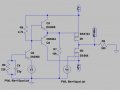
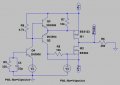
Another question, regarding safety. In the following circuit:

Capture.JPG

What happens if V3 and V4 are disconnected, thereby leaving both the emitter of Q4 and the base of M2 floating?
Will either of M1 or M2 conduct? or worse, would both conduct at the same time?
I've ran it through LTspice, and I'm under the impression that both remain off. M1 mainly because R7 is pulling its gate down (and also the effect of R8 on Q2 and Q3), but I'm not sure about M2. But I don't completely trust LTspice, since you said it does have limitations, especially when analyzing unusual situations.
 

OBW0549

Joined Mar 2, 2015
3,566
OB, in post #58 the OpAmp and the LT1010 are being fed by +12V and -12V sourced by an ordinary 7812 and a 7912 linear regulator, respectively.
Of course, I'll be placing a couple of 10µF caps at the inputs and outputs of those two chips, and I also plan to sprinkle 100nf caps here and there to decouple every chip's +Vs and -Vs and keep noise at a minimum.
My question is, do I have to worry about voltage drift or noise from those two regulators? My instinct tells me "not so much" because although the power boost is coming from those two chips, the precision +7V is being generated by the LT1021-7 and both the OP277 (OP07 in the sim) and the LT1010 are referenced to this precision voltage.

Am I right?
Yes.
 

OBW0549

Joined Mar 2, 2015
3,566
Another question, regarding safety. In the following circuit:

View attachment 87697

What happens if V3 and V4 are disconnected, thereby leaving both the emitter of Q4 and the base of M2 floating?
Will either of M1 or M2 conduct? or worse, would both conduct at the same time?
I've ran it through LTspice, and I'm under the impression that both remain off. M1 mainly because R7 is pulling its gate down (and also the effect of R8 on Q2 and Q3), but I'm not sure about M2. But I don't completely trust LTspice, since you said it does have limitations, especially when analyzing unusual situations.
I didn't notice this before, but R7 should be connect to -7V, not to ground. That way, R7 will be keeping M1 OFF by default, when not actively driven by Q2 or Q3.

That much done, if V3 is disconnected, leaving R8, Q2, Q3 and R7 to pull M1's gate negative and thereby turn it off.

If V4 is disconnected, you've got M2's gate floating. Double-plus ungood, as this leaves M2's gate voltage undefined. Put a resistor (10K should do) between M2's gate and +7V to ensure M2 stays off if its drive is disconnected.
 

Thread Starter

cmartinez

Joined Jan 17, 2007
8,760
Done! I'll have to patch my already etched PCB, but no big deal.
The reason I asked is because V3 and V4 are going to be generated by an MCU, whose outputs stay hi-z (floating) for a few milliseconds during startup.

Thanks again for all your help!

Capture.JPG
 
Last edited:

Thread Starter

cmartinez

Joined Jan 17, 2007
8,760
So I built the thing, and everything works fine, except for the -5V boosted reference.

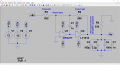
The diagram below shows what I actually built.

Capture.PNG

The +12V and -12V sources arrive from 7812 and 7912 linear regulators, respectively, which in turn are being fed by a ±15V switching power supply (whose outputs are connected to 10uF and 0.1uF caps for stability)
The 5V reference is fed from a MAX6143AASA50 chip, boosted with a transistor. That part is working perfectly, and I won't clutter this discussion with its details.

Anyway, the thing is that when I power up the circuit, the -5V output goes bonkers on me and just won't keep still. Also, the 1k pot that I'm using behaves in too sensitive a way, and will make the output voltage jump a whole volt with a very minor adjustment.
I've disconnected the 100uF cap shown in the schematic, and nothing's changed. The -5V source is simply not stable.
The presence or absence of C1 makes no difference either.

What am I doing wrong?
 

Attachments

crutschow

Joined Mar 14, 2008
38,503
What do you mean "it won't keep still"?

I simulated your circuit with an LT1007 op amp (I don't have a model for the OPA277) and it appears to work fine, with a steady -5V output.
Perhaps there's a problem with your OPA277 model.

To reduce the pot sensitivity, connect a resistor in series with each end of the pot resistance.
The larger the added resistor value, the lower the sensitivity of the pot adjustment.
 

Thread Starter

cmartinez

Joined Jan 17, 2007
8,760
What do you mean "it won't keep still"?

I simulated your circuit with an LT1007 op amp (I don't have a model for the OPA277) and it appears to work fine, with a steady -5V output.
Perhaps there's a problem with your OPA277 model.

To reduce the pot sensitivity, connect a resistor in series with each end of the pot resistance.
The larger the added resistor value, the lower the sensitivity of the pot adjustment.
Thanks for your help.
What I mean, is that my voltmeter will start reading variations (haven't scoped it yet, but I might) in the order of at least ±20mv twice a second, and it also tends to drift... A LOT.
I'm almost sure that the problem lies in the LT1010 chip. Or the way I connected it. Either way, my sim also shows a steady -5V output, but that's not the case in real life.
 

crutschow

Joined Mar 14, 2008
38,503
Thanks for your help.
What I mean, is that my voltmeter will start reading variations (haven't scoped it yet, but I might) in the order of at least ±20mv twice a second, and it also tends to drift... A LOT.
.....................
I don't see how it can drift at all in that circuit unless the +5V is also drifting.
What does the output of the op amp do?
I suspect something is oscillating.
Edit: Try reducing the value of C1.
If you do an AC simulation of the circuit you will see that C1 causes a peak in the response which could indicate an oscillation problem.

Why do you such an assortment of caps on the output?
All you need is a large electrolytic, and a 100nF ceramic.
 
Last edited:

OBW0549

Joined Mar 2, 2015
3,566
I agree with crutschow: your circuit is probably oscillating, most likely in the high hundreds of kHz or low MHz. Such oscillations tend to be erratic and heavily dependent on output voltage and loading.

1. C1 is way too small; increase it to 100nF or thereabouts.
2. Never drive heavy capacitive loads directly from an opamp output, unless you REALLY know what you're doing; put a 10Ω resistor in series with C3, C5, C7 and C8.
3. What is the purpose of R4? I see no use for it.
4. Your trimpot value is way too small; it constitutes an unnecessarily heavy load on your +5V reference. Also, the way you've connected it is counterproductive. Replace your 1kΩ trimpot with a pair of 10kΩ resistors (preferably 1% or 0.1%) and connect a 10kΩ trimpot between +5V and -5V with its wiper connected to the OPA277 inverting input through a 100kΩ resistor. These changes will lighten the load on your +5V reference, and give you a much finer range of adjustment on your trimpot.
5. Also, make sure the OPA277's and LT1010's supply pins are properly decoupled.

I suspect if you make these changes, your problem will disappear.
 

crutschow

Joined Mar 14, 2008
38,503
......................
1. C1 is way too small; increase it to 100nF or thereabouts.
.........................
That may not help, as my simulation showed an increase in peaking for the AC response as C1 is increased in value. May be due to the high capacitive load at the output.
That's why I suggested he try reducing its value.
 
Top