PNP transistor current supply

Audioguru

Joined Dec 20, 2007
11,248
I agree that you will not see or feel the LEDs getting hot but the chip inside an LED is heating and cooling and heating and cooling while slowly flashing and it will probably fail soon with thermal fatigue.
You should always never exceed datasheet ratings by using current limiting resistors, not by simply guessing.
 

Thread Starter

abc14

Joined Oct 15, 2017
123
Hi Guys, thanks for your inputs, I have simulated your suggestions an got following results. By simply changing the resistor values, I got Ib(q2) to 2mA and Ib(q3) to 20mA which is factor of 10, am I right to assume ic(q3) will be 200mA and it will provide upto 200mA boost IC ?

Second rather curious question, I have noticed in datasheets and even in simulaitons its currents are given in "-"?

upload_2017-12-24_10-29-5.png
 

ScottWang

Joined Aug 23, 2012
7,501
Hi Guys, thanks for your inputs, I have simulated your suggestions an got following results. By simply changing the resistor values, I got Ib(q2) to 2mA and Ib(q3) to 20mA which is factor of 10, am I right to assume ic(q3) will be 200mA and it will provide upto 200mA boost IC ?
It should be Ib1(Q1)=2mA, Ib2(Q2)=20mA, Ic3(Q2)=200mA, so you have to find a transistor that the rating current big than 1A, if it reach up to 1.5A is much better.
Second rather curious question, I have noticed in datasheets and even in simulaitons its currents are given in "-"?
The polarity of current is positive or negative that is depends on what position that you comparing with, for the +3V that the voltage less then 3V are all treat them as negative and the current is the same, for the Gnd that the voltage great then 0V are all treat them as positive and the current is the same.
 

Thread Starter

abc14

Joined Oct 15, 2017
123
It should be Ib1(Q1)=2mA, Ib2(Q2)=20mA, Ic3(Q2)=200mA, so you have to find a transistor that the rating current big than 1A, if it reach up to 1.5A is much better.

The polarity of current is positive or negative that is depends on what position that you comparing with, for the +3V that the voltage less then 3V are all treat them as negative and the current is the same, for the Gnd that the voltage great then 0V are all treat them as positive and the current is the same.
Thanks, how is Ib2(Q2) and Ic3(Q2) are calculated. I know Ib1(Q1) is simply 3-.7/1000 ~2.2mA...

But for Ib2(Q2) and Ic3(Q2) am not sure how its been calculated ?
 

ScottWang

Joined Aug 23, 2012
7,501
Thanks, how is Ib2(Q2) and Ic3(Q2) are calculated. I know Ib1(Q1) is simply 3-.7/1000 ~2.2mA...

But for Ib2(Q2) and Ic3(Q2) am not sure how its been calculated ?
Ic3(Q2) should be Ic2(Q2), that was my fault.
The calculation is quite simple that it is using hFE=Ic/Ib=10, and it is also needs calculate from the last stage as 220mA(Ic2-Q2) and Ib2(Q2) = 220mA/10 = 22mA, the Ib2 almost equal to Ic1, so Ic1≅Ib2=22mA, and Ib1=Ic1/10=22mA/10=2.2mA, during the calculation that you can find out the practical values of resistor to suit what the values of calculation needed.

Calculation method and direction:
hFE = Ic/Ib = 10
2.2mA (Ib1-Q1) ← 22mA (Ic1-Q1≅Ib2-Q2) ← 220mA (Ic2-Q2)
 

ScottWang

Joined Aug 23, 2012
7,501
Please see the page 2 to check the line labeled below --
Collector−Emitter Saturation Voltage Vce(sat), it is means that the Vce get into the saturation region and also see the values of Ib and Ic and their relationship.

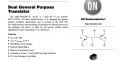
MBT3906DW1T1 -- datasheet.
 

OBW0549

Joined Mar 2, 2015
3,566
but according to datasheet hfe =100 -300
Don't ever, EVER try to design anything using numbers from the "advertising" stuff in the heading of a data sheet!

Always design using numbers from the Characteristics specification, and even then don't ever rely on "Typical" figures.

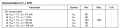
I can't find the ON Semi data sheet you've shown, but the data sheet from Semtech gives the relevant details:

Untitled.png

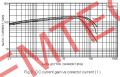
Notice that the hFE = 100 - 300 figures you quoted appear at Ic = 10 mA, and that at higher currents the gain is much lower. Figure 3 shows how the gain falls off with increasing collector current, especially at low values of Vce:

Untitled2.png

Notice also that under Absolute Maximum Ratings, the transistors can only handle 200 mA, not enough for your application.

You need to use a more appropriate transistor that can handle higher current.
 

Audioguru

Joined Dec 20, 2007
11,248
Saturation voltage ratings are when a transistor is turned on hard and is a switch. hFE ratings are when the transistor has plenty of voltage across it so it is an amplifier, not a switch.

The MBT3906 is the wrong transistor for the job:
1) With a collector current of 50mA and a base current of 5mA its maximum saturation voltage is 0.4V which is a fairly high voltage loss for such a low current.
2) They do not show maximum saturation voltages for higher currents because they might be almost 1V!
3) The package maximum allowed heating is 150mW but at 200mA and a saturation voltage of 0.8V the heating is more than the maximum allowed.

I would use an MBT4401 which would be much better since it has a maximum collector current rating of 600mA and lower saturation voltages.
 

Thread Starter

abc14

Joined Oct 15, 2017
123
Guys,


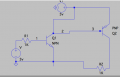
I have modified my circuit as below, since i realised I don't need to keep the PNP in active mode, as long as it provides vcc at collector.
I tested this circuit on breadboard with MBT3906DW1T1 and it works fine, with three LEDs and Attiny85 processor driving the LEDs. When I put a resistor at the base of PNP then circuit stops working otherwise its all good.

Now is it because the transistor is in saturation mode, it doesn't really care what active mode parameters are ? and its simply acting a switch allowing whatever at its emitter to pass through ?

And when I put back the base resistor it some how brings it into active mode and eventually not enough collector current in this mode stops it from providing enough current for the leds ?


upload_2017-12-24_21-16-8.png
 

Audioguru

Joined Dec 20, 2007
11,248
Your new circuit is missing two very important resistors:
1) Q1 needs a collector resistor because now Q1 is simply shorting the 3V to ground with unlimited current.
2) Q2 needs a base resistor because now the base is shorted to the emitter so it never turns on.
 
Top