Please help me understand Power Factor

Thread Starter

skradtim

Joined Jan 7, 2024
1
Was wondering if someone could help me understand more what Power Factor means. I never payed much attention to it until recently when I realized some lights I have, have a lower PF. Everything I tested before had a PF of 1 or in the high .90s which I'm almost certain is a good thing. For measuring I use this cheaper device called Kill A Watt made by Intertek. When I searched on google I gained a little more understanding but I'm still confused. From what I read people were talking about how it's usually from lower quality drivers for LED lighting and it's bad for the electrical grid. I have always thought for many years Volts x Amps = Watts. I never realized until recently that reading watts compared to reading VA can vary by so much which is where the PF comes into play. I'm also confused now as to which is being billed to the electric company.

I have this decorative small hydroponic gardening system QYO20. It's nothing too special but looks kinda cool. It's rated at 36 watts but said the product could vary. I wanted to calculate about how much a month this would cost to run. My meter generally said 115.5 volts, .26 amps, 17.3 watts, 30.3 VA, 59.9 Hz, .57 PF. Please note that these numbers change constantly but not drastically. 115.5 Volts x .26 Amps ≈ 30.3 VA. I understand the .57 PF is the % difference from the 17.3 watts. Am I being billed roughly for the 30.3 VA, the 17.3 watts, or some other amount?

Also thought this was interesting. An old cheap Walmart Great Value Brand CFL bulb. It is labeled 19 watts, 120 volts, .32 amps. Strange to me as 120 volts x .32 amps would be 38.4 watts. My meter says 116.1 volts, .25 amps, 19.1 watts, 29.3 VA, .63 PF. How would I calculate how much something like this would cost to run? Do I use the 19 watts, the 29.3 VA, or something else?

Then I have these cheap Walmart Great Value LED bulbs that claim 120 volts, 15.5 watts, .144 Amps. My meter says 116.3 volts, .12 amps, 14.3 watts, 14.5 VA, .99 PF. This makes things so much easier to me as there is very little difference in the watts and VA. I never realized until now that some products have a bad PF rating. Was wondering if anyone could explain to me in simpler terms what causes this lower PF rating, how much power is actually being drawn, which numbers do I use to calculate what I am being billed for? I know calculating the cost with a very high PF is easy. Such as in this case 14.3 watts for about 24 cents a kilowatt hour would be 24 cents x .0143 KW = .3432 cents per hour to run, or 8.2368 cents per day, etc. If I use 14.5 instead of 14.3 there is not much difference.
 

Ian0

Joined Aug 7, 2020
13,097
Power is the rate that which your load uses energy.
VA is the power supply voltage multiplied by the power supply current.
Power factor is the ratio of power to VA.

VA is the same as power for a DC supply.
For an AC supply, if the current is out of phase with the voltage (as in an inductive load) or the current waveshape deviates from a sinewave, then Power is no longer equal to rms voltage * rms current.
Power is always the average of ( instantaneous voltage * instantaneous current) .


You pay for power* not for VA, so a poor powerfactor will not increase your bill, but it increases the current in your cables.

*on a domestic supply
 

Papabravo

Joined Feb 24, 2006
22,058
Fundamentals of AC Power:
  1. With a resistive load, the AC voltage and the AC current have the same phase. Peaks will match peaks and zero crossing will match zero crossings.
  2. With ANY other kind of load there will be a phase difference between the AC voltage and the AC current.
The cosine of the phase difference is the power factor. When the phase difference is zero, the cosine(0) = 1. I'm no expert on how the power company charges for electricity so someone else will have to weigh in on that.
 

Ya’akov

Joined Jan 27, 2019
10,226
Welcome to AAC.

This chapter from the AAC textbook Lessons in Electric Circuits (free, here on AAC) discusses three different “kinds” of power:

  1. True, measured in Watts
  2. Reactive, measured in VAR
  3. Apparent, measured in VA

These distinctions only make sense in the context of AC circuits. The clean simple formulas you are familiar with for dealing with DC immediately begin to break down when dealing with AC. The higher the frequency of the AC the more problematic it can be to pin down.

So, \( {W=V\times A} \) that works perfectly to characterize the power dissipated by a DC circuit using the simple unit Watts cannot account for the variations in an AC circuit where, unlike DC the unit Ω doesn’t refer to resistance but something called impedance. This is because in an AC circuit the equivalent of resistance is frequency dependent.

Circuit impedance comes into play when the load is reactive. That is, when there are capacitive or inductive parts to it. A purely resistive load on an AC circuit is like the DC case—the simple formula for P, in Watts, works fine. So an incandescent lightbulb, for example, which is effectively nothing but a resistor can be treated in the simplest way.

But, a power supply, like the one that would be used in an LED (of CFL) bulb, particularly the kind called a capacitive dropper which actually depends on the idea of shifting the current around in the waveform, will not behave that way. This is where apparent power becomes important. As @Ian0 already mentioned, as a residential customer you are charged only for the true power you consume but industrial customers are charged for apparent power.

This is because (in the past) it made no sense to pay the cost try to work out apparent power for individual residences while the industrial customers were single, large consumers and installing equipment to meter apparent power was worthwhile. However, with the advent of smart meters that feature chipsets even more capable than your Kill a Watt, this may (and many expect it to) change. This could mean much higher bills for people using the very “energy efficient” bulbs pushed by the power companies and government!

In any case, the impedance of the circuit will determine the relationship between the waveforms of the two cogent components of the AC power being consumed: Voltage and Current. In the US, AC power is 60Hz (Hertz, cycles per second) and in the UK it is 50Hz. This means the polarity of the waveform changes 120 and 100 times a second respectively.

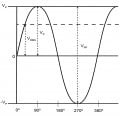
This constant varying from the positive to negative happens in the form of a sine wave. This is a very natural outcome of how electricity is generated—by spinning things—and represents a circle, split horizontally and divided between up and down. As you may have worked out, the sine wave starts at 0V, goes up to the peak positive voltage, crosses back down past 0V again, down to the peak negative voltage, and finally back to 0V.

AC-waveform.jpeg

This is why voltages are often quoted as “Volts Peak to Peak” (\( V_{P—P} \) which would be the difference in volts between the peak positive and negative voltages without concern about the + or - sign. So, \( 120V_{P-P} \) utility power in the swings 60V on either side of 0V, making the full circle (360°) 60Hz (and alternating between + and - twice that often at 120Hz).

This circular aspect becomes important in terms of characterization of the power as we start to introduce those reactive elements into the circuit.

Unmolested, the AC waveform has a phase relationship between the voltage and current of 0°. That is, as the voltage increases the current does in direct proportion at the same time. If you plot the two waveforms overlaid, there only appears to be one. But, of we introduce a reactive element, that changes.

There are two kinds of reactance we are concerned with capacitive and reactive. These are the outcome of how capacitors and inductors respond to changing voltages. It is this change that makes things so complicated. For example, a capacitor blocks DC. A steady DC voltage applied to a capacitor will not pass through it.

Capacitors only pass changing voltages. When a DC voltage is applied to an uncharged capacitor it will first charge up (taking some period of time according to the RC constant, that is the combination of the resistance and capacitance involved). During this charging, it will pass the voltage, which is not yet really DC since it is rising. Once the capacitor charges, the current stops flowing and the steady state DC is blocked.

On the other hand an inductor is basically an electromagnet. While the capacitor stores energy in an electric field, the inductor does it in a magnetic field. It is a direct analogy of the capacitor except that in the case of the inductor is is changes in current that affect it. As the current through the inductor changes the magnetic field around it either grows or shrinks.

If it grows, it uses power reducing the current until it reaches equilibrium; if it shrinks–-because the current through it diminishes—the collapsing magnetic field will induce a current in the inductors coil as if it is trying to keep the current at whatever level made that field possible. The capacitor does the same things with the voltage, charging and discharging in response to the varying voltage applied to it.

If you think about it, you might work out the reason this complicates the waveform picture. We have the capacitor opposing changes in voltage and the inductor opposing changes in current. If we match the two so that the waveform is kept as if it is only one, all is well, but if there is more capacitive reactance than inductive, the waveform for voltage will lag the current proportionally making it out of phase. If the inductive reactance dominates the voltage will lead the current by a proportional amount.

The reason this is problematic concerns the period of time during which the voltage and current waveforms are on the opposite sides of the 0V line. While current is still flowing, true power will be diminished by the magnitude of the difference. That’s because true power, (in Watts) is the product of Volts and Amps, and if they spend some time on opposite side of 0V the math says we can’t get any power for that time.

The result is a reduction in the actual work that can be done with the power during the interval. The larger the interval (the more degrees out of phase they are) the less power it is possible to transfer. This can affect transmission lines a great deal because to send ensure that enough real power is transferred the current in the lines would need to go up to compensate. More current means more heat, and there is a limit to the amount of heat that can be safely tolerated before the lines sag and possible short to ground. This means the worse the aggregate reactance on the network the more the capacity of the network is diminished.

This entire thing is summed up in Power Factor. A PF of 1 means the current and voltage are in perfect phase. This is almost never really the case for practical circuits with have inductive and capacitive reactance as a normal thing. But, a purely resistive circuit, like one for incandescent lighting, can come close. Generally inductive reactance is more of a problem because things like motors and even the wires themselves exhibit it in varying degrees.

That’s why Power Factor Correction is a thing. The efficiency of power delivery with increase in proportion to improvement. If you have a load with linear reactance where the curve of its reactance follows a linear curve, networks of passive components including capacitors and inductors can be used to bring the two waveforms back into phase. On the other hand, things that cause non-linear changes require active correction which is much more complicated and expensive.

The dramatic increase in the use of capacitive dropper power supplies in lighting and small appliances means there is more incentive for the power companies to try to recover the cost of delivering power by charging residential customers on the basis of apparent power rather than the real power we pay for now—and the smart meters are making that possible. Some manufacturers seem to be trying to improve the PF of their devices, and I have to think that before the power companies could shift to tariffs apparent power there would be a lot of noise from a lot of people.

If we are going to see such a thing, I think it would be proceeded in a new interest in effective and affordable residential PF correction gear. This would actually be a benefit to everyone since an increase in efficiency of the power grid is generally beneficial.
 

Ya’akov

Joined Jan 27, 2019
10,226
Fundamentals of AC Power:
  1. With a resistive load, the AC voltage and the AC current have the same phase. Peaks will match peaks and zero crossing will match zero crossings.
  2. With ANY other kind of load there will be a phase difference between the AC voltage and the AC current.
The cosine of the phase difference is the power factor. When the phase difference is zero, the cosine(0) = 1. I'm no expert on how the power company charges for electricity so someone else will have to weigh in on that.
As a rule, tariffs are on true power for residential customers and apparent power for industrial ones.
 
Top