Playing with inductors

WBahn

Joined Mar 31, 2012
32,840
What if the inductors have a fixed, unmovable position, such as the two lines present in a common-mode choke? Would that behave erratically?
My question relates to the fact that I can't find a commercially available inductor out there with the inductance and current characteristics that I want.
So what are you looking for in your inductor? What are your requirements?

I see that DigiKey has a 50 mH inductor with a 2 A rating. Is that close enough? What other characteristics are important?
 

Thread Starter

cmartinez

Joined Jan 17, 2007
8,762
So what are you looking for in your inductor? What are your requirements?

I see that DigiKey has a 50 mH inductor with a 2 A rating. Is that close enough? What other characteristics are important?
Economy ... the inductor you've mentioned retails for about about $10 bucks, and I was looking for something more along the line of $3.00 dlls. I need to make quite a few of these circuits, and the difference adds up. Another thing that bothers me a little, is that if I buy a two-line chuck, the second line will remain unused ... seems to me like a waste, but what the heck.

Another characteristic is that I'd like it to have a working voltage of at least 230 VAC, but I doubt that's a requirement hard to comply with.

I was thinking about buying one of those things that I've just linked, and split its core in half, so that the two lines can be completely separated ... but I think (and I'm almost sure, as a matter of fact) that I'd completely alter its inductive properties.
 

ebp

Joined Feb 8, 2018
2,332
"I was thinking about buying one of those things that I've just linked, and split its core in half, so that the two lines can be completely separated ... but I think (and I'm almost sure, as a matter of fact) that I'd completely alter its inductive properties."

You mean the one with the blue core at #11?
Yes, you would reduce its inductance probably by a factor of a few hundred. It becomes closer to your first-linked inductor - the spool-core type, except the (blue) core is less suitable for power. Even if you split the core and put it back together with a half millimetre air gap between the ends it would dramatically reduce the inductance - but it would allow it to handle much more DC bias without saturating.

What is the current at the peak of the (filtered) sinusoid? The inductor that WBahn suggested gives you an idea of the size that you must expect for a 50 mH inductor that will handle 2 A. [EDIT] Sorry, no, somehow I looked at the wrong thing. That inductor is again a common mode type and with a winding that will deliver 50 mH per side when used as such it is very likely to saturate at a very small current if used as a normal mode choke. This will be universally true for any high inductance common mode choke. Ungapped ferrite just is not suitable. Toroids are also considerably more expensive because they are much more difficult to wind. The first common mode choke you linked to, with the little gear teeth at the side of the coil, is a type that is cheap to wind. A two piece bobbin snaps onto a one-piece core, the gear teeth are engaged by the winding machine and it winds on a bunch of turns in a heartbeat. I have vague recollections of getting ones rated at about 2 amperes for around fifty or sixty cents.
 
Last edited:

Thread Starter

cmartinez

Joined Jan 17, 2007
8,762
@cmartinez: Only I can to find and what will work just fine, is 48mH, 0.64Ohm, 3A
string of 16 inductors. Price of string is $7.15, free shipping.
Buy them and make pilot model of PWM. Next time you will use DIY inductor, I guess.
View attachment 154302
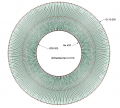
Lol! ... as a matter of fact, I tried to calculate, and then draw, my own inductor ... it ended looking a monster like this:

upload_2018-6-12_23-42-32.png

I guess my main limitation is the core material. Soft iron is not ideal when it comes to a compact design.
 

Danko

Joined Nov 22, 2017
2,169
Seems using several small inductors in series instead one bigger, dramatically reduce weight of core and copper,
and lower resistance of coil.
Edit: So, very interesting, how it possible? :eek:
 
Last edited:

Thread Starter

cmartinez

Joined Jan 17, 2007
8,762
Edit: So, very interesting, how it possible? :eek:
I'm laughing here ... if someone with your level of experience is making such a comment, where does that leave me? ... I consider myself an amateur, now I realize I'm more of a sub-noobie! :D
 

Danko

Joined Nov 22, 2017
2,169
I'm laughing here ... if someone with your level of experience is making such a comment, where does that leave me? ... I consider myself an amateur, now I realize I'm more of a sub-noobie! :D
Really, when we calculate inductor for keeping qualified quantity of energy, we have monster core, because in core we store energy. We use all volume of core, up to saturation. But in several small inductors, using 1000 times (for example) lover volume of cores in summary, we store the same energy, as in one monster. o_O
 

BobTPH

Joined Jun 5, 2013
11,515
Putting inductors in series will not increase the saturation current and will increase the series resistance.

Both are the opposite of what you want.

Bob
 

-live wire-

Joined Dec 22, 2017
959

ebp

Joined Feb 8, 2018
2,332
Again, ferrite core toroids are not suitable for the application. A common mode choke is intended to be operated with essentially zero net magnetizing force at low frequency.

There are really only two options for toroids that can handle DC bias and exhibit tolerable loss at high frequency.

Tape-wound cores consist of a very thin high-permeability metal that is wound to make a toroid shape. Each layer is insulated from the next by oxide or some other method to prevent eddy currents from flowing layer to layer. Core like this are not at all common and the alloys used are expensive.

By far the most popular core material for this sort of application is "powder", as I mentioned previously. Powder cores have vastly lower permeability than the ferrites used for common mode inductors. The ferrites will typically be between 5000 and 10000 perm. for CM chokes. There are very few choices in powder cores with permeability of more than about 150 - and that gets you into molybdenum permalloy powder that is very expensive. Inexpensive powdered iron tops out a permeability of about 100. In practical toroid geometries that are reasonably easy to wind, the ratio of cross section to magnetic path length does not vary by a lot. This means that regardless of the size of the core, there isn't much variation in inductance index, perhaps two or three to one, from one to another in a particular formulation. For example a Micrometals T106-26 (suitable material but not size for task at hand) is just over an inch OD and has an AL of 93 nanohenries per turn squared. A T400-46B which is 4" in OD has an AL of 205 nH/t^2. Micrometals type 26 material has an initial permeability of 75, is inexpensive and popular (and counterfeited!).

Taking the T106-26 for 10 mH at zero bias:
inductance is 10 x 10^6 nanohenries
divided by AL is 107527
the square root of which is 328
You would need 328 turns for a 10 mH inductor - that would be considered a "full" winding with about 25 AWG.
A 40 mH inductor would require twice a many turns.​
As soon as you apply any DC bias, the inductance will be reduced (my computer with my spreadsheet for doing this calc isn't running at the moment; I think Micrometals has on-line and down-loadable free tools for doing all the necessaries)

You can stack two toroid cores for twice the inductance index. Theoretically you could stack more, but practically the winding become a big problem.

Magnetics Inc. is a nice place to go core shopping for some of the more exotic core materials. Take lots of money with you.
 

Danko

Joined Nov 22, 2017
2,169
Putting inductors in series will not increase the saturation current and will increase the series resistance.
Both are the opposite of what you want.
Bob
Saturation current was 3A and still 3A.
Series resistance was 40mOhm and became 0.64Ohm.
Exactly as TS want.
What is wrong?
 

Danko

Joined Nov 22, 2017
2,169
Maybe combine two of these in series?
https://www.mouser.com/ProductDetai...=sGAEpiMZZMsVJzu5wKIZCRKkZmKdbMQO/zW5tu4Di6w=
That totals to $5. They are listed as "AC line filters" so they should work with your 230VAC. They are rated for 2A and are 25mH, with 200mOhms ESR.
Common mode chokes are not applicable, because they calculated for zero magnetization current.
2 A current is rated only for coils resistance and do not effect on tiny core, because currents in coils flow in opposite directions.
 

ebp

Joined Feb 8, 2018
2,332
I just looked at the specs for the little green toroid and I absolutely do not believe them.

3 mH with 20 turns equates to an AL of 7500 nH per turn squared (also expressed as millihenries per thousand turns). That means it could only be ferrite - there isn't the slightest chance it could be any powder material. Based on estimated dimensions of the core, an AL that high would require a permeability of around 10 000. A moderate permeability powdered iron core that size will be down to about 75-85% of initial permeability at 60 ampere-turns. 10k ferrite would be pretending to be air.

I would believe that you can put three amperes through the winding without excessive heating.
 
Last edited:

Danko

Joined Nov 22, 2017
2,169
I just looked at the specs for the little green toroid and I absolutely do no believe them.

3 mH with 20 turns equates to an AL of 7500 nH per turn squared (also expressed as millihenries per thousand turns). That means it could only be ferrite - there isn't the slightest chance it could be any powder material. Based on estimated dimensions of the core, an AL that high would require a permeability of around 10 000. A moderate permeability powdered iron core that size will be down to about 75-85% of initial permeability at 60 ampere-turns. 10k ferrite would be pretending to be air.

I would believe that you can put three amperes through the winding without excessive heating.
Good estimation! For ferrite and powdered iron cores.
How about some new (top secret:cool:) materials, like anisotropic alloys and so?
Information, provided by seller:
3X(Product Name : Toroid Inductor;Material : UL-polyolefin, Metal
DC Resistance(Max) : 40mOhm;Rated Current : 3A
Inductance : 3MH;Body Size : 16.5 x 7mm / 0.65" x 0.3"(D*H)
Lead Diameter : 0.8mm / 0.03"
Switching power output smoothing circuits.

Seems core material is not powder or ferrite, but some "metal"
Usually sellers are not lying.
And there is returns option:
buyer pays return shipping 30 days.
 
Top