Playing with inductors

Thread Starter

cmartinez

Joined Jan 17, 2007
8,760
I connected two 100 µH in series like this one and, as expected, their total inductance added up perfectly to 200 µH when I measured it with my meter, no matter which phase was connected to which.

But something funny happened when I drew them close together. If both of their phases are connected forward-biased (that is, the non-dot phase of the first inductor connected to the dotted phase of the second one) their total inductance would come down to 165 µH, but if I connected them back-to-back (with both dotted phases connected together) then their total inductance would increase to 365 µH.

Question, can I take advantage of that phenomena to build a, say, single 44 mH inductor out of a two-line 12 mH choke by connecting its two windings back-to-back?
 
Last edited:

MisterBill2

Joined Jan 23, 2018
27,513
By moving the two inductors near to each other you coupled the magnetic fields, thus changing the effective inductance. I recommend not using this in applications that require the inductance to be constant for the reason that any movement will change the inductance a lot, which may cause a problem.
BUT you have learned something, which is that most coils have a magnetic field around them that can affect other items near to them. That is important to know when building things that include inductors.
 

Thread Starter

cmartinez

Joined Jan 17, 2007
8,760
I recommend not using this in applications that require the inductance to be constant for the reason that any movement will change the inductance a lot, which may cause a problem.
What if the inductors have a fixed, unmovable position, such as the two lines present in a common-mode choke? Would that behave erratically?
My question relates to the fact that I can't find a commercially available inductor out there with the inductance and current characteristics that I want.
 

ebp

Joined Feb 8, 2018
2,332
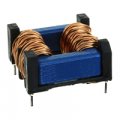
The inductor in the link is a common mode choke. It consists of two identical coils on a common high-permeability ferrite core.

The intent is that the current through the two windings should be equal and opposite. This cancels the inductance to the differential signal, but allow substantial inductance (impedance) to a signal that is equal and in-phase on both sides. This blocks high-frequency noise common-mode noise, but does not impede the differential current. The reality is somewhat different.

The winding design is such that there will be some normal (differential) mode inductance. This can be beneficial for the intended purpose of blocking RFI. Usually there will be a spec for differential mode inductance and it will be much lower than the common mode inductance.

Because the core is a high-permeability ferrite, it can withstand only a small amount of magnetizing force without saturation. This is OK for the common mode current because of the cancellation. If you were to connect the two windings in series [EDITED to correct error] you would get approximately four times the inductance of one of the windings alone. This is because the magnetic path is common, you have essentially doubled the number of turns and inductance is proportional to the square of the number of turns.

Ferrite core inductors intended to handle significant current are gapped - almost all of the stored energy is actually stored in the air gap. The gap greatly reduces the effective permeability and thus the inductance. Many inductors intended for power applications use "powder" cores where a ferromagnetic powder is held together with a non-magnetic binder to produce a distributed air gap.
 
Last edited:

MisterBill2

Joined Jan 23, 2018
27,513
There are definitely times when a recommendation based on one aspect is not the best choice. Using coupled inductors will be a more tedious way to obtain a specific value with a particular current rating, but it might be the only way to do it using standard components. It might become a real issue if it was in a production process instead of a single unit build.
.Another option would be to get a higher value coil and remove turns to obtain the desired inductance, or to wind an inductor with the required value and other properties.
BUT before going to any large effort I suggest a study of the design to determine if adjusting other component values, resistance or capacitance, might allow use of a standard part. Much of design engineering is about trade-offs, after all.
In summary, my advice was only a recommendation, not an order or an edict. And I never said that it won't work, just that it may be a challenge.
 

WBahn

Joined Mar 31, 2012
32,827
I connected two 100 µH in series like this one and, as expected, their total inductance added up perfectly to 200 µH when I measured it with my meter, no matter which phase was connected to which.

But something funny happened when I drew them close together. If both of their phases are connected forward-biased (that is, the non-dot phase of the first inductor connected to the dotted phase of the second one) their total inductance would come down to 165 µH, but if I connected them back-to-back (with both dotted phases connected together) then their total inductance would increase to 365 µH.

Question, can I take advantage of that phenomena to build a, say, single 44 mH inductor out of a two-line 12 mH choke by connecting its two windings back-to-back?
Probably not. I'm not familiar with the specs on these kinds of chokes, but I wouldn't be surprised if the individual inductors are much less than 12 mH (perhaps 4 mH? or so) and the 12 mH rating is the common-mode inductance.

You need to be very careful trying to use the mutual inductance of two inductors to set the effective inductance of a part -- there are lots of things that can alter the coupling coefficient by redirecting the magnetic field in the vicinity. This is harder, but not impossible, to do with a single isolated inductor (as your first measurement indicates).

But you CAN use this effect to make all kinds of detectors and sensors.
 

WBahn

Joined Mar 31, 2012
32,827
What if the inductors have a fixed, unmovable position, such as the two lines present in a common-mode choke? Would that behave erratically?
My question relates to the fact that I can't find a commercially available inductor out there with the inductance and current characteristics that I want.
I'd recommend revisiting why you think you need an inductor with a value you can't find commercially. If it is the result of earlier design choices, then revisit those choices and see if they can be tweaked to shift the inductor value close enough to a commercially available part to be acceptable. Design work is often about these kinds of iterations. Choose some components based on one reason and see what other components need to be. Then, with that knowledge, step back and fix the values of those other components instead and see what the first components work out to be and whether that is more workable.
 

ebp

Joined Feb 8, 2018
2,332
The inductor in the first link is an open magnetic path "bobbin" or "spool" core - essentially a ferrite rod with a ferrite flange on each end, wound with a few layers of ordinary magnet wire. I describe them as slopping magnetic flux all over the landscape. They are terrible for coupling to and from anything and everything nearby. The biggest thing they have going for them is that they are inexpensive because the core requires no precision finishing and they are easy to wind. They do have their uses, such as filtering where the current is mostly DC with some high-frequency crud upon it.

What characteristics do you require in your inductor of choice? What sort of application?

If you are considering inductors for a power application, many can be readily be pushed beyond specifications if you understand what you are doing. For example, many toroids on powdered iron cores will be specified for some "maximum" current based on some moderate fractional reduction in inductance ("swing") due to DC bias, but in many circuits allowing substantially more reduction is not only tolerable but a very reasonable target.
 

Thread Starter

cmartinez

Joined Jan 17, 2007
8,760
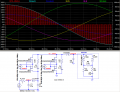
What I want to do, is find an alternative for the L1-C1 and L2-C5 low-pass filters in this circuit so generously posted by @Danko.

pwm_10_20khz_2.png

I've been experimenting with a few alternatives, and it seems that a value of 10 mH and 4 µF for the inductors and the caps, respectively, should do the trick. My concern now, is that the inductor I've chosen (I'd be using only one line of it, that is I'd be using two separate components for L1 and L2) is not of the toroid type. And my goal here is to reduce EMI as much as possible. I'm not sure there will be too much difference between using this rectangular choke, or a toroid type:


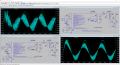
Below is the graph comparing the original 51 mH - 0.5 µF (right side) vs the 10 mH - 4 µF pair (left side). Output voltage is almost as smooth as the original, but the current flowing through L2 has a much more distorted form, especially at startup. I don't know if that's important. Also, I can tell that more current spikes are flowing through L2, but they're well within the 2.5A capability of the chosen inductor.

upload_2018-6-11_21-58-6.png
 

Attachments

ebp

Joined Feb 8, 2018
2,332
The rectangular type will be essentially the same as a toroid in terms of containment of the magnetic field. Effective permeability of the core is probably compromised slightly because it may be two U cores instead of a one-piece core which would mean a very tiny air gap where the faces of the cores meet, but the effect will be small.

If the motor model is correct, why are you filtering at all? A few millihenries in series with over half a henry (windings as taken as fully in parallel) seems rather futile. It certainly isn't going to have appreciable effect on the motor current. In the sim, compare the inductor current to the capacitor current and the current to the motor. Given the motor model, the filter capacitor makes a path for high frequency current that would not otherwise exist.
 

Thread Starter

cmartinez

Joined Jan 17, 2007
8,760
If the motor model is correct, why are you filtering at all? A few millihenries in series with over half a henry (windings as taken as fully in parallel) seems rather futile.
The motor is being PWM'd without any filtering, and it's causing enough EMI to sporadically reset the MCU producing the PWM signal itself. It's also interfering with UART communications and other things. The purpose of this circuit is to inhibit EMI produced during switching.
 

ebp

Joined Feb 8, 2018
2,332
So the LC filter is place as close as possible to the switches?

Assuming there are lead wires to the motor, be sure they are twisted or tightly bundled together to reduce loop area. This is an often overlooked critical aspect of EMI/RFI reduction.

You can probably reduce EMI with much smaller L and C - just sufficient to reduce the slew rate of the voltage in the wires without actually trying to eliminate the fundamental of the switching frequency. Consider one or more ferrite "beads" close to the switch end of the wires.
 

Thread Starter

cmartinez

Joined Jan 17, 2007
8,760
Assuming there are lead wires to the motor, be sure they are twisted or tightly bundled together to reduce loop area. This is an often overlooked critical aspect of EMI/RFI reduction.
Quite true ... as a matter of fact, the three cables are untwisted and unshielded ... I'm gonna put a cap to that ... thanks for the heads up.
 

ebp

Joined Feb 8, 2018
2,332
Have you 'scoped the signals at the output of the switches? Sometimes you can get some abominable ringing that is at a frequency much higher than the switching fundamental. This is where ferrite beads and things like RC snubbers can be helpful.
 

OBW0549

Joined Mar 2, 2015
3,566
... as a matter of fact, the three cables are untwisted and unshielded ... I'm gonna put a cap to that ... thanks for the heads up.
For sure, twist the conductors leading to the motor and shield them if at all possible. This will greatly reduce radiated EMI.

The motor is being PWM'd without any filtering, and it's causing enough EMI to sporadically reset the MCU producing the PWM signal itself. It's also interfering with UART communications and other things. The purpose of this circuit is to inhibit EMI produced during switching.
In addition to radiated EMI, don't overlook ground topology. The ground connections to your motor, to its filter cap C5 (ref. the diagram in post #11) and to the remaining power switching components should be taken directly back to ground at the power input, rather than through any paths in your MCU circuitry. All wiring and all circuit board traces have inductance; and this inductance, however small it is, can produce large transient voltages given the high motor current and the high dI/dT's of your PWM switching circuit.
 

MaxHeadRoom

Joined Jul 18, 2013
30,658
You could take a leaf out of the current method of wiring VFD's, the conductors are twisted inside a overall shield cover which is grounded at both ends, also the frame of the motor is connected to the same ground source.
Earth Ground preferably.
Max.
 

AnalogKid

Joined Aug 1, 2013
12,128
I think that combining the two inductors in a common mode choke will work as you want, but -

The choke's inductance is not tightly controlled, and the specific location of each winding of each inductor is not guaranteed from one part to another, leading to variations in the coupled inductance value. If you application can handle these variations, then I think it's worth at least prototyping.

ak
 

WBahn

Joined Mar 31, 2012
32,827
I think that combining the two inductors in a common mode choke will work as you want, but -

The choke's inductance is not tightly controlled, and the specific location of each winding of each inductor is not guaranteed from one part to another, leading to variations in the coupled inductance value. If you application can handle these variations, then I think it's worth at least prototyping.

ak
Although, if the application can handle those variations, it is more likely that an off-the-shelf inductor can be found that is close enough, too.
 
Top