Facebook
 Google
 GitHub
 Linkedin

djsfantasi
- Joined Apr 11, 2010
- 9,237
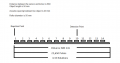
You seem to be having a problem understanding the concept of a bit in a shift register following a point on the conveyor. As you still seem to think in terms of 16500 pulses I will try to describe it in terms of a 16500 stage shift register. (Serial in and serial out.)Think of this shift register on the diagram above (The one in post #139) drawn below the line that says 16500 pulses. The serial in is the right hand end and the serial out is the left hand end. The serial in will be zero except when an item to be rejected is detected. The shift register is clocked with the encoder pulses. When an item to be rejected is detected the input to the shift register (Right hand end.) is set to a ONE state so the next encoder pulse will clock it into the first stage of the shift register.The shift register moves the bit one position to the left for every clock pulse (Encoder pulse.). So after 16500 pulses the ONE bit will have reached the output position (Left hand end.) This will be the same time that the item to be rejected reaches the reject point. The ONE bit at the output of the shift register can trigger the air jet to blow the faulty item off the conveyor.
Les.
A 16,500 bit shift register would be accurate to 0.07mm. I doubt he needs that much accuracy. If you could divide the counter by 100, you’d only need a 165 bit shift register and still be accurate within 0.7cm.
There’s a big savings to be had. Using 8 bit shift registers is a hell of s lot of chips. Using a 64 bit shift register and not dividing down the clock requires ~257 chips. Dividing down by 100 would require 3 chips. Of course, there are pesky details...