Photoelectric Optical Smoke Sensor

crutschow

Joined Mar 14, 2008
38,532
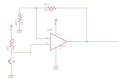
Okay, thank you for that. So setting it to be 0.2/0.3v with no smoke and no light will be the bias needed. Then just using a pot instead of the fixed resistor in the position specified will allow me to change the bias to get whats needed. Then changing R23 lower it would increase the gain.

I don't have a 1Mohm pot, i will get some ordered tonight. I'm guessing that a 20k would be miles off? Also, are you saying put the phototransistor to 3.3v because then the voltage that flows through is smaller and therefor wont hit the rails so easily? I have it connected to 5v.
Set it to a few tenths of a volt with light but no smoke.

I suggested a 10 megohm pot, not a 1 megohm.
You can try a smaller value, I just don't know how high a resistance is needed to get the desired signal.

5V is fine. Somehow I was thinking you had a 3.3V supply.
 

Thread Starter

Sam Matthews

Joined Jan 16, 2016
178
Okay, i will get a 10Mohm ordered then. They are hard to come across as cheap as the 1M or less pots.

I must admit that i'm a little confused why you want it biased with light at a few tenths if i;m honest though. It will never have 'light' hitting it, only a very small portion of light bouncing back from the smoke, i personally would have thought it was needed to bias it when there was no light hitting it so then the very small portion that does hit it from the smoke would be amplified up towards the 5v rail.... But hey, what do i know, that why i'm here asking you. Just explaining my thoughts, i will do as you suggest and see what the outcome is, thank you!

5V it is then. Also, once i have it setup to what looks to be right would you then substitute this pot for a fixed value of the same value that the pot is set to or would you leave a pot there for adjustments if needed however i do plan for this to be concealed away in a casing.
 

crutschow

Joined Mar 14, 2008
38,532
Well, I'm a little confused by your confusion. :confused:
By light on, I mean the LED is powered.
I assume when the LED is on the will be a small amount of light hitting the phototransistor, even when there's no smoke.
You bias it with that light.

You can try some fixed resistors first to see what the range of resistance is required.
A pot just makes it easier than swapping resistors.
You only need the pot if you are building more than one and don't want to hand select the resistor for each unit.
 

Thread Starter

Sam Matthews

Joined Jan 16, 2016
178
Well, I'm a little confused by your confusion. :confused:
By light on, I mean the LED is powered.
I assume when the LED is on the will be a small amount of light hitting the phototransistor, even when there's no smoke.
You bias it with that light.

You can try some fixed resistors first to see what the range of resistance is required.
A pot just makes it easier than swapping resistors.
You only need the pot if you are building more than one and don't want to hand select the resistor for each unit.
By no light that is what i meant sorry. So inside the chamber with the led on but no external light and no smoke is what i was trying to say. I was being too vague, sorry. So basically its to be setup in the conditions that it would be in normal use and bias to a few tenths with the pot adjustment and then introduce smoke and adjust the gain to suit so that smoke activation causes the output to fall just under or on the rail voltage?
 

crutschow

Joined Mar 14, 2008
38,532
........................... So basically its to be setup in the conditions that it would be in normal use and bias to a few tenths with the pot adjustment and then introduce smoke and adjust the gain to suit so that smoke activation causes the output to fall just under or on the rail voltage?
With the changes the output polarity is reversed so the voltage will now increase when smoke is detected.
 

Thread Starter

Sam Matthews

Joined Jan 16, 2016
178
With the changes the output polarity is reversed so the voltage will now increase when smoke is detected.
Yeah, so when it detects smoke the output should be around 4v-ish, well anything that is below the rail voltage, so anywhere between the biased voltage at no smoke and 5v (top end of the op-amp capabilities due to the supply voltage of 5v). Have i grasped your instructions correctly?
 

BobTPH

Joined Jun 5, 2013
11,537
Did you ever try what I suggested, changing the collector resistor? Changing from 10K to 100K will have the same effect as using an op amp to amplify by 10.

The way a phototransisor works is like this:

Light hits the base. This causes a base current proportional to the intensity of the light, which causes a collector current that is Beta times the base current.

So, for a given amount of light, the same collector current results.

Now, say the collector current is 10uA. If you have a 10K resistor this will result in a change of 0.1V at the collector. With a 100K resistor it will result in a change of 1V. With a 1 Meg resistor it will result in a change of 10V (assuming the supply was at least that high).

I think with the the proper arrangement of the chamber and a suitable collector resistor you could detect the scattered light. You say you put the LED and the detector right next to each other and pointed them down into the chamber. This is not good. Light will leak across from one to the other. They should be side by side, but separated by opaque black material (construction paper would work fine). Also angle them a bit toward each other so that the detector is looking directly at the smoke in the path of the LED.

Bob
 

Thread Starter

Sam Matthews

Joined Jan 16, 2016
178
So let me just clarify what you two are saying now;

@crutschow, you're recommending this configuration:
Phototransistor.jpg

@BobTPH, you're recommending this configuration:

Phototransistor2.jpg

I will attempt this with further detail tomorrow, i did quickly try Crutschow's suggestion however i was having trouble getting the biasing sorted, it was very very sensitive once it started to move and once i got it to around 0.5vish (I wanted 0.2) it wasn't responding to smoke. I think my biggest issue right now is trying to simulate the chamber for this to sit in. I think i may have to get one 3d printed off of 3dhubs.com while i'm waiting to get a 3d printer myself, as i'm struggling to get the chamber simulated properly, even to the point i can't get the LED and phototransistor to sit still properly.
 

MrAl

Joined Jun 17, 2014
13,711
Hi,

I dont get this project at all. Do i understand this right, that the light has to "bounce" off the smoke particles to be detected? If so, then what about black smoke, which comes from some plastics and stuff like that? Is that going to reflect or absorb?
Also, how much smoke are you trying to detect, very light smoke or very dense smoke?
Either way, the remainder of this post addresses the issues of measuring small quantities with high resolution. You might want to note however that modern smoke detectors use atomic radiation to detect the presence of smoke particles.

Another idea would be to detect the smoke by detecting how it interferes with a normal light beam. In this case it doesnt matter if it gets absorbed or reflected, as long as the chamber walls cant reflect anything.

Also, when trying to measure very small quantities it's often hard to find a technology that can provide the required resolution so it is very hard to measure absolute quantities. Going back in history, we find that they may have realized this as far back as 2000BC when they started using a balance scale. They found they could compare the weight of one thing to another thing where the other thing could be called the standard. The key here is when the comparison item is not the same there is a clear indication, and it doesnt take much to tip the balance. Thus even small differences could be detected, which is the whole idea in small measurments.

Lucky today we dont need the balance scale because we have op amps. Op amps can detect very small differences in their inputs and provide us with a huge output change which clearly shows that something has changed. That, along with the fact that sensors change innately over time without any provocation means that we should use a differential technique to measure small quantities if we cant find a good absolute measurement technique.

The implementation of these ideas is not new and is not particularly difficult. Using two sensors, one is the standard and one is the actual sensor. Light is shone on both sensors from the same light source, and if one sensor produces a signal that is even a tiny bit different that the first 'standard' sensor, we know something went wrong. So the implementation is similar to the 2000 (or more) year old weight scale.
BTW, if the two sensors age in a similar manner it wont need adjustment for a long time.

Using two sensors and detecting the difference with the op amp creates a very sensitive system that can detect very small changes. So given that, see what you can come up with :)
 

BobTPH

Joined Jun 5, 2013
11,537
So let me just clarify what you two are saying now;

@crutschow, you're recommending this configuration:
View attachment 106799

@BobTPH, you're recommending this configuration:

View attachment 106800

I will attempt this with further detail tomorrow, i did quickly try Crutschow's suggestion however i was having trouble getting the biasing sorted, it was very very sensitive once it started to move and once i got it to around 0.5vish (I wanted 0.2) it wasn't responding to smoke. I think my biggest issue right now is trying to simulate the chamber for this to sit in. I think i may have to get one 3d printed off of 3dhubs.com while i'm waiting to get a 3d printer myself, as i'm struggling to get the chamber simulated properly, even to the point i can't get the LED and phototransistor to sit still properly.
No, that is not at all what I was saying. I was saying that you don't need an opamp. Just take your original circuit and replace the 10K resistor with a 100K or 1Meg resistor to get more sensitivity, and leave it in the collector, it will be more senstive in that configuration. Note that you will get a high voltage with no light dectected and a lower voltage with light detected.

Bob
 

Thread Starter

Sam Matthews

Joined Jan 16, 2016
178
No.
You put the collector of the phototransistor to the +5V and the resistor between the emitter and ground.
The op amp input then goes to the junction of the emitter and resistor.
It would seem i put the images in the wrong spot. So if the one containing the POT anything like what you're suggesting? I have just looked over it again and i'm sure that its what your saying. At least, that is what i'm interpreting it as, i'm sorry if i'm wrong again, i'm finding this very challenging to 100% understand the proposed circuits.... I do suspect that i don't need to connect the pot to 5v, i think i have done that wrong. Maybe just connect the wiper to the emitter of the transistor and then they other side of the pot to GND.

No, that is not at all what I was saying. I was saying that you don't need an opamp. Just take your original circuit and replace the 10K resistor with a 100K or 1Meg resistor to get more sensitivity, and leave it in the collector, it will be more senstive in that configuration. Note that you will get a high voltage with no light dectected and a lower voltage with light detected.

Bob
Right okay, sorry. I just assumed you meant to do this on the input of the op amp. So you're saying to simply just increase the 10k resistor to a 100k resistor on my original circuit of:
 

Thread Starter

Sam Matthews

Joined Jan 16, 2016
178
Awesome, so the biasing is working as intended now it seems. Thank you for instructing me that i was making a mistake in the wiring. However, as i thought, this is incredibly hard to simulate without being able to print the enclosure for the LED and phototransistor to sit in properly, i have simulated it using the container that i have with no modifications to it due to having no supplies to work with. So, i think the next step now is to get my 3d printer all built and get an enclosure made for this to test it out. Thank you for your continued support guys!
 
Top