Photo-interrupter from a copy machine

MisterBill2

Joined Jan 23, 2018
27,568
What we have is a photo transistor that is either just a bit leaky or a bit turned on. It always has some amount of connectivity. And right now I am guessing that it was removed from service for some reason.
AND, as for pull-up resistors, they are vital to assure that logic goes to defined states for specific conditions. In most cases, operation is only defined with a specific pull up, or pull down resistance to a specified voltage and the manufacturer makes no claims for any operation under other conditions. That is why specifications matter. There is usually no promise of any particular performance outside of specified conditions.
 

Thread Starter

Alchemy One

Joined Oct 5, 2019
217
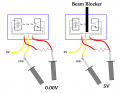
This is a crude representation of what a hall sensor does: It either supplies a voltage or holds the output pin to ground.
View attachment 258789
====================================
In regard to hall sensor, the only one I have had is the popular one... ( wonder why it is the popular one, once I thought. It is probably the easiest to make), the A3144.
I have tested it many times.
Behavior of hall sensor in pictures.
No magnet, flactuating small voltage that can trigger.... I can't think of anything at the moment. Perhpas turn on the world tiniest led that to see the LED, in my old age I would need a magnifying glass.
If I could have included a video I would have to show that supplying power or not had no effect on the flactuating output pin. Just being any electrical and electronic or living thing, it gets voltage.
AND THAT IS HOW I UNDERSTOOD WHAT FLOATING MEANS IN WHATEVER FORM, OUTPUT OR WHATEVER.
OF COURSE I HAVE BEEN WRONG MY WHOLE LIFE.

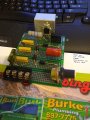
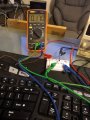
In pictures:
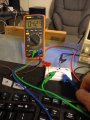
Picture one: measuring output just because it is there with nothing connected and caught the output at lowest trend.
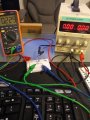
Picture two: Just touching the probe by one hand and measuring output. Power supply off.
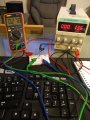
Picture three: No volts supplied and measuring output. Power supply on.
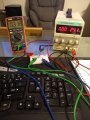
Picture four: 13 volts supplied and measuring output.
Picture five: 24 volts supply and measuring output.
 

Attachments

MisterBill2

Joined Jan 23, 2018
27,568
All of the hall devices that I have worked with produced noise, with or without a magnet. That was when they were connected to a high impedance oscilloscope input. About 50 millivolts as I recall.

But connected to a digital IC with the recommend resistor the output was a bit less noisy, but either about zero volts or about 5 volts, magnet/no magnet, when supplied by 5 volts connected to the V+ as shown in the application literature. Connecting as recommended makes all kinds of difference.
 

Tonyr1084

Joined Sep 24, 2015
9,744
The third picture shows the power supply supplying ZERO volts, and yet the meter is reading 0.229V.

Try this: Touch the two meter leads together and see if you get a voltage. If you do - and I suspect you will - either you've discovered a free source of energy or the meter is not properly calibrated. All my cheap meters will read a voltage when the leads are touched together. Same is true when measuring a resistor - leads together should read zero ohms but they measure some very low resistance. Likely it is a function of the resistance of the test leads.

What you're seeing is an artifact of the meter. A good (expensive) meter will be able to negate those artifacts.
 

Tonyr1084

Joined Sep 24, 2015
9,744
Connect a 1K resistor from the battery + to the signal wire. Now use a voltmeter to read the voltage on the signal wire both with and without the interrupter blocked. Then you will understand.
I couldn't agree more. When the beam is blocked the right end of the resistor will not be grounded, and the meter will read 5V. When the beam is NOT blocked the transistor will pull the right end of the resistor to ground and the meter should read zero volts. Here, let me draw you a picture. If this doesn't do it for you then nothing will.
1643297772284.png
 

Thread Starter

Alchemy One

Joined Oct 5, 2019
217
I couldn't agree more. When the beam is blocked the right end of the resistor will not be grounded, and the meter will read 5V. When the beam is NOT blocked the transistor will pull the right end of the resistor to ground and the meter should read zero volts. Here, let me draw you a picture. If this doesn't do it for you then nothing will.
View attachment 258854
===================================
I am tempted to say that there should be some voltage drop across the emitter LED.
Aside from that, on the right picture what would be reading if the meter probe on the right side were placaed on the left side of resistor? Wouild it also not read the same voltage as you are then simply measuring the supply voltage. No? But that doesn't seem right. Say it is 75K resistor. The right side of the resistor is closer to ground voltage than the left side of it or so I think. Maybe I need to snooze more
 
Last edited:

BobTPH

Joined Jun 5, 2013
11,524
There is no voltage drop across a resistor that is not carrying any current. On the right side, the resistor is not carrying any current.

That said, it is true that if you raise the resistor high enough, you will see a voltage drop. That is because the meter is pulling a small amount of current to read the voltage. A typical multimeter has a 1MΩ input resistance. So if you used a 1M resister, it would read 2.5V.

You really need to learn some basic electronics.

Bob
 

Thread Starter

Alchemy One

Joined Oct 5, 2019
217
There is no voltage drop across a resistor that is not carrying any current. On the right side, the resistor is not carrying any current.

That said, it is true that if you raise the resistor high enough, you will see a voltage drop. That is because the meter is pulling a small amount of current to read the voltage. A typical multimeter has a 1MΩ input resistance. So if you used a 1M resister, it would read 2.5V.

You really need to learn some basic electronics.

Bob
================================
So what you have said that the voltage does drop in actual reality but not enough to care about in so far as our senses are concerned. Is that the basic electronics that I was not aware of or was I?
My problem is, lots of things just made 0 sense. I mean no sense in the context of actual teaching. And without a second chance for any double take, things just kept going to the next chapter.

It started long long ago:
Everything was made of charges.
Then came:
Bobby, charge that battery.
It was a no brainer what it means and I mean that is that.
I went home because the forces were against me. I would have been chased my men, women and savage dogs if I said: " Either I am crazy or you are all out to lunch". Of course I lose. Get that disturbance outta here.

So I was left to whisper to my petty self: "But you said everything and I mean everything is made of charges. Isn't the entire battery including the case and it surrounding air-space and all things in it is nothing but charges. And if somehow not true exactly, then where did the charges go and wherever you get it from, aren't you depleting that. I am sure that source don't want to depart with their charges and all the place you forced them charges to go to from the battery, forcing and dumping them charges on them and causing them to be ..... I don't know charged up or something... it is hard telling what is what... all just.... I don't know whatever.. semantics, taking things too literally.. bad grammer, bad english... bad writing. run on statements. word salad...... and on and on. This is bogus". Out to digging ditches where I was to reckon with".

"And electricity moves through wires and you said what is electricity dear sir, charges or moving charges. And it moves like water through a pipe and generator produce it like water pump produce water.... I am getting dizzy. Somebody get me some water"

And one fine day when all was forgotten: " All computer know is 0 and 1. It converts everything into 0 and 1. It is the machine language. So whatever you put in to a computer, it converts it in to 0 and 1. Hmmmm are you sure it is not just a figure of speech and that no such thing exist in an electronic device. I wonder if I have to get an electron microscope to find these zillions of 0s and 1s."
Long gone those days... thank heaven. Strangely the teachings have not changed in all matter of fact. It repeats itself constantly without the slightest pause. In fact it actually starts there.
And computer science took the cake indeed.

[[Strangely I have yet to find one gentle and humble soul ( no that won't happen) to explain to me what on earth is this thing that is called "information" and please do not use these terms: " bits, bytes, binary, data, codes, logics, files, program, software, instruction, memory............. and whatever other abstraction that is still up your sleeve.]] Not a single human being, a single academic, a single expert have been able to tell me in clear plain simple language. And those who get really clever and start getting philosophical on me.... Well it depends what you mean by info.... blah blah blah...

Although I design and repair electronic components and keeping to myself when I see how even the "know people" mess up the most obvious things, screwing things up and even with deliberate and planned obsolence to make it difficult to find the fault or repair something and lack of access to blue prints and specifictions and creating the masses of a developed country to become parts changers at best. And the experts learn to follow instruction only so the system doesn't fall apart or there will be trouble. Repeat after me Jo and do what you are told if you want a secure job in the future or else you will be the lame bastard who will be calling the experts because you would be knowing nothing.

There is more than one way to create slaves.
The greatest tool, the greatest weapon and has been so from the time humankind learned to make noise through his mouth. Language.
Having a good command over language along with being in so called seat of know-how....oh my.
 

BobTPH

Joined Jun 5, 2013
11,524
Wow, that was truly enlightening. You might even say it gave me some information, though it is not what you were trying to convey.

Here is a definition of information: that which reduces uncertainty.

Bob
 

Tonyr1084

Joined Sep 24, 2015
9,744
if the meter probe on the right side were placaed on the left side of resistor? Wouild it also not read the same voltage as you are then simply measuring the supply voltage. No?
"NO?" you ask? Actually yes because you would read the supply voltage regardless of whether the beam was blocked or not.
Now, we can get real nit picky and point out line losses and forward voltage drops and all that stuff, but for the sake of understanding what's going on 5V on the left side regardless of the beam condition; 5V on the right side ONLY when the beam strikes the transistor. You would read zero volts when the beam is unbroken.

I said it before - I'll say it again - it's as simple as beans. If you haven't gotten it by now then I'm not able to help you any further.
Although I design and repair electronic components and keeping to myself when I see how even the "know people" mess up the most obvious things, screwing things up and even with deliberate and planned obsolence to make it difficult to find the fault or repair something and lack of access to blue prints and specifictions and creating the masses of a developed country to become parts changers at best. And the experts learn to follow instruction only so the system doesn't fall apart or there will be trouble. Repeat after me Jo and do what you are told if you want a secure job in the future or else you will be the lame bastard who will be calling the experts because you would be knowing nothing.
Here's my final word on this: ALL of us will BOW TO YOUR SUPERIOR KNOWLEDGE AND ACCEPT YOUR REALITY!

Now that we're done a moderator can lock the thread because it's going no where fast, and we can't convince you of the most simple logic of a circuit such as a photo interrupter or a hall sensor.

Good Night Gracie.
 

Thread Starter

Alchemy One

Joined Oct 5, 2019
217
Wow, that was truly enlightening. You might even say it gave me some information, though it is not what you were trying to convey.

Here is a definition of information: that which reduces uncertainty.

Bob
===============
That is a philosophical answer, not computer/electronic device reality.
Not a good thing to resort to that type of answer. Why? It is because I mastered philosophy since I could not get the lingo of science. Trust me. You don't want to know the half of it or you will be standing in there either totally in awe or perceive me of having inhaled some funny weeds, not that you don't think that now. :)
I perfectly understood and my question was answered to my satisfaction otherwise I would have kept on going until I got it.

[And by the way just because someone ( and I am included) know how to diagnose and repair something means they know what is actually going on.
So do you still charge batteries...?
Is this gonna work or should I call the professional?
This tread has served its purpose.
Good night mate.
 

Attachments

Thread Starter

Alchemy One

Joined Oct 5, 2019
217
Wow, that was truly enlightening. You might even say it gave me some information, though it is not what you were trying to convey.

Here is a definition of information: that which reduces uncertainty.

Bob
================
No enlightment was intended... but I have no say over another's perception.
And by the way, I want to remind you ( in case you have forgotten, which you all have). It is you who taught me that information in fact is what?.... Think now...... just think...
No I do remember.
Here is what you told me.
Information is ENERGY. That is in terms of actual physics of electricity.
YOU THINK ABOUT THAT....

Reminder: First you stored that energy in magnetic fields.. And it was too cumbersom
Then it became far more effecient to use electric field.....
No? hmmm. Right.
And it remained so to this day...
 

ThePanMan

Joined Mar 13, 2020
921
I am tempted to say that there should be some voltage drop across the emitter LED.
Yes, there will be. But that's not the part you're focused on. The SIG output is what you've been trying to figure out.
on the right picture what would be reading if the meter probe on the right side were placaed on the left side of resistor?
The full voltage. In the case of the diagram it would read 5V.
Say it is 75K resistor. The right side of the resistor is closer to ground voltage than the left side of it or so I think.
The right side of the resistor is not grounded if the beam is blocked. In that case it would read the full voltage. 5V in this case. Remember, if the beam is blocked the transistor is not conducting. Therefore no current is flowing through the resistor. Both sides of the resistor will measure the full voltage.
if you raise the resistor high enough, you will see a voltage drop. That is because the meter is pulling a small amount of current to read the voltage. A typical multimeter has a 1MΩ input resistance. So if you used a 1M resister, it would read 2.5V.
Think about it. Like Bob said, there is slight changes in the reading based on the meter itself. No measurement can be taken without some minute change in the current performance. Cheap meters will have greater error than the high cost meters. So for the sake of argument let's proceed assuming a meter has absolutely no affect on the circuit under measurement. Yes, Bob is right - but let's ignore the minute details and focus on the function of the sensor itself.
So what you have said that the voltage does drop in actual reality but not enough to care about in so far as our senses are concerned. Is that the basic electronics that I was not aware of or was I?
The difference would be in the pico range. Too small in nearly all cases to make a difference. There ARE times when the meter needs to be taken into condition, but again, let's focus on the circuit itself and ignore things like 0.000000001 changes in the reading. Your meter can't discern that small a difference. Nor should you care in this case.
"Either I am crazy or you are all out to lunch". Of course I lose. Get that disturbance outta here.
No need to take this to that extreme. We're just trying to help you understand the function of your circuit.
even the "know people" mess up
True, we ALL make mistakes. If someone doesn't make mistakes then they can't learn. Well, that's not 100% true, but I can assure you that MY mistakes have taught me just as much as any book or instructor.
There is more than one way to create slaves.
Nobody is trying to enslave you. They say "You'll know the truth and the truth will set you free." The definition of truth is "Accurate Knowledge". It comes from the Greek word epignosis, which means two things - "Epi" = Epitome, and Gnosis is the Greek for knowledge or to "Know".

So let's recap: The beam is blocked - the transistor is not conducting. Measuring the voltage on either side of the resistor will give you 5V (minus the very very very minute change the meter has caused). However, when the beam is not blocked - the transistor is in saturation and fully conducting (let's ignore the very slight voltage drop the transistor is producing and continue to talk theory". With the transistor fully conducting the meter reading on the left side of the resistor will read 5V and the right side will read (for all intents and purposes) 0V.

That's all there is to that circuit. How you choose to use the signal output is up to the designer/engineer. You can use it to turn something ON or OFF. You can use it to indicate any given message whether it's "Paper Out" or "Paper Jam" or a host of as many things as you can imagine. YOU are the limit to your growth.

The folks here only have good intentions and a sincere desire to lend assistance. They've helped me when I didn't understand. The key is that the learner has to be willing to embrace things they may have had mis-understandings about before.

That's it. That's the best I've got. If this. hasn't settled your mind then I think perhaps you might want to pick up a different hobby. Peace bro.
 

MisterBill2

Joined Jan 23, 2018
27,568
If you want to see something really confusing, connect your DVM across an LED , on the low volts range, and shine a light on the LED. Some LEDs withsom colors of light will give almost a volt! And there are also some LEDs that produce almost no voltage at all.
Is that fun or what??
 
Top