You left off the part of my post that told you how to test it after hooking it up.
Your question was how to hook up the signal wire. I answered it. MrChips has subsequently told you how yo hook up all the leads, giving a different value for the resistor, which us OK because it is not critical. Have you tried that?
It is difficult to decipher what you have written in such a long post.
The bottom line is: WE DON'T KNOW.
Because we are not there looking over your shoulder to see what you are doing.
We don't know what power source you are using.
We don't know what you are using to measure voltage.
We cannot see how your device is connected and how you are taking a measurement that would produce a negative voltage.
==================================
It is not so exhaustively involved to simply assume just using common sense that I am not using a high voltage 3 Phase AC power supply. Be assured no such thing.
Just simple 5 volts. In fact 2 volts.
Okay, keep it at first grade elementary grade level.
2 Volts to its positive leg and its negative leg to negative power supply. And by the way lets say it is DC, not AC. I am not using 2 Volts AC power. Make a note of it.
If you read my post clearly you will notice what pins I am supply this DC supply to.
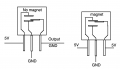
Then comes this third pin, third wire sticking out next to the other two. This wire they term it signal pin. [ Refer to photo)
Read carefully, there is no need that you have see over my shoulder. This is reader's digest level english.
When 2 volts is supplied, the signal wire is at the same voltage at the ground, meaning there is 2 volts between the it ( it means the signal wire, okay?) and the positive pin. Exactly the same as the voltage at the positive and its ground. So the signal wire is at the same voltage level as the ground. Do you know what all this means?
So if you take your voltmeter and place its two probes and touch the signal and the ground, it reads 0 volts and between the signal wire and the positive it will read 2 volts. You follow?
When interrupted.... Meaning the path the space between the emitter and the detecter ( SEE THE PHOTOS), then there is no voltage reading between the signal and the power wire, you will get 0 volts.
NOW DO YOU STILL NEED TO SEE OVER MY SHOULDER TO SEE WHAT I AM DOING?
If you don't get this..... I don't feel so bad now, having flunked everything.
[And by the way just for kicks I did manage to design a circuit using a PNP BJT and a P channel FET and inverted the whole signal output temperment to make a pulse motor work as good as it would have got. In fact when it the signal lost its negative output and went to 0 is when the FET energized the coil. It certainly is not as agile/responsive as a hall sensor. But that is neither here nor there]
Nice try. What you have posted is an extremely terrible attempt to communicate.
You have posted almost 1000 words that add no clarity to your situation.
You may think that "looking over your shoulder" is a joke and unnecessary.
Because you cannot communicate properly, had we been there looking over your shoulder we could tell exactly what you are doing wrong in 10 seconds.
There are some important lessons in electronics to learn here.
#1 - Use the proper language and terminology in order to communicate electronics concepts.
When a signal goes negative it should be indicated with a negative sign on a digital voltmeter.
We do not use the expression "go negative" when a signal is 0V with respect to the negative supply input.
The point of reference for measuring voltage in this case is the negative supply input. All voltages are described with reference to this point.
If there is no AC signal in your circuit, the voltage cannot go lower than the negative supply line. Hence there is no negative voltage.
If you connect the RED lead of your DMM (digital multi-meter) to the signal wire and the BLACK lead to the negative supply, you should read 0V.
If you then connect the BLACK lead of the DMM to the +2V supply line while leaving the RED lead on the signal wire, the DMM should show -2V.
This does not mean that the voltage at the signal wire is negative 2V. It is only negative with respect to +2V. The voltage at the signal wire is still 0V with respect to the negative supply line.
#2 - Understand the meaning of open-collector.
Do you know the meaning of open-collector? Do you understand what it means to apply a pull-up resistor to an open-collector output? This has already been pointed out to you.
Connect a 1kΩ resistor between the signal wire and the positive supply input.
Oh Wow!!! I had never considered that "going negative" might mean "returning to zero", so it confused me as well. Hence my comment in post #21.
Speaking in at least two different languages is bound to lead to misunderstandings.
(A lot like the words used by one small-board computer company that I have seen)
If this doesn't explain it - I don't know what will.
Somebody give that man a Snickers Bar. DUDE! We're only trying to help. But we can only go on the picture you paint. If you don't give sufficient detail - how can we be accurate?
2 Volts to its positive leg and its negative leg to negative power supply. And by the way lets say it is DC, not AC. I am not using 2 Volts AC power. Make a note of it.
This was the first time I've seen where you said the voltage being used was 2 volts. What is your power source? Is it an adjustable power supply? Can you preset the current? If we don't know what you're cooking we can't recommend a recipe.
Not understanding why you're having so much trouble getting this point: When the transistor is seeing the LED the signal (output) is held to ground (and not going negative). While held to ground it either tells another part of the circuitry in the printer that - perhaps it means you're out of paper - or whatever circuit it was on. When the LED is blocked, the transistor goes open. Meaning there is no transmittal of power. An open signal can mean (in the case of sensing paper) the printer can go ahead with the printing operation.
I don't see any reason for getting frustrated with us. We're only trying to be helpful. If we can't give you the answer you expect then perhaps it's time to change your expectation. I'm pretty much a novice at electronics. Most of the guys here are technicians or engineers. Or perhaps even better. And they have far more experience than I have. Likely more experience than you have. But if you insist that 5 + 5 = -2 then we can't help you. The best thing you can do is try and learn something. And whomever suggested you hook up a 1KΩ resistor - yeah, I can see how that wouldn't help you, but rather frustrate you. It would frustrate me for sure. But I've seen plenty of excellent answers. Not necessarily on a first grade level, but on a level that most slightly experienced beginners should be able to understand.
Perhaps you might take and post a clearer picture of the underside of the sensor you're working with. If we can see what circuitry is present, and if any other components are present, we might change our response. A picture paints a thousand words.
This might help you understand. If a paper tray sensor, there's likely a swinging arm that blocks the beam unless paper is present. This tells the printer that it has paper and is ready to print. If the last sheet is pulled through the printer and there is no longer any paper to trip the swinging arm then the beam will be broken and the transistor will stop conducting. The printer ready signal will go away and the printer will alert you that the paper try is empty. The only thing that is more simple than that is bubble gum.
I have re-read your original post, and, for starters, there is no question in it.
The first two responses explain how a typical photo-interrupter work. I can appreciate that you did not understand those because did not have the vocabulary (open collector, for instance.)
In your second post, you do ask a question:
Just want to know where the signal wire is connected to, to behave that way.
Now that I have reread everything, I assume “to behave that way” means the way you saw it work on YouTube as described in your first post, though that was not clear before, the context being too far removed.
So now I can answer your question:
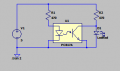
Please note: The photocoupler symbol shows 4 leads. Yours has three, the bottom two being combined internally, which I did externally for this circuit.
Nice try. What you have posted is an extremely terrible attempt to communicate.
You have posted almost 1000 words that add no clarity to your situation.
You may think that "looking over your shoulder" is a joke and unnecessary.
Because you cannot communicate properly, had we been there looking over your shoulder we could tell exactly what you are doing wrong in 10 seconds.
There are some important lessons in electronics to learn here.
#1 - Use the proper language and terminology in order to communicate electronics concepts.
When a signal goes negative it should be indicated with a negative sign on a digital voltmeter.
We do not use the expression "go negative" when a signal is 0V with respect to the negative supply input.
The point of reference for measuring voltage in this case is the negative supply input. All voltages are described with reference to this point.
If there is no AC signal in your circuit, the voltage cannot go lower than the negative supply line. Hence there is no negative voltage.
If you connect the RED lead of your DMM (digital multi-meter) to the signal wire and the BLACK lead to the negative supply, you should read 0V.
If you then connect the BLACK lead of the DMM to the +2V supply line while leaving the RED lead on the signal wire, the DMM should show -2V.
This does not mean that the voltage at the signal wire is negative 2V. It is only negative with respect to +2V. The voltage at the signal wire is still 0V with respect to the negative supply line.
#2 - Understand the meaning of open-collector.
Do you know the meaning of open-collector? Do you understand what it means to apply a pull-up resistor to an open-collector output? This has already been pointed out to you.
Connect a 1kΩ resistor between the signal wire and the positive supply input.
====================================================
See if this is clear.
Say I supply 5VDC to the device, (this opto-interruptor), if I check the voltage between its ground (placing the negative probe of the DMM) and its positive wire ( the positive probe of the DMM), naturally it would read 5 volts. Of course it would, because it is what I am supplying it.
Okay, now I take my DMM and do the same thing as above. I place its negative probe on the signal wire and its positive to the positive wire, it would read 5 volts. You read it correct, 5V. That is, it is the same voltage reading as between the ground and 5V supply in the first paragraph. Whatever voltage I supply is the same voltage I would read between the signal and the supply. Is that clear?
Now when the path of light in the device is blocked the reading between the ouput pin and the positive reads 0V. Whatever term you want to use I have nothing to do with it. I am not using any terms/lingo, just describing it without putting a label on it.
You can put any label on it you like.
Now with respect to your 1K "pull up resistor" to be used on the signal wire. That is a bad thing. Just bare with me. I don't expect you to agree with me.
The so called pull up and pull down stuff that is used for signal wires are used for a specific purpose.
That purpose is for what is called floating voltage.
Floating voltage is that area of voltage that is neither belongs to the negative ( call it 0 volts) nor does it belong to positive voltage ( call it the high voltage). It is in between voltage.
A pull up resistor ( or pull down for that matter) is used to make sure that whatever the signal wire is supplying signal ( voltage or current), that it is either supplying or it is not. The default value of the output signal ( that is the value of when the sensor is supplied with voltage) can be either floating positive or floating negative. For instance hall sensors are all for the most part floating positive. That is when you supply voltage to a hall sensor, you can read small voltage between the signal and the ground wire, very small voltage even after all the amplifications. And when you pass a magnet by it, that is when you will read voltage between the signal and the positive supply. It means that the signal wire becomes at the same voltage as the ground wire. With respect to supply to the gate of whatever transistor, it means that when a magnet is by the hall, the transistor actually turns off and when there is no magnet present, the transistor is on. No, not because the signal wire is actually supplying voltage to the transistor, nope. It is because the signal is is connected to the positive supply. And the reason the resistor ( the so called pull up resistor) is there is simply to control the voltage so the gate of the transisor doesn't get a full dose of full voltage from the positive supply.
Now look, the signal wire on this opto-interruptor is clearly not a floating output. Something you should really consider.
There is nothing to pull up or pull down or whatever.
Having said that, it is clear to this uneducated hard headed fellow says that with this device, that a resistor must actually be placed a resistor between the signal wire and the gate of the device it is sending signal to, but furthemore a resistor should be placed between the positive pin of the emitter and the supply voltage. Just how much in my estimation, 1K each.
Those resistors are used for the purpose of keeping signal of the ouput, digital you could say, that is either it is one value or another.
The signal of this device is obviously has the exact value of whatever the input voltage but it is not a positive value. That means it is not at the same value as the positive supply but the same value as the ground.
If it had the same value as the positive supply it would mean you will be reading voltage reading between it and the ground.
So this means that if you hook up this signal wire to a gate of whatever, it is the same as if you are hooking up the negative, the ground supply to the gate and when the path of emitter is blocked the ground disappear, no voltage, the same as turning off the switch.
In this regard negative voltage exist just like positive voltage. And then 0 voltage exist. It is a fact.
This is all covered in transistor subjects, enhancement and depletion modes. How each respond to 0 volts.
For instance N channel mosfet in enhancement mode does not conduct current at 0 volts or below while the depletion mode does.
The depletion mode is on down to -3V. You with me longer? However you can't really find depletion mode FETs, okay?
Not good connecting the signal wire to the positive rail unless you want fire on your hand. That would be like connecting the negative leg ( ground) of the emitting diode to the positive rail as if the resistor will help you, plus it serves no purpose plus you will get lots of smokes. Not good.
Floating voltage is that area of voltage that is neither belongs to the negative ( call it 0 volts) nor does it belong to positive voltage ( call it the high voltage). It is in between voltage.
No. It's not a voltage at all. It's an open. Not an open voltage it's just like taking your probe and sticking it in the air. You're not going to read any kind of voltage. Your meter may be saying it sees something but that's just an artifact of the meter and not a voltage.
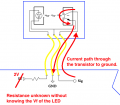
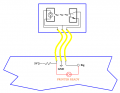
When you apply 5V to the first of three wires (as shown in post #32 reading from left to right) and ground the middle pin the LED will emit light. When it emits light that reaches the photo transistor the transistor will conduct whatever is present on the signal wire will be held to ground. Being held to ground is an absolute - it is grounded. When you block the light the transistor no longer conducts whatever is present on the signal to ground - it is floating.
If you have a 24 volt lamp (and I'm using 24 as just an example) and on one lead you connect it to a 24 volt source and the other end of the SOURCE to ground (middle wire) the light will light up when the LED is shining on the transistor. When you block the light from the LED the 24 V lamp will go out. It thinks there's an open circuit - be it a switch or a broken wire the 24 volts goes nowhere.
In Tony's illustration when the beam is not broken the "Printer Ready" light will be lit. When you block the beam the "Printer Ready" light will go out. In that illustration it can be anything connected to the signal. When the beam strikes the transistor the transistor conducts whatever voltage and current present to ground. Be it a light, a fan, a siren or anything else, all the beam is doing is turning that transistor on or off. No light - no conduction. Light - transistor conducts whatever is present on the signal line. It's a follower setup. You can have a 9V battery hooked to a 9V fan, positive to the positive lead of the fan, the negative lead of the fan connected to "Sig" and the negative lead from the battery connected to ground then the fan will run unless you block the beam.
If you still don't understand then I'm at a loss to figure out a way to help you further without sitting side by side and building some experiments.
I give up. I answer his exact question with a schematic, and he goes back to explaining the behavior, which all of us already understand and has been a explained in every possible way, with no comment on my answer. Apparently, his entire purpose is that argue with us.
I give up. I answer his exact question with a schematic, and he goes back to explaining the behavior, which all of us already understand and has been a explained in every possible way, with no comment on my answer. Apparently, his entire purpose is that argue with us.
I was coming to the same conclusion. Either he's trolling us or he just refuses to let go of his notions even though it has been thoroughly explained to him.
No. It's not a voltage at all. It's an open. Not an open voltage it's just like taking your probe and sticking it in the air. You're not going to read any kind of voltage. Your meter may be saying it sees something but that's just an artifact of the meter and not a voltage.
When you apply 5V to the first of three wires (as shown in post #32 reading from left to right) and ground the middle pin the LED will emit light. When it emits light that reaches the photo transistor the transistor will conduct whatever is present on the signal wire will be held to ground. Being held to ground is an absolute - it is grounded. When you block the light the transistor no longer conducts whatever is present on the signal to ground - it is floating.
If you have a 24 volt lamp (and I'm using 24 as just an example) and on one lead you connect it to a 24 volt source and the other end of the SOURCE to ground (middle wire) the light will light up when the LED is shining on the transistor. When you block the light from the LED the 24 V lamp will go out. It thinks there's an open circuit - be it a switch or a broken wire the 24 volts goes nowhere.
In Tony's illustration when the beam is not broken the "Printer Ready" light will be lit. When you block the beam the "Printer Ready" light will go out. In that illustration it can be anything connected to the signal. When the beam strikes the transistor the transistor conducts whatever voltage and current present to ground. Be it a light, a fan, a siren or anything else, all the beam is doing is turning that transistor on or off. No light - no conduction. Light - transistor conducts whatever is present on the signal line. It's a follower setup. You can have a 9V battery hooked to a 9V fan, positive to the positive lead of the fan, the negative lead of the fan connected to "Sig" and the negative lead from the battery connected to ground then the fan will run unless you block the beam.
If you still don't understand then I'm at a loss to figure out a way to help you further without sitting side by side and building some experiments.
===============================
Providing a path to the ground. Wollah. Caught it in the last second.
You are a good man Charlie Brown.
Holding hands and bowing.

 Facebook
 Google
 GitHub
 Linkedin