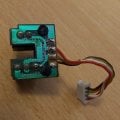
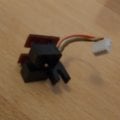
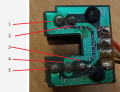
I have an usual photo interrupter which has 5 pins rather than the usual 4. Can someone explain this to me? On the PCB it says Vcc, Blast, Incept1 and Incept2.
I know the usual 4 pins are Vcc, GND, collector and emitter.
Yes, the photosensitivity of the base is the main point of a phototransistor, but, many include an external electrical connection to it. This allows for a couple of useful things: biasing, to adjust sensitivity; and overriding of the output electrically.
It can probably be ignored in your application since you didn't anticipate using it. Just test the device and work out which pin gives you the output you expect and leave the other unconnected.
Yes, the photosensitivity of the base is the main point of a phototransistor, but, many include an external electrical connection to it. This allows for a couple of useful things: biasing, to adjust sensitivity; and overriding of the output electrically.
It can probably be ignored in your application since you didn't anticipate using it. Just test the device and work out which pin gives you the output you expect and leave the other unconnected.
2 pin side is emitter LED
3 pin side was likely to be transistor as Dick Chapels and others suggested but... due to additional info on the PCB silkscreen, i would say this it not the case, this must be a dual output product as used in computer mouse (quadrature encoder). and since on a separate PCB this is most likely scroll wheel sensor. same was used for X/Y position in the old ball mouse but those would be on the same PCB.
I suggest that instead of going over the possibilities, that perhaps some investigation with a meter is in order. The investigation I suggest will require a DMM with a diode test function. Start with checking the side with the three pins in the diode test mode, and see if any combination of connections shows other than an open circuit.
BUT, consider that it has one of those three pins tied to a pin on the LED side, discover which connection is to light the LED. Then for the two leads from the three pin side, connect 10K resistors to the other supply side that is not connected to the two pins. Now with the LED power supplied, check both of the leads with the pull up resistors as the sensor is blocked and unblocked.
Also, visit the Digikey website catalog and look at the listing for optical interrupters. That may provide some useful information, totally unlike the cartoonchannel.
2 pin side is emitter LED
3 pin side was likely to be transistor as Dick Chapels and others suggested but... due to additional info on the PCB silkscreen, i would say this it not the case, this must be a dual output product as used in computer mouse (quadrature encoder). and since on a separate PCB this is most likely scroll wheel sensor. same was used for X/Y position in the old ball mouse but those would be on the same PCB.
This makes sense since the naming—poorly translated Chinese—supports it. But, if that’s the case, testing for an output that works and ignoring the other will work just as well.

 Facebook
 Google
 GitHub
 Linkedin