Facebook
 Google
 GitHub
 Linkedin

Using a circulating fluid becomes less desirable if you need a quick change, because one of the main advantages of the approach is the large reservoir of liquid at the desired temperature. It may still be a viable approach, just a little less attractive now.
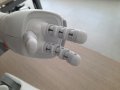
Since the hand is metal, it conducts heat well and it's going to feel cold at ambient temperature. I don't think you'd ever need to actively cool it unless ambient temp is over 90°F or so. So maybe you can simplify your project a LOT by using a resistive heater such as nichrome wire and concede defeat on the cooling.
Do you have a plan to measure the temperature of the user's hand and the robot's hand? Your ability to have a good feedback loop will depend on the speed and precision of determining the ∆T. You can employ a control scheme as simple as a bang-bang (on or off) thermostat, or you might want to learn about a PLC approach to provide a more elegant heating control.
Since the hand is metal, it conducts heat well and it's going to feel cold at ambient temperature. I don't think you'd ever need to actively cool it unless ambient temp is over 90°F or so. So maybe you can simplify your project a LOT by using a resistive heater such as nichrome wire and concede defeat on the cooling.
Do you have a plan to measure the temperature of the user's hand and the robot's hand? Your ability to have a good feedback loop will depend on the speed and precision of determining the ∆T. You can employ a control scheme as simple as a bang-bang (on or off) thermostat, or you might want to learn about a PLC approach to provide a more elegant heating control.