If you try to do a root mean square average on power, you get the wrong answer. Root mean square averages only work on parameters that need to be squared to give power.
In text books, one usually find the explanation of the root mean square average alongside a sinewave, with a derivation of the DC voltage that will result in the same dissipation in a resistor. The association between rms and a sinewave, has somewhere been misconstrued that rms is a property of sinewaves. So "rms power" has be a misnomer for sinewave power i.e the power dissipated in a certain load resistors by the largest amplitude the amplifier can produce at a given level of distortion. In order to make the figures better, use a higher level of distortion.
If the power were a sinewave, then there would be as much power being transferred to the robot in the positive going half cycle as was being transferred from the robot back to the power supply in the negative going half cycle, and the average power transferred would be zero.
Fisher was one of the most popular brands back then ... along with Marantz, Pioneer and Alpine ... although the last two were mainly for automotive sound systems
Fisher was one of the most popular brands back then ... along with Marantz, Pioneer and Alpine ... although the last two were mainly for automotive sound systems
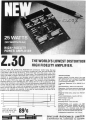
I built my first stereo amp (actually it was a 4-channel quadraphonic sound system) based on the Sinclair Z.30 amplifier modules. I too went on to building stereo systems for friends.

 Facebook
 Google
 GitHub
 Linkedin