Peak Power vs. Peak Wattage

Thread Starter

joeyd999

Joined Jun 6, 2011
6,438
Someone explain this to me. I've never seen an amp specified with two different numbers for "Output Power" and "Output Wattage".

I suspect this is a marketing gimmick, and both are lies -- as is typical today. At least they didn't specify "RMS Power".

----------
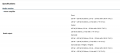
YAMAHA R-S202BL Stereo Receiver

Product information

Connectivity TechnologyBluetooth version 4.1 + EDR
Controller TypeRemote Control
Other Special Features of the ProductAdvanced circuitry design.Speaker selector for 2 systems. Input Sensitivity (CD): 500 MV/47k ohmsHead phone terminalAuto power standby functionSpeaker selector and speaker terminals for two systems
Compatible DevicesSmartphone, Tablet, Speaker, Television, Game Console
Connector TypeHDMI
Audio EncodingStereo
Audio Output ModeAdvanced circuitry design.Speaker selector for 2 systems. Input Sensitivity (CD): 500 MV/47k ohmsHead phone terminalAuto power standby functionSpeaker selector and speaker terminals for two systems
Surround Sound Channel Configuration0.0, 2
Output Power85 watts
Number of Channels2
Output Wattage100 watts
Supported Internet Servicesstreaming music services
Control MethodRemote
Audio Output TypeSpeakers
FormatWMA
Wireless TechnologyBluetooth

I am in the market for a decent amp to replace the 4 year old (cheap) Pyle that quit on me. Willing to spend up to $300. 100W to 300W per channel is an acceptable power range. I'm taking suggestions from those with experience.
 

Thread Starter

joeyd999

Joined Jun 6, 2011
6,438
The Watt is a unit of power.
And who says there's nothing new to learn here on AAC?

I'm looking for the answer as to why there are two different numbers, both synonymous with "Output Power".

And this is Yamaha, for Pete's sake. They've been writing spec sheets (some pretty good ones) since before I was alive.
 

Thread Starter

joeyd999

Joined Jun 6, 2011
6,438
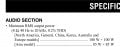
Help me make sense of these:

Minimum RMS output power
(8 Ω, 40 Hz to 20 kHz, 0.2% THD)
[North America, General, China, Korea, Australia and
Europe models] ................................................. 100 W + 100 W
[Asia model] ......................................................... 85 W + 85 W
• Dynamic power per channel (8 Ω/6 Ω/4 Ω/2 Ω, IHF)
....................................................... 125 W/150 W/165 W/180 W
• Maximum power per channel (4 Ω, 1 kHz, 0.7%, THD)
[Europe model] ..................................................................... 115 W
• Maximum effective output power (8 Ω, 1 kHz, 10%, THD)
[General model] ....................................................................140 W
[Asia model] .........................................................................125 W

Minimum Output Power? So I can't turn it down? (That's a joke.)

Which is the spec that counts?
 

nsaspook

Joined Aug 27, 2009
16,438
Help me make sense of these:

Minimum RMS output power
(8 Ω, 40 Hz to 20 kHz, 0.2% THD)
[North America, General, China, Korea, Australia and
Europe models] ................................................. 100 W + 100 W
[Asia model] ......................................................... 85 W + 85 W
• Dynamic power per channel (8 Ω/6 Ω/4 Ω/2 Ω, IHF)
....................................................... 125 W/150 W/165 W/180 W
• Maximum power per channel (4 Ω, 1 kHz, 0.7%, THD)
[Europe model] ..................................................................... 115 W
• Maximum effective output power (8 Ω, 1 kHz, 10%, THD)
[General model] ....................................................................140 W
[Asia model] .........................................................................125 W

Minimum Output Power? So I can't turn it down? (That's a joke.)

Which is the spec that counts?
I usually look at RMS power as the prime spec for power amps but brands rate receivers differently because they don't expect most people to be listening in studio conditions. Some (that cater to the Audiophiles) like low distortion in the spec and others (big box pushers) like more power on the paper. At normal listening levels in a house IMO it doesn't matter with modern equipment at your price point. Your speakers, placement and room modes will make the difference.

Here's the power spec for my Denon AVR.
1787516325734.png

Power consumption: 660 W

I have separate bass amplification so the receiver never gets to play the low stuff.
 
Last edited:
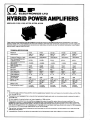
Back in the 1970s in Britain, there was a firm named ILP who made a killing with power amp modules that had great spec and low price, I put an amp together using one, for a punk rock band in Liverpool, I needed very few components:

1787517771181.png
 
I'd say the Sony is a better model because it is rated down to 10Hz, even though it's 1% (5x the Yamaha) THD at 100W. Fair?
To compare green apples to green apples, I have always used the Watts RMS @ 1% THD power spec. It is a realistic, reliable and consistent power measurement method. The other methods provide unrealistic or unpredictable power levels.
 
Back in the 1970s in Britain, there was a firm named ILP who made a killing with power amp modules that had great spec and low price, I put an amp together using one, for a punk rock band in Liverpool, I needed very few components:

View attachment 370702
What happened to that company?
When I was an EE student in the 1970s, I built several of these for friends.
They would advertise in US electronics magazines. Then suddenly, they disappeared.
 
Top