Until 2020, global shipping used dirty, high-sulphur fuels that produced air pollution. The pollution particles blocked sunlight and helped form more clouds, thereby curbing global heating. But new regulations at the start of 2020 slashed the sulphur content of fuels by more than 80%.
The new analysis calculates that the subsequent drop in pollution particles has significantly increased the amount of heat being trapped at the Earth’s surface that drives the climate crisis. The researchers said the sharp ending of decades of shipping pollution was an inadvertent geoengineering experiment, revealing new information about its effectiveness and risks.
‘Termination shock’: cut in ship pollution sparked global heating spurt
Sudden cut in pollution in 2020 meant less shade from sun and was ‘substantial’ factor in record surface temperatures in 2023, study finds
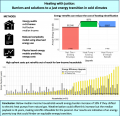
Below-median income households, which today experience a median energy burden of 6 %, would see it rise to 10 % if they shifted to electric heat pumps from natural gas. Weatherization could offset this increase, bringing burdens down to pre-electrification levels. However, median payback is 24 years, making retrofits infeasible for the poorest. Our results are indicative of an energy poverty trap that could hinder an equitable energy transition.
It's called 'science' when you go where in evidence leads. The evidence is IMO only inconveniently twisted to those pushing an agenda of 'doom and gloom' or 'don't worry about it'.
Enhancing Predictive Models
According to the researcher, solid, long-term data is crucial for producing accurate predictions of future glacier evolutions and sea level rise, and this study provides new insights into a vast area in East Antarctica.
“The long time series of glaciers improves our ability to make more accurate models of future ice changes, as the models are trained on historical observations,” concludes Bjørk.
It's called 'science' when you go where in evidence leads. The evidence is IMO only inconveniently twisted to those pushing an agenda of 'doom and gloom' or 'don't worry about it'.
The plastics industry has admitted that there is no way to recycle, not even theoretically, most of the plastic stamped with the "triangle". It was strictly an attempt to stay competitive with other packaging materials. Something like <5% of all "recyclable" plastic is actually recycled. A much larger fraction gets pushed into the ocean.
The plastics industry has admitted that there is no way to recycle, not even theoretically, most of the plastic stamped with the "triangle". It was strictly an attempt to stay competitive with other packaging materials. Something like <5% of all "recyclable" plastic is actually recycled. A much larger fraction gets pushed into the ocean.
This tall statement seems to negate everything I've learned about chemistry. The real issue IMO is providing sufficient input energy, reagents and a catalyst to initiate a chemical cascade. Of course this demands research into what cascades are actually efficient which is a woefully underfunded area of society. To my knowledge, there are very few chemical species that cannot be converted to new species because the reaction requires so much input energy. The result is the equilibrium is permanently shifted in favour of the products so the reaction appears to be irreversible as in the case of a combustion reaction but it's not.
On the other hand, there is something to the idea of "forever chemicals" such as flourine based species. Even then, there is a threshold that can cause the atoms to separate which is still outside the realm of nuclear chemistry.
... negative prices don’t necessarily bring down people’s electricity bills, and can also bring a host of downsides, including disrupting the business case for building more renewables.

 Facebook
 Google
 GitHub
 Linkedin