A " - - - C - - - " ? ? ? It was Panic Mode who first solved the problem with a relay. MY work was just based off his diagram. Maybe that's why I'm getting a C? Because I copied? I DID give credit where it was due. Same with the DPDT approach.
this forum is called all about circuits... any type of circuits.
if the post #9 was an electronic circuit, yes, those symbols are to be interpreted as capacitors and it would appear incomplete. but that was not a mistake, it was just another standard that you are not familiar with,
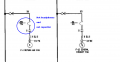
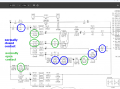
post #9 is showing an electrical drawing (more specifically RLD, or relay ladder diagram representation) and electrical symbols are somewhat different from electronic symbols.
for example two highlighted elements do not represent headphones and capacitor. also to an outsider, this does not appear as a complete circuit - there seem to be a solid connection on the left side as indicated by dot but it appears that this is not a closed loop, the motor seem to be a dead end of the branch.... and this too is not a mistake. it is just another way to show circuits - this is sort of "short hand" notation and many details are are assumed to be obvious, even if not shown. this allows much greater density of circuits to be represented on a piece of paper or monitor...
or in case of post #9, there are things that could be added for clarity for example but nevertheless, this is a standard representation. also this is common representation of code in RLL ("relay ladder language") which is one of common languages used in industrial automation (PLC programming) or anything else that may need a "PLC" such as CNC, robots, drives etc
OK, an interesting challenge here. But first to verify the initial assertions: All three lights are mains powered , each thru it's own single pole switch, which is in the "line" feed to the light. And the other side of each light is tied to the neutral. The lights are #1, #2, and #3.
So the function to be implemented is a triple input AND function. To power light #4 requires #1x#2x#3=#4
If the switches were double pole it would be very simple. But the switches are all single pole.
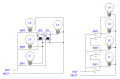
So the solution requires two relays with 120 volt coils. The coil of relay #1 is connected across light #2, and the coil of relay #2 is connected across light #3. Relay #1 contact terminal "A" is connected to the line side of light #1, the "B"contact terminal connects to the "A" terminal of relay #2, the "B" terminal of relay #2 connects to one side of light #4, the other side of light #4 connects to neutral. So switch #1 provides the power to the contact of relay #1 and when light #2 is powered the relay #1 contacts feed power to the contact of relay #2, which when light #3 is powered connects it to light #4.
Where does the conclusion that the switches are necessarily single-pole, single-throw come from. It just says that each light has it's own switch.
As is often the case, it all depends on the actual constraints of the assignment and, as is often the case, the TS didn't provide that information and then disappeared.
My one concern about this circuit in post #17 is connecting the lights mains power to a GROUND. Other than that the circuit looks very good. AND a "plus" is that the relays are all "K" notations while the lights are all"L" notations.
My interpretation of post #1 was, and still is, that it was a request for additions to an existing arrangement, not a request for a total redesign, changing the switches and sequences of connections. I also guessed that it was mains powered, as most lighting systems are. And if you look at the display of light switches in most stores it is rare that you will find a double pole light switch that is not a "four way" lighting control.
And the circuit looks a lot like what I suggested earlier. But MUCH MORE ATTRACTIVE RENDITION!!
My one concern about this circuit in post #17 is connecting the lights mains power to a GROUND. Other than that the circuit looks very good. AND a "plus" is that the relays are all "K" notations while the lights are all"L" notations.
My interpretation of post #1 was, and still is, that it was a request for additions to an existing arrangement, not a request for a total redesign, changing the switches and sequences of connections. I also guessed that it was mains powered, as most lighting systems are. And if you look at the display of light switches in most stores it is rare that you will find a double pole light switch that is not a "four way" lighting control.
And the circuit looks a lot like what I suggested earlier. But MUCH MORE ATTRACTIVE RENDITION!!
So what's wrong with using a switch that is a "four way" lighting control? It's just a double-pole, double-throw switch with a name on the package that is the common name in the context of the applications it is typically used for.
Those switches that are used for a "four way" application have one switch on at a time. So they are not DPST, they ARE DPAT, (Double Pole Alternate Throw.)
While in sizing of the diagram, what might appear to be a ground is actually a common. You know this - there are three ground symbols: (for the sake of those who might not know this): Ground (earth grounding), Common Ground (the diagram symbol used), and Chassis ground. Chassis ground and Common Ground can be the same, while Common Ground can be part of multiple circuits using common points not shared with the chassis ground or earth ground. Clicking the image will reveal a full-size version, making it easier to see the Common Ground symbol. Redrawing all common points tied together and to neutral without ground symbols is more clutter-prone than drawing with Common Ground Symbols.
Since the symbology used on the drawing can confuse those who have less understanding of the symbology perhaps it should have been drawn with all the neutrals tied together and NOT have used the common ground.

 Facebook
 Google
 GitHub
 Linkedin